Priming effect of dengue and yellow fever vaccination on the immunogenicity, infectivity, and safety of a tetravalent dengue vaccine in humans
- PMID: 21976579
- PMCID: PMC3183784
- DOI: 10.4269/ajtmh.2011.10-0436
Priming effect of dengue and yellow fever vaccination on the immunogenicity, infectivity, and safety of a tetravalent dengue vaccine in humans
Abstract
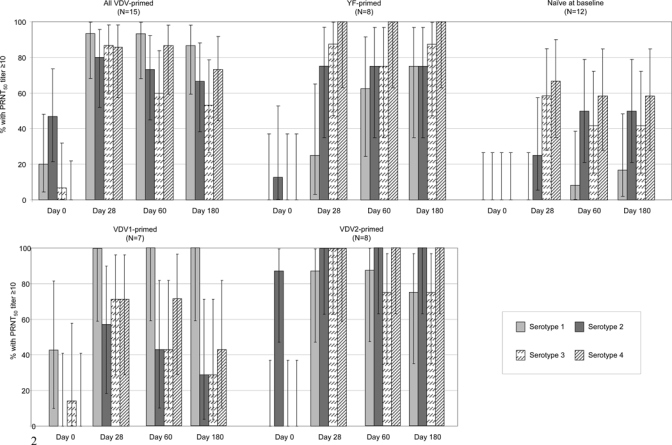
A dengue vaccine effective against all four serotypes is urgently needed. However, safety and immunogenicity could be affected by prior exposure to flaviviruses. This open, controlled, phase IIa study was conducted in 35 healthy adults who had received monovalent, live attenuated Vero cell-derived dengue vaccine against dengue virus 1 (VDV1) or 2 (VDV2) or yellow fever (YF) vaccine 1 year before or who were flavivirus-naïve. All participants received one subcutaneous injection of tetravalent dengue vaccine (TDV) and were followed for 180 days. Previous vaccination did not increase reactogenicity, laboratory abnormalities, or incidence of vaccine viremia, but it did increase the neutralizing antibody response to dengue virus that persisted at day 180. There was no increase in YF antibodies in participants previously immunized with YF vaccine. Prior exposure to YF or monovalent dengue vaccines had no adverse effects on the safety or incidence of viremia associated with this TDV, but it increased immunogenicity.
Figures
References
-
- Green S, Rothman A. Immunopathological mechanisms in dengue and dengue hemorrhagic fever. Curr Opin Infect Dis. 2006;19:429–436. - PubMed
-
- Kurane I. Dengue hemorrhagic fever with special emphasis on immunopathogenesis. Comp Immunol Microbiol Infect Dis. 2007;30:329–340. - PubMed
-
- Guirakhoo F, Arroyo J, Pugachev KV, Miller C, Zhang ZX, Weltzin R, Georgakopoulos K, Catalan J, Ocran S, Soike K, Ratterree M, Monath TP. Construction, safety, and immunogenicity in nonhuman primates of a chimeric yellow fever-dengue virus tetravalent vaccine. J Virol. 2001;75:7290–7304. - PMC - PubMed
-
- Guy B, Guirakhoo F, Barban V, Higgs S, Monath TP, Lang J. Preclinical and clinical development of YFV 17D-based chimeric vaccines against dengue, West Nile and Japanese encephalitis viruses. Vaccine. 2010;28:632–649. - PubMed
Publication types
MeSH terms
Substances
LinkOut - more resources
Full Text Sources
Other Literature Sources
Medical