. 2011 Dec 22;118(26):6963-70.
doi: 10.1182/blood-2011-07-368811. Epub 2011 Oct 5.

Polyphosphate is a cofactor for the activation of factor XI by thrombin

Affiliations

Polyphosphate is a cofactor for the activation of factor XI by thrombin

Sharon H Choi et al. Blood. .

Abstract

Factor XI deficiency is associated with a bleeding diathesis, but factor XII deficiency is not, indicating that, in normal hemostasis, factor XI must be activated in vivo by a protease other than factor XIIa. Several groups have identified thrombin as the most likely activator of factor XI, although this reaction is slow in solution. Although certain nonphysiologic anionic polymers and surfaces have been shown to enhance factor XI activation by thrombin, the physiologic cofactor for this reaction is uncertain. Activated platelets secrete the highly anionic polymer polyphosphate, and our previous studies have shown that polyphosphate has potent procoagulant activity. We now report that polyphosphate potently accelerates factor XI activation by α-thrombin, β-thrombin, and factor XIa and that these reactions are supported by polyphosphate polymers of the size secreted by activated human platelets. We therefore propose that polyphosphate is a natural cofactor for factor XI activation in plasma that may help explain the role of factor XI in hemostasis and thrombosis.


Figures

Figure 1
Figure 1
polyP enhances FXI activation by α-thrombin. In all panels, initial rates of FXI activation were quantified at 37°C in reactions containing 30nM FXI, 5nM α-thrombin, and polyP or dextran sulfate. Data are mean ± SE (n = 4). (A) Concentration dependence of polyP-mediated enhancement of FXI activation by α-thrombin, tested with 4 different polyP polymer lengths: 22mer (●), 65mer (▿), 167mer (■), and 350mer (◊). (B) PolyP polymer length dependence of the enhancement of FXI activation by α-thrombin, using size-fractionated polyP preparations at 4μM phosphate (0 indicates no polyP). (C) EcPPXc abrogates the ability of polyP, but not dextran sulfate, to enhance FXI activation by α-thrombin. Rates of FXI activation were quantified in the absence (open bars) or presence (solid bars) of EcPPXc. Reaction conditions included no polyanion (control), with 1 μg/mL dextran sulfate (DS) or with 4μM polyP (80mer or 255mer, as indicated).
Figure 2
Figure 2
Activated platelets and platelet releasates enhance the rate of FXI activation by α-thrombin. In all panels, initial rates of FXI activation were quantified at 37°C in reactions containing 30nM FXI, 5 to 20nM α-thrombin, and activated platelets or platelet releasate. (A) Dose response for platelet releasates from donor A in supporting FXI activation by 5nM (▴), 10nM (■), or 20nM (●) α-thrombin. Controls included boiled releasate (⊙) incubated with FXI and 20nM α-thrombin; and releasate preincubated with 250 μg/mL EcPPXc (○) or predigested with 70 μg/mL rPPX1 (ø) and then allowed to react with FXI and 20nM α-thrombin. (B) Activated platelets and releasates enhance FXI activation by thrombin. Initial rates of FXI activation by 20nM α-thrombin were quantified in the presence of 10-fold diluted platelet releasate (solid bars) or the same dilution of activated platelets plus releasate (open bars) from donor B, with or without preincubation with 250 μg/mL EcPPXc. Controls include FXI incubated with activated platelets (or releasate) from donor B but without α-thrombin, and FXI incubated with α-thrombin but without platelets or releasate. Data are mean ± SE (n = 3–4) from 2 separate donors. Platelets from donor A were activated at a concentration of 1.6 × 10⁷/μL, whereas platelets from donor B were activated at a concentration of 5.3 × 10⁶/μL.
Figure 3
Figure 3
polyP accelerates FXI autoactivation and FXIa autolysis. (A) Progress curves of FXI autoactivation in which 60nM FXI was incubated with 4μM polyP 77mer (○), 4μM polyP 255mer (●), or 2 μg/mL dextran sulfate (■). (B) PolyP polymer length dependence of the enhancement of FXI autoactivation. Second-order rate constants for FXI autoactivation (k2) were determined in reactions containing 30nM FXI and 4μM polyP of the indicated polymer lengths (0 indicates the absence of polyP). (C) SDS-PAGE analyses of FXI autoactivation in the presence of polyP (77mer or 225mer) or DS. Parallel timed samples from the experiment in panel B were resolved on reducing SDS-PAGE and silver stained. The position of FXI (Z) and the FXIa heavy chain (HC) and light chain (LC) are indicated. The lane labeled FXIa contained purified FXIa. (D) PolyP polymer length dependence of the enhancement of FXIa autolysis. Initial rates of loss of FXIa enzymatic activity were quantified in reactions containing 6nM FXIa and polyP preparations of varying polymer lengths, whose concentrations were adjusted to yield 3nM polymer (0 indicates the absence of polyP). Data in panels A, B, and D are mean ± SE (n = 3).
Figure 4
Figure 4
α-thrombin, β-thrombin, FXI, and FXIa bind with high affinity to immobilized polyP. Binding of α-thrombin, β-thrombin, FXI, or active site–inhibited FXIa to polyP was quantified using SPR, with biotinylated polyP bound to streptavidin sensorchips, over which varying protein concentrations were flowed. Panels are representative sensorgrams for 2.5 to 20nM α-thrombin (A), 5 to 80nM β-thrombin (B), 1.25 to 40nM FXI (C), and 2.5 to 20nM active site–inhibited FXIa (D). Kd values were derived as described under “Methods.”
Figure 5
Figure 5
PolyP plus β-thrombin accelerates plasma clotting and enhances thrombin generation. (A) PolyP shortens plasma clotting times triggered by β-thrombin (measured using a mechanical coagulometer). Citrated FXII- or FXI-deficient plasmas containing 100 μg/mL corn trypsin inhibitor and 20μM PCPSPE were incubated for 1 minute at 37°C with 12nM β-thrombin and varying polyP concentrations, after which CaCl2 was added and the time to clot formation was measured. PolyP tested with FXII-deficient plasma included 22mer (●), 65mer (▿), 101mer (♦), 211mer (○), or 445mer (▴). FXI-deficient plasma was tested with 445mer polyP (▵). Data are mean ± SE (n = 5). Panels B and C are mean thrombin generation (CAT) curves for FXII-deficient plasmas containing 100 μg/mL corn trypsin inhibitor, 20μM PCPSPE, and 20nM FVa (4 experiments of triplicate wells). (B) Concentration dependence of polyP's ability to enhance thrombin generation in the presence of 20nM β-thrombin and varying polyP (101mer at 0-50μM phosphate). (C) Effect of polyP polymer length on thrombin generation in the presence of 20nM β-thrombin and with or without 50μM polyP (65mer, 101mer, or 445mer). (D-H) Mean peak thrombin levels from experiments represented in panels B and C (± SE; n = 4) obtained with 20nM β-thrombin and varying polyP. (D) Peak thrombin levels in FXII-deficient plasma at the indicated concentrations of polyP 65mer (▿), 101mer (♦), or 445mer (▵). In control experiments, polyP 445mer was preincubated with 250 μg/mL EcPPXc (◊) or predigested with 40 μg/mL rPPX1 (□). (E) Peak thrombin levels in FXII-deficient plasma preincubated with anti-FXI antibody ± 50μM polyP 101mer. (F) Peak thrombin levels in FXI-deficient plasma ± 50μM polyP 101mer. (G) Peak thrombin levels in FXI-deficient plasma to which 4 μg/mL FXI had been added ± 50μM polyP 101mer. (H) Peak thrombin levels in FXI-deficient plasma to which 50pM FXIa had been added ± 50μM polyP 101mer.
Figure 6
Figure 6
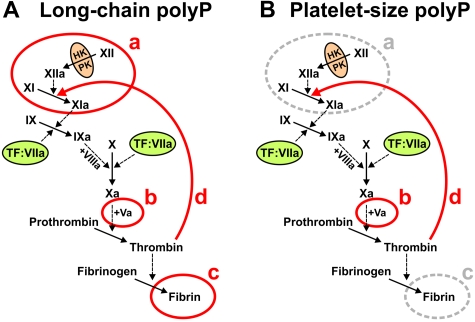
Summary of roles of polyP in blood clotting. (A) Long-chain polyP (hundreds to thousands of phosphate units long) acts at 4 points in the clotting cascade, indicated in red: a, initiates the contact pathway of blood clotting,; b, accelerates FV activation,; c, enhances fibrin polymerization,; and d, accelerates FXI activation by thrombin (this study). (B) Platelet-size polyP (60-100mers) acts most potently at 2 points in the clotting cascade, indicated in red: b, accelerates FV activation; and d, accelerates FXI activation by thrombin (this study).

Comment in

References

    1. Davie EW, Ratnoff OD. Waterfall sequence for intrinsic blood clotting. Science. 1964;145:1310–1312. - PubMed
    1. Ragni MV, Sinha D, Seaman F, Lewis JH, Spero JA, Walsh PN. Comparison of bleeding tendency, factor XI coagulant activity, and factor XI antigen in 25 factor XI-deficient kindreds. Blood. 1985;65(3):719–724. - PubMed
    1. Salomon O, Steinberg DM, Seligshon U. Variable bleeding manifestations characterize different types of surgery in patients with severe factor XI deficiency enabling parsimonious use of replacement therapy. Haemophilia. 2006;12(5):490–493. - PubMed
    1. Rosenthal RL, Dreskin OH, Rosenthal N. Plasma thromboplastin antecedent (PTA) deficiency; clinical, coagulation, therapeutic and hereditary aspects of a new hemophilia-like disease. Blood. 1955;10(2):120–131. - PubMed
    1. Asakai R, Chung DW, Davie EW, Seligsohn U. Factor XI deficiency in Ashkenazi Jews in Israel. N Engl J Med. 1991;325(3):153–158. - PubMed

Publication types