


Dimethyl fumarate, an immune modulator and inducer of the antioxidant response, suppresses HIV replication and macrophage-mediated neurotoxicity: a novel candidate for HIV neuroprotection
- PMID: 21976775
- PMCID: PMC3208057
- DOI: 10.4049/jimmunol.1101868
Dimethyl fumarate, an immune modulator and inducer of the antioxidant response, suppresses HIV replication and macrophage-mediated neurotoxicity: a novel candidate for HIV neuroprotection
Abstract
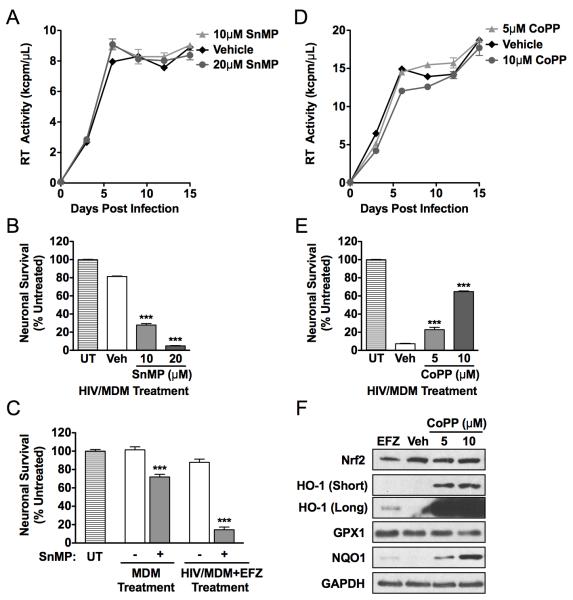
Despite antiretroviral therapy (ART), HIV infection promotes cognitive dysfunction and neurodegeneration through persistent inflammation and neurotoxin release from infected and/or activated macrophages/microglia. Furthermore, inflammation and immune activation within both the CNS and periphery correlate with disease progression and morbidity in ART-treated individuals. Accordingly, drugs targeting these pathological processes in the CNS and systemic compartments are needed for effective, adjunctive therapy. Using our in vitro model of HIV-mediated neurotoxicity, in which HIV-infected monocyte-derived macrophages release excitatory neurotoxins, we show that HIV infection dysregulates the macrophage antioxidant response and reduces levels of heme oxygenase-1 (HO-1). Furthermore, restoration of HO-1 expression in HIV-infected monocyte-derived macrophages reduces neurotoxin release without altering HIV replication. Given these novel observations, we have identified dimethyl fumarate (DMF), used to treat psoriasis and showing promising results in clinical trials for multiple sclerosis, as a potential neuroprotectant and HIV disease-modifying agent. DMF, an immune modulator and inducer of the antioxidant response, suppresses HIV replication and neurotoxin release. Two distinct mechanisms are proposed: inhibition of NF-κB nuclear translocation and signaling, which could contribute to the suppression of HIV replication, and induction of HO-1, which is associated with decreased neurotoxin release. Finally, we found that DMF attenuates CCL2-induced monocyte chemotaxis, suggesting that DMF could decrease recruitment of activated monocytes to the CNS in response to inflammatory mediators. We propose that dysregulation of the antioxidant response during HIV infection drives macrophage-mediated neurotoxicity and that DMF could serve as an adjunctive neuroprotectant and HIV disease modifier in ART-treated individuals.
Figures



References
-
- Antinori A, Arendt G, Becker JT, Brew BJ, Byrd DA, Cherner M, Clifford DB, Cinque P, Epstein LG, Goodkin K, Gisslen M, Grant I, Heaton RK, Joseph J, Marder K, Marra CM, McArthur JC, Nunn M, Price RW, Pulliam L, Robertson KR, Sacktor N, Valcour V, Wojna VE. Updated research nosology for HIV-associated neurocognitive disorders. Neurol. 2007;69:1789–1799. - PMC - PubMed
-
- McArthur JC, Steiner J, Sacktor N, Nath A. Human immunodeficiency virus-associated neurocognitive disorders: Mind the gap. Ann. Neurol. 2010;67:699–714. - PubMed
-
- Dunfee R, Thomas ER, Gorry PR, Wang J, Ancuta P, Gabuzda D. Mechanisms of HIV-1 neurotropism. Curr. HIV Res. 2006;4:267–278. - PubMed
-
- Petito CK, Cho ES, Lemann W, Navia BA, Price RW. Neuropathology of acquired immunodeficiency syndrome (AIDS): an autopsy review. J. Neuropathol. Exp. Neurol. 1986;45:635–646. - PubMed
-
- Ho DD, Rota TR, Schooley RT, Kaplan JC, Allan JD, Groopman JE, Resnick L, Felsenstein D, Andrews CA, Hirsch MS. Isolation of HTLV-III from cerebrospinal fluid and neural tissues of patients with neurologic syndromes related to the acquired immunodeficiency syndrome. New Engl. J. Med. 1985;313:1493–1497. - PubMed
Publication types
MeSH terms
Substances
Grants and funding
LinkOut - more resources
Full Text Sources
Other Literature Sources
Medical
