Effect of doxycycline in patients of moderate to severe chronic obstructive pulmonary disease with stable symptoms
- PMID: 21977068
- PMCID: PMC3183640
- DOI: 10.4103/1817-1737.84777
Effect of doxycycline in patients of moderate to severe chronic obstructive pulmonary disease with stable symptoms
Abstract
Background: The protease-antiprotease hypothesis proposes that inflammatory cells and oxidative stress in chronic obstructive pulmonary disease (COPD) produce increased levels of proteolytic enzymes (neutrophil elastase, matrix metalloproteinases [MMP]) which contribute to destruction of parenchyma resulting in progressive decline in forced expiratory volume in one second. Doxycycline, a tetracycline analogue, possesses anti-inflammatory properties and inhibits MMP enzymes.
Objectives: To assess the effect of 4 weeks doxycycline in a dose of 100 mg once a day in patients of moderate to severe COPD with stable symptoms.
Methods: In an interventional, randomized, observer-masked, parallel study design, the effect of doxycycline (100 mg once a day for 4 weeks) was assessed in patients of COPD having stable symptoms after a run-in period of 4 weeks. The study participants in reference group did not receive doxycycline. The parameters were pulmonary functions, systemic inflammation marker C-reactive protein (CRP), and medical research council (MRC) dyspnea scale. Use of systemic corticosteroids or antimicrobial agents was not allowed during the study period.
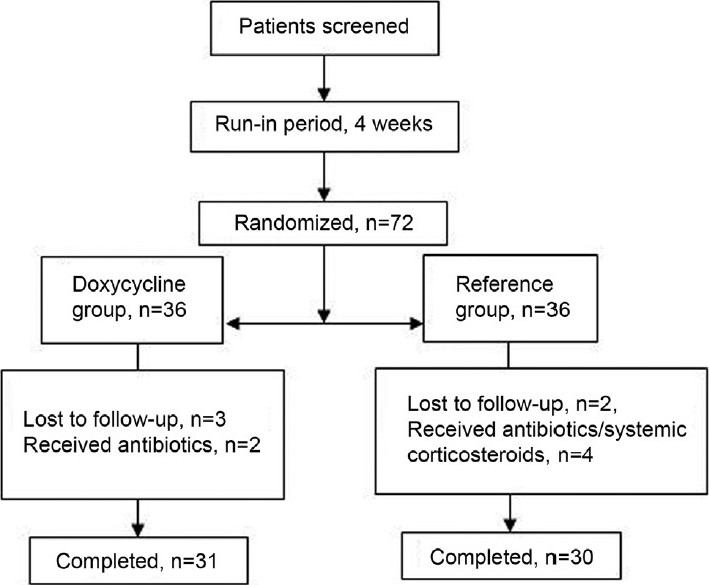
Results: A total of 61 patients completed the study (31 patients in doxycycline group and 30 patients in reference group). At 4 weeks, the pulmonary functions significantly improved in doxycycline group and the mean reduction in baseline serum CRP was significantly greater in doxycycline group as compared with reference group. There was no significant improvement in MRC dyspnea scale in both groups at 4 weeks.
Conclusion: The anti-inflammatory and MMP-inhibiting property of doxycycline might have contributed to the improvement of parameters in this study.
Keywords: Anti-inflammatory; C-reactive protein; doxycycline; dyspnea; matrix metalloproteinase; respiratory function tests.
Conflict of interest statement
Figures

References
-
- Global Initiative for chronic obstructive lung disease. Global strategy for the diagnosis, management and prevention of chronic obstructive pulmonary disease. 2009. [Last accessed on 2010 Oct 15]. Available from: http:/www.goldcopd.com .
-
- Belvisi MG, Bottomley KM. The role of matrix metalloproteinases (MMPs) in the pathophysiology of chronic obstructive pulmonary disease (COPD): A therapeutic role for inhibitors of MMPs? Inflamm Res. 2003;52:95–100. - PubMed
-
- Reilly JJ, Jr, Silverman EK, Shapiro SD. Chronic Obstructive Pulmonary Disease. In: Casper DL, Braunwald E, editors. Harrison's Principles of Internal Medicine. New York: McGraw-Hill; 2006. pp. 1547–54.
-
- Betsuyaku T, Nishimura M, Takeyabu K, Tanino M, Venge P, Xu S, et al. Neutrophil granule proteins in bronchoalveolar lavage fluid from subjects with subclinical emphysema. Am J Respir Crit Care Med. 1999;159:1985–91. - PubMed
LinkOut - more resources
Full Text Sources
Research Materials
Miscellaneous