. 2010:1:182-90.
doi: 10.3762/bjnano.1.22. Epub 2010 Dec 28.

Magnetic interactions between nanoparticles

Affiliations

Magnetic interactions between nanoparticles

Steen Mørup et al. Beilstein J Nanotechnol. 2010.

Abstract

We present a short overview of the influence of inter-particle interactions on the properties of magnetic nanoparticles. Strong magnetic dipole interactions between ferromagnetic or ferrimagnetic particles, that would be superparamagnetic if isolated, can result in a collective state of nanoparticles. This collective state has many similarities to spin-glasses. In samples of aggregated magnetic nanoparticles, exchange interactions are often important and this can also lead to a strong suppression of superparamagnetic relaxation. The temperature dependence of the order parameter in samples of strongly interacting hematite nanoparticles or goethite grains is well described by a simple mean field model. Exchange interactions between nanoparticles with different orientations of the easy axes can also result in a rotation of the sub-lattice magnetization directions.

Keywords: dipole interactions; exchange interactions; spin structure; superferromagnetism; superparamagnetic relaxation.


Figures
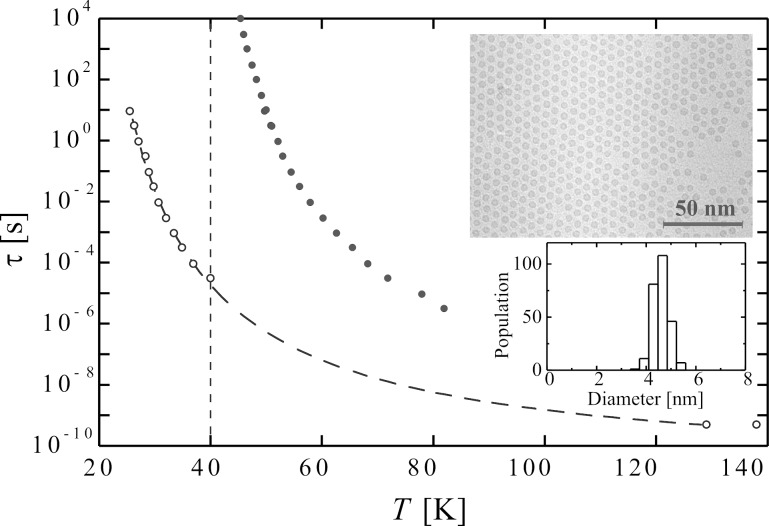
Figure 1
Figure 1
The relaxation time of 4.7 nm Fe100−xCx nearly monodisperse particles suspended in decalin as a function of temperature. The data were obtained from AC susceptibility measurements. The open circles are data from a dilute sample, whereas the full circles are data for a concentrated sample. The insets show a transmission electron microscopy (TEM) image of the particles deposited on an amorphous carbon film and the corresponding particle size distribution obtained from the TEM images. Adapted from Djurberg, C.; Svedlindh, P.; Nordblad, P.; Hansen, M. F.; Bødker, F.; Mørup, S. Dynamics of an Interacting Particle System: Evidence of Critical Slowing Down, Phys. Rev. Lett. 1997, 79, 5154. Copyright (1997) by the American Physical Society.
Figure 2
Figure 2
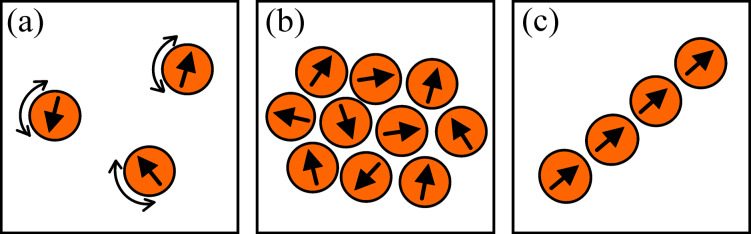
Schematic illustration of interacting magnetic nanoparticles. (a) Isolated nanoparticles dominated by superparamagnetic relaxation. (b) Interacting nanoparticles forming a dipole glass. (c) Nanoparticles forming a chain with aligned dipole moments.
Figure 3
Figure 3
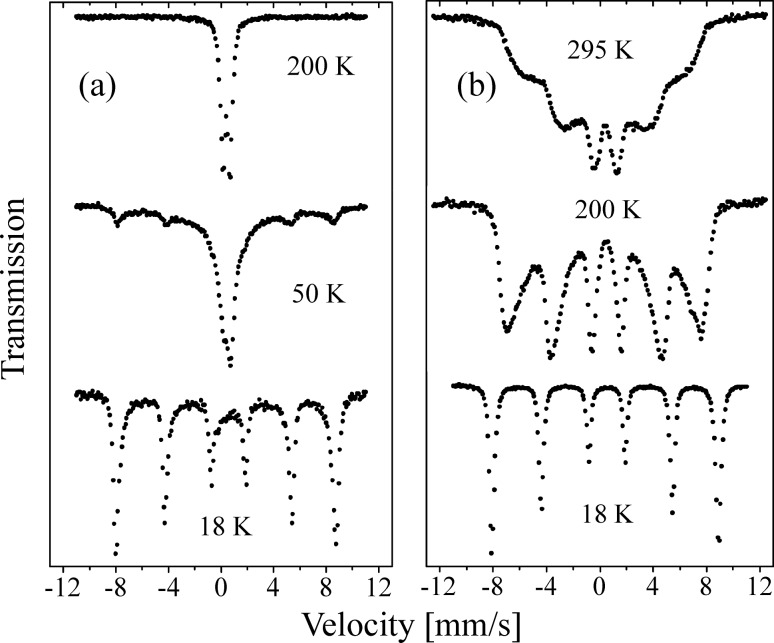
Mössbauer spectra of 8 nm hematite particles (a) coated (non-interacting) and (b) uncoated (strongly interacting) nanoparticles. The spectra were obtained at the indicated temperatures. Reprinted from Frandsen, C.; Mørup, S. Spin rotation in α-Fe2O3 nanoparticles by interparticle interactions, Phys. Rev. Lett. 2005, 94, 027202. Copyright (2005) by the American Physical Society.
Figure 4
Figure 4
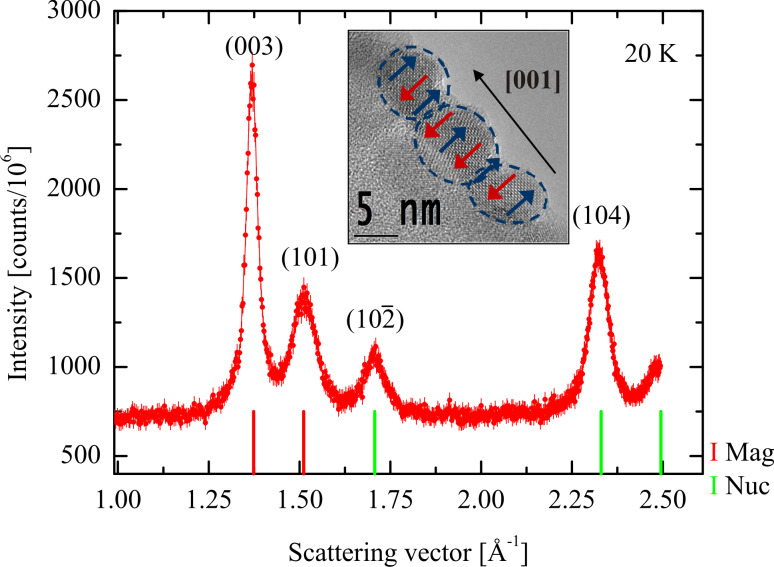
Neutron diffraction data for interacting 8 nm α-Fe2O3 particles obtained at 20 K. The inset shows a TEM image of three α-Fe2O3 particles attached along their common [001] axis. The antiferromagnetic order is indicated by the blue and red arrows superimposed on the TEM image. Adapted from Frandsen, C.; Bahl, C. R. H.; Lebech, B.; Lefmann, K.; Kuhn, L. T.; Keller, L.; Andersen, N. H.; von Zimmermann, M.; Johnson, E.; Klausen, S. N.; Mørup, S. Oriented attachment and exchange coupling of α-Fe2O3 nanoparticles, Phys. Rev. B 2005, 72, 214406. Copyright (2005) by the American Physical Society.
Figure 5
Figure 5
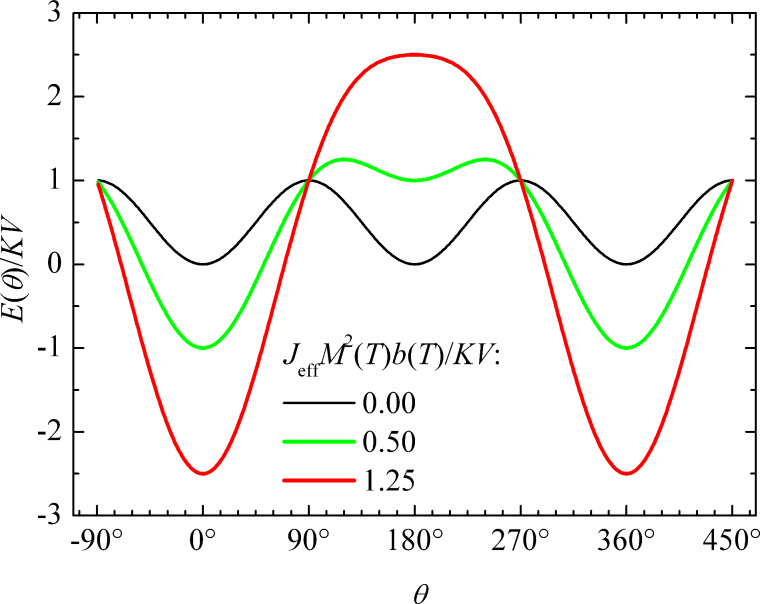
The normalized magnetic energy, E(θ)/KV (Equation 9) for different values of the ratio between the interaction energy JeffM2(T)b(T) and the anisotropy energy, KV.
Figure 6
Figure 6
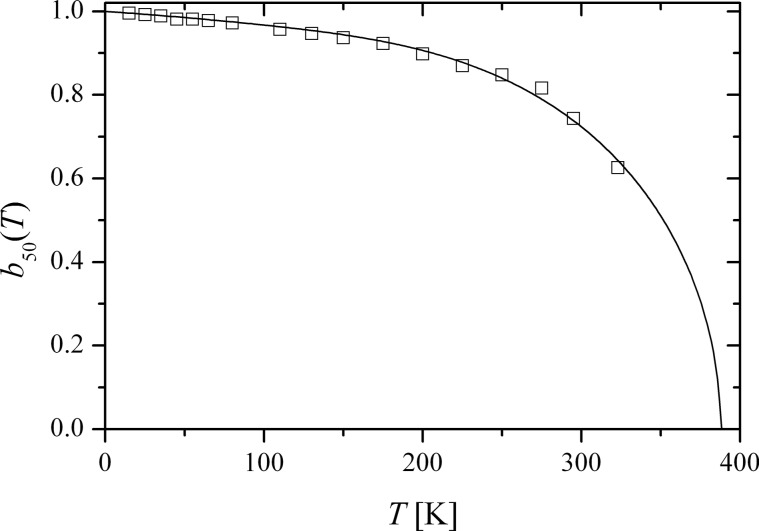
Temperature dependence of the median value of the order parameter, b50(T) for interacting 20 nm hematite nanoparticles. The open squares are the experimental data, and the solid line is a fit to the superferromagnetism model (Equation 11). Adapted from Hansen, M. F. ; Koch, C. B.; Mørup, S. Magnetic dynamics of weakly and strongly interacting hematite nanoparticles, Phys. Rev. B 2000, 62, 1124. Copyright (2000) by the American Physical Society.
Figure 7
Figure 7
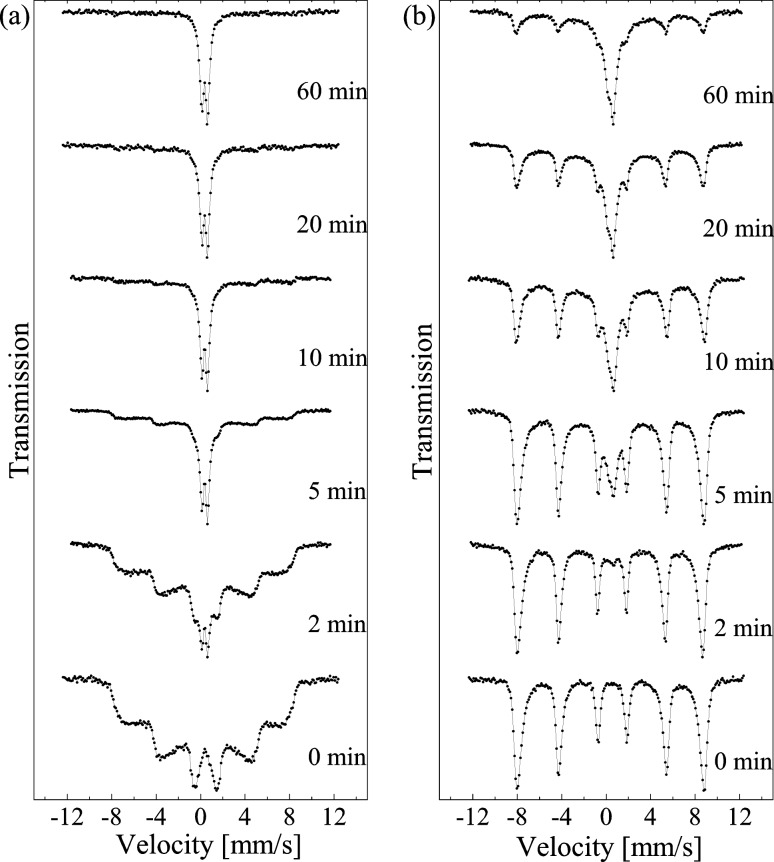
Mössbauer spectra of 8 nm hematite nanoparticles ground in a mortar with η-Al2O3 nanoparticles for the indicated periods of time. (a) Spectra obtained at room temperature. (b) Spectra obtained at 80 K. Reprinted with permission from Xu, M.; Bahl, C. R. H.; Frandsen, C.; Mørup, S. Inter-particle interactions in agglomerates of α-Fe2O3 nanoparticles: Influence of grinding, J. Colloid Interface Science 2004, 279 132–136. Copyright (2004) by Elsevier.
Figure 8
Figure 8
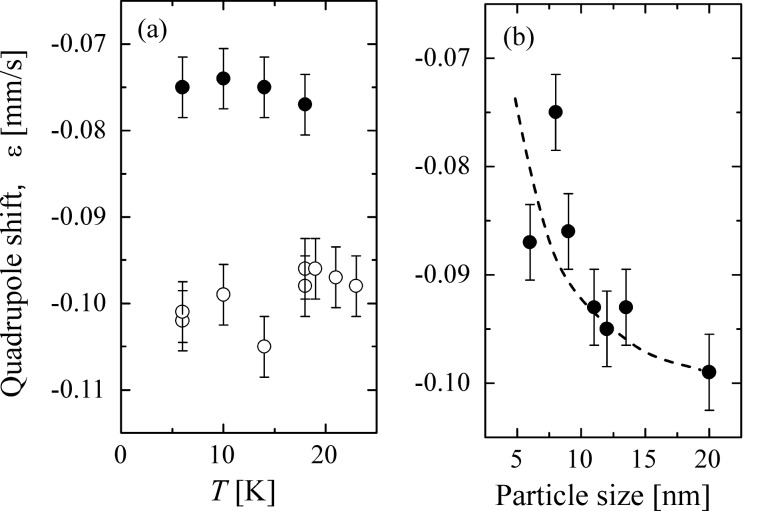
(a) The quadrupole shift of coated (open circles) and uncoated (solid circles) 8 nm hematite particles as a function of temperature. (b) The quadrupole shift of uncoated hematite nanoparticles at 20 K as a function of particle size. Reprinted from Frandsen, C.; Mørup, S. Spin rotation in α-Fe2O3 nanoparticles by interparticle interactions, Phys. Rev. Lett. 2005, 94, 027202. Copyright (2005) by the American Physical Society.

References

    1. Berkowitz A E, Takano K. J Magn Magn Mater. 1999;200:552–570. doi: 10.1016/S0304-8853(99)00453-9. - DOI
    1. Nogués J, Schuller I K. J Magn Magn Mater. 1999;192:203–232. doi: 10.1016/S0304-8853(98)00266-2. - DOI
    1. Nogués J, Sort J, Langlais V, Skumryev V, Suriñach S, Muñoz J S, Baró M D. Phys Rep. 2005;442:65–117. doi: 10.1016/j.physrep.2005.08.004. - DOI
    1. Meiklejohn W H, Bean C P. Phys Rev. 1956;102:1413–1414. doi: 10.1103/PhysRev.102.1413. - DOI
    1. van der Zaag P J, Ijiri Y, Borchers J A, Feiner L F, Wolf R M, Gaines J M, Erwin R W, Verheijen M A. Phys Rev Lett. 2000;84:6102–6105. doi: 10.1103/PhysRevLett.84.6102. - DOI - PubMed

LinkOut - more resources