


Terminally differentiated astrocytes lack DNA damage response signaling and are radioresistant but retain DNA repair proficiency
- PMID: 21979466
- PMCID: PMC3307974
- DOI: 10.1038/cdd.2011.129
Terminally differentiated astrocytes lack DNA damage response signaling and are radioresistant but retain DNA repair proficiency
Abstract
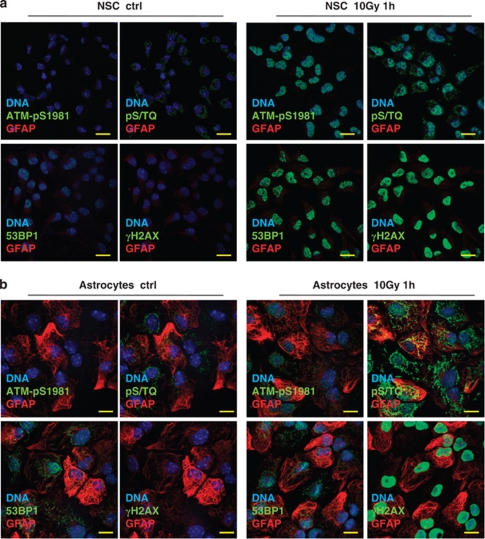
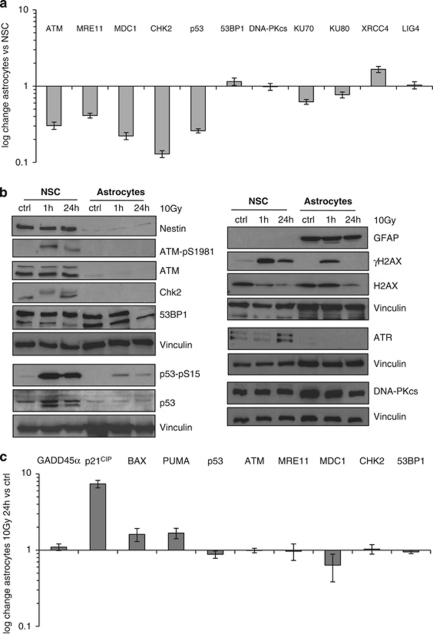
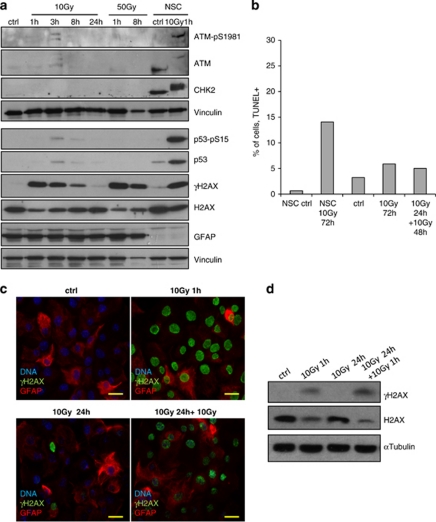
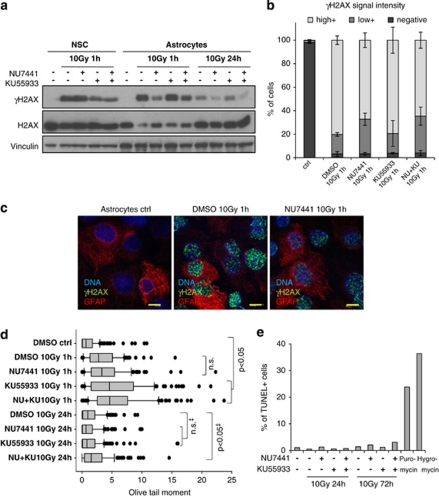
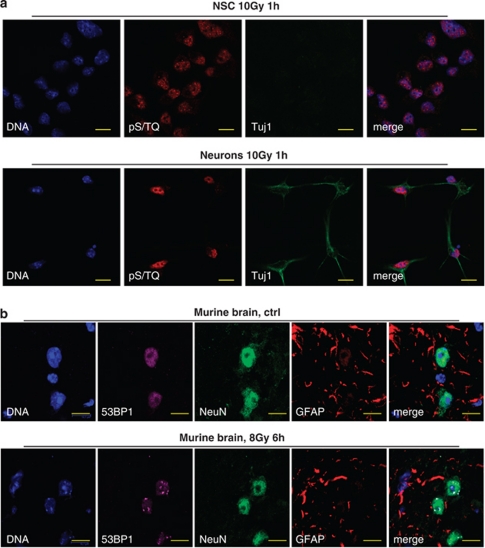
The impact and consequences of damage generation into genomic DNA, especially in the form of DNA double-strand breaks, and of the DNA-damage response (DDR) pathways that are promptly activated, have been elucidated in great detail. Most of this research, however, has been performed on proliferating, often cancerous, cell lines. In a mammalian body, the majority of cells are terminally differentiated (TD), and derives from a small pool of self-renewing somatic stem cells. Here, we comparatively studied DDR signaling and radiosensitivity in neural stem cells (NSC) and their TD-descendants, astrocytes - the predominant cells in the mammalian brain. Astrocytes have important roles in brain physiology, development and plasticity. We discovered that NSC activate canonical DDR upon exposure to ionizing radiation. Strikingly, astrocytes proved radioresistant, lacked functional DDR signaling, with key DDR genes such as ATM being repressed at the transcriptional level. Nevertheless, astrocytes retain the expression of non-homologous end-joining (NHEJ) genes and indeed they are DNA repair proficient. Unlike in NSC, in astrocytes DNA-PK seems to be the PI3K-like protein kinase responsible for γH2AX signal generation upon DNA damage. We also demonstrate the lack of functional DDR signaling activation in vivo in astrocytes of irradiated adult mouse brains, although adjacent neurons activate the DDR.
Figures
References
-
- Shiloh Y. The ATM-mediated DNA-damage response: taking shape. Trends Biochem Sci. 2006;31:402–410. - PubMed
-
- d'Adda di Fagagna F. Living on a break: cellular senescence as a DNA-damage response. Nat Rev Cancer. 2008;8:512–522. - PubMed
-
- Bakkenist CJ, Kastan MB. DNA damage activates ATM through intermolecular autophosphorylation and dimer dissociation. Nature. 2003;421:499–506. - PubMed
-
- Burma S, Chen BP, Murphy M, Kurimasa A, Chen DJ. ATM phosphorylates histone H2AX in response to DNA double-strand breaks. J Biol Chem. 2001;276:42462–42467. - PubMed
Publication types
MeSH terms
Substances
LinkOut - more resources
Full Text Sources
Research Materials
Miscellaneous
