. 2011 Dec;22(8):773-8.
doi: 10.1097/FBP.0b013e32834d0f3c.

Drinking sucrose enhances quinpirole-induced yawning in rats

Affiliations

Drinking sucrose enhances quinpirole-induced yawning in rats

Michelle G Baladi et al. Behav Pharmacol. 2011 Dec.

Abstract

Food and drugs can activate brain dopamine systems and sensitivity to the effects of drugs acting on those systems is influenced by amount and content of food consumed. This study examined the effects of drinking sucrose on behavioral effects of the direct-acting dopamine receptor agonist quinpirole. Male Sprague-Dawley rats (n=6/group) had free access to water or 10% sucrose and quinpirole dose-response curves (yawning and hypothermia) were generated weekly for 8 weeks. Subsequently, all rats drank water for 8 weeks with quinpirole dose-response curves determined on weeks 9, 10, and 16. In rats drinking sucrose, the ascending (D3 receptor-mediated), but not descending (D2 receptor-mediated), limb of the yawning dose-response curve shifted leftward. The D3 receptor-selective antagonist PG01037 shifted the ascending limb of the dose-response curve to the right in all rats. When rats that previously drank sucrose drank water, their sensitivity to quinpirole did not return to normal. Quinpirole-induced hypothermia was not different between groups. These data show that drinking sucrose increases sensitivity to a dopamine D3, but not D2, receptor-mediated effect and that this change is long lasting. Dopamine receptors mediate the effects of many drugs and the actions of those drugs are likely impacted by dietary factors.


Figures
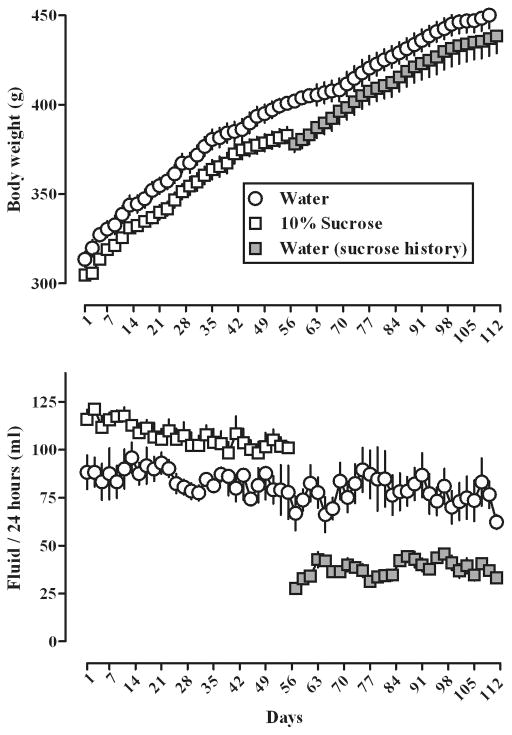
Fig 1
Fig 1
Body weight (upper panel) and fluid intake (lower panel) in two groups of rats over the 16-week (112-day) study. One group had free access to water throughout the study (open circles) while the other group had free access to a 10% sucrose solution for 8 weeks (56 days; open squares) followed by free access to water for 8 weeks (gray squares). Each symbol represents the mean (± SEM) of 6 rats. Horizonal axes: day of study. Vertical axes: mean (± SEM) body weight in g (upper panel) and mean (± SEM) fluid intake in ml in a 24-hour period (lower panel).
Fig 2
Fig 2
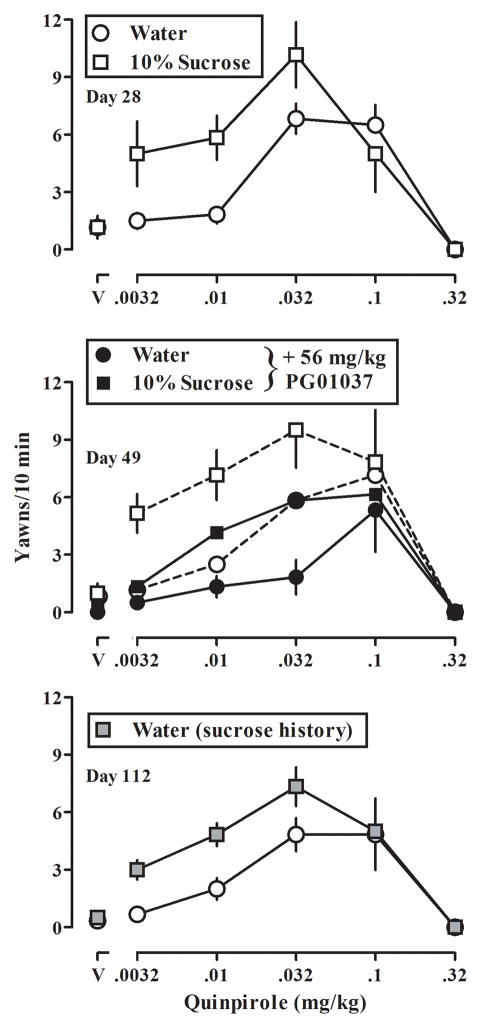
Quinpirole-induced yawning in two groups of rats on days 28, 49, and 112 of the study (upper, middle, and lower panels, respectively). Data shown by symbols and dashed lines in the middle panel are the effects of quinpirole determined on day 42 (one week prior to the antagonism study with PG 01037 on day 49) in rats drinking either water or 10% sucrose. Horizonal axes: dose in milligrams per kilogram of body weight; “V” = vehicle. Vertical axes: mean (± SEM) number of yawns in 10 min. See Fig 1 for other details.
Fig 3
Fig 3
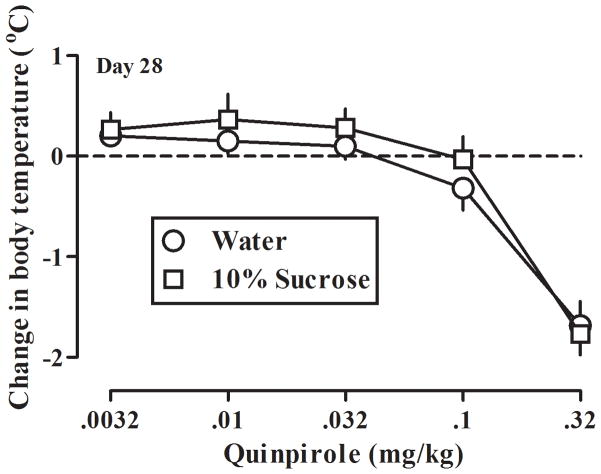
Quinpirole-induced hypothermia in two groups of rats on day 28 of the study. Vertical axis: mean (± SEM) change in body temperature in °C. See Fig 1 for other details

References

    1. Avena NM, Rada P, Hoebel BG. Underweight rats have enhanced dopamine release and blunted acetylcholine response in the nucleus accumbens while bingeing on sucrose. Neurosci. 2008;156:865–871. - PMC - PubMed
    1. Baladi MG, France CP. High fat diet and food restriction differentially modify the behavioral effects of quinpirole and raclopride in rats. Eur J Pharmacol. 2009;610:55–60. - PMC - PubMed
    1. Baladi MG, France CP. Eating high-fat chow increases the sensitivity of rats to quinpirole-induced discriminative stimulus effects and yawning. Behav Pharmacol. 2010;21:615–620. - PMC - PubMed
    1. Baladi MG, Newman AH, France CP. Dopamine D3 receptors mediate the discriminative stimulus effects of quinpirole in free-feeding rats. J Pharmacol Exp Ther. 2010;332:308–315. - PMC - PubMed
    1. Baladi MG, Newman AH, France CP. Influence of body weight and type of chow on the sensitivity of rats to the behavioral effects of the direct-acting dopamine-receptor agonist quinpirole. Psychopharmacology (Berl) 2011 [Epub ahead of print] - PMC - PubMed

Publication types