


Behavioral sensitization to 3,4-methylenedioxymethamphetamine is long-lasting and modulated by the context of drug administration
- PMID: 21979834
- PMCID: PMC3212638
- DOI: 10.1097/FBP.0b013e32834d13b4
Behavioral sensitization to 3,4-methylenedioxymethamphetamine is long-lasting and modulated by the context of drug administration
Abstract
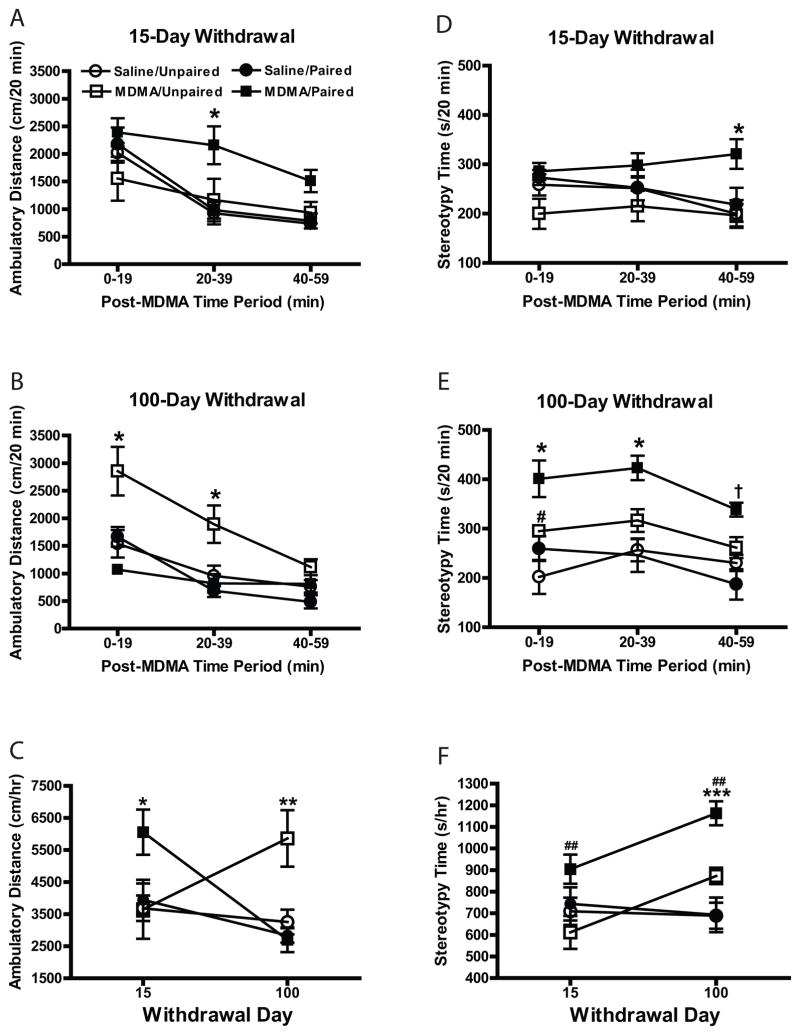
To begin to characterize the temporal profile of behavioral sensitization to the amphetamine derivative 3,4-methylenedioxymethamphetamine (MDMA), rats were treated with either saline or MDMA (5.0 mg/kg) twice daily for 5 days, followed by a challenge injection of MDMA (2.5 mg/kg) either 15 or 100 days later. Because we found previously that contextual drug associations are important for the expression of behavioral sensitization to MDMA following relatively short withdrawal periods, rats received the repeated injections either in their home cages (unpaired group) or in the activity monitors that were used for testing sensitization on challenge day (paired group). Locomotor sensitization was evident at 15 days of withdrawal but only in the paired MDMA-treated group. Interestingly, however, sensitization was apparent at 100 days of withdrawal in both paired and unpaired rats but the form of sensitization differed between groups. Thus, sensitization in paired rats was expressed as an increase in stereotypy, whereas sensitization in unpaired rats was expressed as an increase in locomotion, paralleling locomotion levels in paired animals at 15 days of withdrawal. These results suggest that the neural changes that underlie behavioral sensitization to MDMA are quite enduring but involve an interaction between withdrawal time and the context of drug administration.
Figures
References
-
- Academies NRCotN. Guidelines for the care and use of mammals in neuroscience and behavioral research. Washington, DC: National Academies Press; 2003. - PubMed
-
- Ball KT, Budreau D, Rebec GV. Context-dependent behavioural and neuronal sensitization in striatum to MDMA (ecstasy) administration in rats. European Journal of Neuroscience. 2006;24:217–228. - PubMed
-
- Dafters RI. Hyperthermia following MDMA administration in rats: effects of ambient temperature, water consumption, and chronic dosing. Physiol Behav. 1995;58:877–882. - PubMed
Publication types
MeSH terms
Substances
Grants and funding
LinkOut - more resources
Full Text Sources
Medical
