


Review
doi: 10.1038/eye.2011.246.
Epub 2011 Oct 7.
Emerging techniques to treat corneal neovascularisation
Affiliations
- PMID: 21979862
- PMCID: PMC3259583
- DOI: 10.1038/eye.2011.246
Item in Clipboard
Review
Emerging techniques to treat corneal neovascularisation
Eye (Lond).
2012 Jan.
Abstract
Neovascularisation is a major cause of visual loss in a number of ophthalmic diseases. This review aims to outline the basic regulators of vessel growth in corneal neovascularisation. An understanding of the underlying principles of physiological and pathophysiological vascular development helps to appreciate current approaches to prevent or treat corneal neovascularisation. Options for future interventions will be discussed in the light of recent evidence provided by animal models of corneal neovascularisation.
Figures
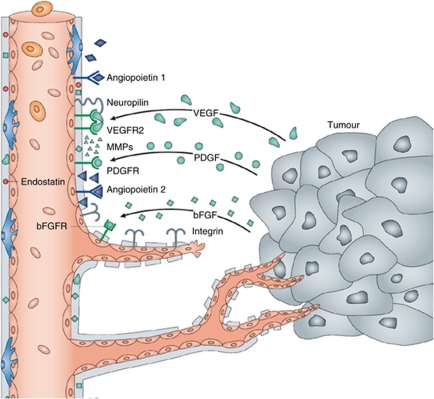
Soluble angiogenic factors are released from tumour cells to induce and regulate key steps in angiogenesis. Many of these factors have also been found to have a role in ocular and, more specifically, corneal neovascularisation. Angiopoietin-1 binds to endothelial Tie-2 receptors to stabilise the established vasculature. Angiopoietin-2, however, which is secreted by tumour cells, and which competes with angiopoietin-1 for the Tie-2 receptor, increases vascular basal membrane degradation and EC migration. Vascular endothelial growth factor (VEGF), platelet-derived growth factor (PDGF), and basic fibroblast growth factor (bFGF) may also be secreted by tumour cells, and exert pro-angiogenic effects via their respective EC receptors (with VEGF-receptors requiring assistance from neuropilins). Tumours or ECs may also release matrix metalloproteinases (MMPs). These have some pro-angiogenic effects, but also cleave antiangiogenic endostatin from collagen XVIII of the extracellular matrix, and angiostatin from circulating plasminogen (not depicted; adapted from Folkman, with permission from Macmillan Publishers Ltd).
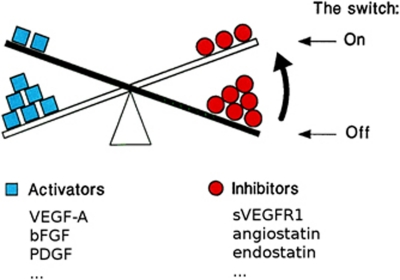
The ‘angiogenic switch' hypothesis. In health or mild disease, pro-angiogenic factors are counteracted by the inhibitors of angiogenesis. Quiescent vasculature is stimulated to cause neovascularisation, if increasing levels of activators of angiogenesis tilt the balance towards vessel growth. Likewise, increased presence of inhibiting factors or removal of activators can tilt it back towards maintaining avascularity. VEGF, vascular endothelial growth factor; bFGF, basic fibroblast growth factor; PDGF, platelet-derived growth factor; sVEGFR1, soluble VEGF receptor 1. (Adapted from Hanahan and Folkman, with permission from Elsevier).
References
-
- Lee P, Wang CC, Adamis AP. Ocular neovascularization: an epidemiologic review. Surv Ophthalmol. 1998;43:245–269. - PubMed
-
- Michaelson IC. The mode of development of the vascular system of the retina. With some observations on its significance for certain retinal diseases. Trans Ophthalmol Soc UK. 1948;68:137.
-
- Pardanaud L, Yassine F, Dieterlen-Lievre F. Relationship between vasculogenesis, angiogenesis and haemopoiesis during avian ontogeny. Development. 1989;105:473–485. - PubMed
-
- Risau W. Mechanisms of angiogenesis. Nature. 1997;386:671–674. - PubMed
Publication types
MeSH terms
Substances
LinkOut - more resources
Full Text Sources
