. 2011 Oct 1;25(19):2079-92.
doi: 10.1101/gad.17153811.

The Caenorhabditis elegans SOMI-1 zinc finger protein and SWI/SNF promote regulation of development by the mir-84 microRNA

Affiliations

The Caenorhabditis elegans SOMI-1 zinc finger protein and SWI/SNF promote regulation of development by the mir-84 microRNA

Gabriel D Hayes et al. Genes Dev. .

Abstract

Hundreds of microRNAs (miRNAs) have been discovered in metazoans and plants, and understanding of their biogenesis has advanced dramatically; however, relatively little is known about the cofactors necessary for miRNA regulation of target gene expression. In Caenorhabditis elegans, the conserved miRNA let-7 and its paralogs, including mir-84, control the timing of stage-specific developmental events. To identify factors required for the activity of mir-84 and possibly other miRNAs, we screened for mutations that suppress the developmental defects caused by overexpression of mir-84. Mutations in the somi-1 gene prevent these defects without affecting the expression level of mir-84. Loss of somi-1 also causes phenotypes similar to deletion of mir-84, showing that somi-1 is necessary for the normal function of this miRNA. somi-1 encodes a zinc finger protein that localizes to nuclear foci and binds the promoters of let-60/RAS, lin-14, and lin-28, genes that may be targeted by mir-84 and similar miRNAs. Genetic evidence shows that somi-1 inhibits lin-14 and induction of the vulval precursors by the let-60/RAS pathway. Proteomic and genetic screens identified conserved chromatin-remodeling and homeodomain transcription factor complexes that work with somi-1 to regulate differentiation. Our results suggest that somi-1 coordinates a nuclear response that complements the activity of mir-84.


Figures
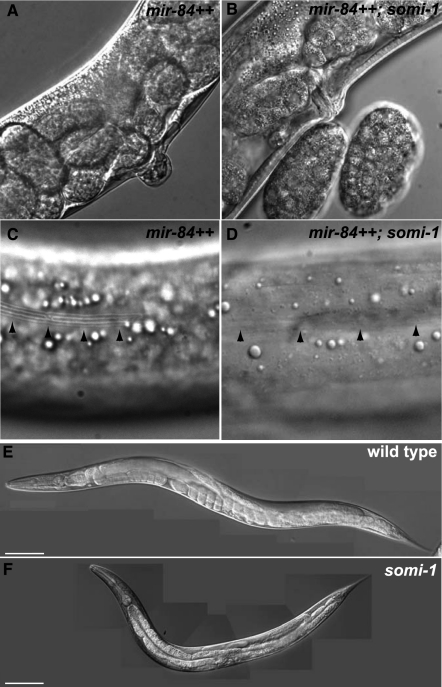
Figure 1.
Figure 1.
Loss of somi-1 suppresses precocious development caused by overexpression of mir-84. (A) mir-84-overexpressing adult with a vulval protrusion. (B) mir-84-overexpressing somi-1(mg415) mutant adult with a functional vulva next to two embryos. (C) Precocious alae (arrowheads) on the cuticle of a mir-84-overexpressing L4 larva. (D) A mir-84-overexpressing somi-1(mg415) mutant L4 larva lacking alae (arrowheads). Wild-type (E) and somi-1(mg415) (F) young adults 74 h after egg lay at 20°C. Bars, 100 μm.
Figure 2.
Figure 2.
somi-1 encodes two C2H2 zinc finger proteins that are conserved in nematodes. (A) Gene structures for somi-1a and somi-1b isoforms, which are supported by expressed sequence tag data (not shown). Boxes denote exons and lines denote introns. Positions of mutations in somi-1, the zinc finger domain, and predicted NLS are shown. Nucleotide numbering refers to cosmid M04G12.4 (accession no.: emb|Z88103) and amino acid numbering refers to M04G12.4A (accession no.: ref|NP_506320.3). (B) Alignment of SOMI-1B sequences from C. elegans and two related nematodes. Black shading denotes amino acid identity and gray shading denotes similarity. The zinc finger domain is underlined, and a similar sequence that lacks the second histidine residue is marked with a dashed line. The NLS is boxed, and positions where the protein is truncated in somi-1 nonsense mutants are marked by vertical lines. The alignment was produced with ClustalW 1.83 and shading was produced with Boxshade 3.21. Accession numbers are as follows: C. elegans: ref|NP_872161.2|; C. briggsae: ref|XP_002647630.1; and C. remanei: ref|XP_003114157.1.
Figure 3.
Figure 3.
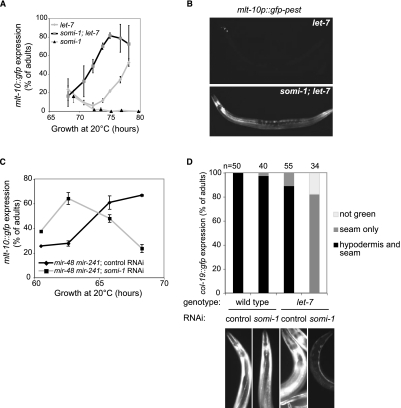
Loss of somi-1 enhances defects in exit from the molting cycle and differentiation of the hypodermis in adults with mutations in let-7 or its paralogs. (A) Supernumerary expression of mlt-10p::gfp-pest, a reporter for molting, in populations of GR1436, GR1605, and GR1707 mutant adults plated as synchronized L1 larvae. The combined results of two experiments are shown. A total of at least 90 animals were scored at each time point. (A,C) Error bars indicate SEM. (B) Typical mlt-10p::gfp-pest expression in let-7(mg279) single and somi-1(mg415); let-7(mg279) double mutants at 74.5 h of growth. (C) mlt-10p::gfp-pest expression in mir-48 mir-241(nDf51) mutant adults plated as synchronized L1 larvae to somi-1 or control RNAi. The combined results of three experiments are shown. A total of at least 40 animals were scored at each time point. (D) Loss of somi-1 enhances the failure of let-7(mg279) mutants to express a reporter for the adult-specific collagen COL-19 in the hypodermal syncytium. Animals were fed somi-1 or control RNAi, and their progeny were scored as gravid adults for expression of col-19::gfp using a Zeiss SV-6 microscope. The combined results of two independent experiments are presented. (B,D) Images of typical animals were captured using the same exposure settings and were processed identically.
Figure 4.
Figure 4.
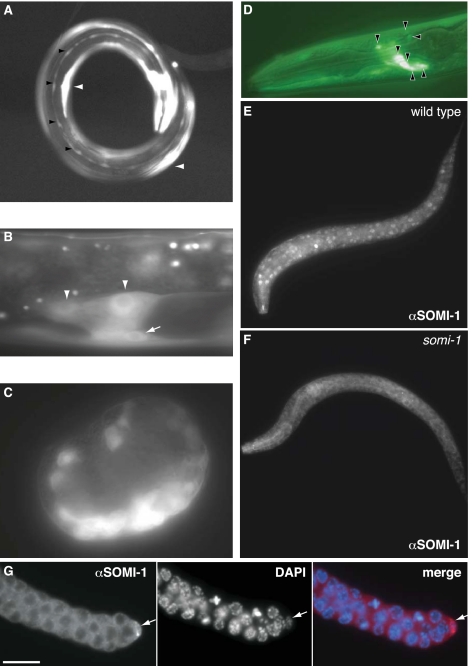
somi-1 is expressed in tissues affected by loss of paralogs of let-7 and in other tissues. (A–D) somi-1p::gfp::somi-1 3′ UTR expression. (A) Adult expressing somi-1p::gfp in the hypodermal seam cells (black arrowheads), body wall muscle (white arrowheads), and neurons. (B) somi-1p::gfp in the somatic gonad (arrowheads) and a VPC (arrow) of an L3 larva. (C) Onset of somi-1p::gfp expression in a comma stage embryo. (D) somi-1p::gfp in head neurons (arrowheads) of an L3 larva. GFP image overlaid on Nomarski image. (E) SOMI-1 immunostaining in the nuclei of hypodermal, muscle, and other cells of a wild-type L1 larva. (F) Immunostaining of a somi-1(mg415) mutant L1 larva showing only background staining. (G) SOMI-1 immunostaining in the distal tip cell (arrow) of the somatic gonad. Faint cytoplasmic staining of the germ cells was sometimes also seen in somi-1 mutants and may be nonspecific. Bar, 10 μm.
Figure 5.
Figure 5.
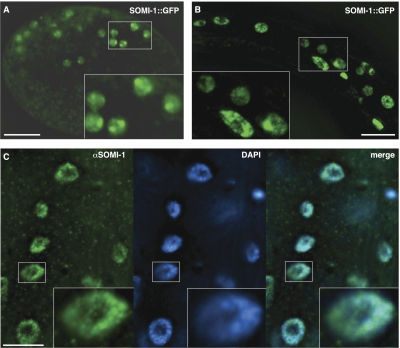
SOMI-1 localizes to nuclear foci. (A,B) mgIs57[SOMI-1::GFP] expression. (A) SOMI-1::GFP in the nuclei of a comma stage embryo. The image corresponds to one deconvolved optical section. (B) SOMI-1::GFP in hypodermal and neuronal nuclei of an L2 larva. Five deconvolved optical sections were flattened into one image. (C) SOMI-1 immunostaining (green) in hypodermal nuclei near the tail of a wild-type adult with DNA visualized by DAPI. Images correspond to one deconvolved optical section. (A–C) Bars, 10 μm. Boxed areas are magnified in insets.
Figure 6.
Figure 6.
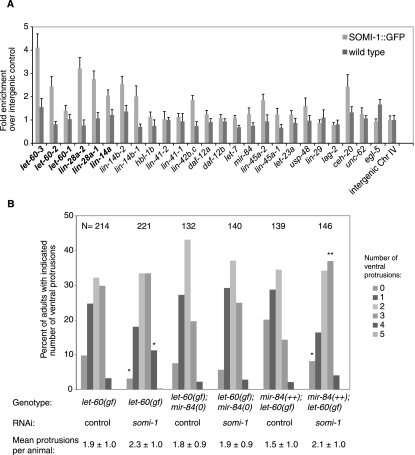
SOMI-1 is enriched at the promoters of let-60/RAS, lin-14, and lin-28. (A) Chromatin was isolated from α-GFP immunoprecipitates of L2 stage SOMI-1::GFP or wild-type worms and the purified DNA was assayed by qPCR with primers homologous to the promoters of candidate genes (see Supplemental Table S5). The abundance of each DNA relative to an intergenic control is plotted. Genes in bold were consistently enriched at least twofold in independent experiments. Error bars indicate SEM in qPCR replicates. (B) Inactivation of somi-1 enhances a let-60 gain-of-function mutant. MT2124, GR1689, or GR1690 animals were placed on somi-1(RNAi) or control bacteria, and the number of ventral protrusions, representing ectopic induction of the VPCs, was scored in each of their adult progeny using a dissecting microscope. The mean number of protrusions per animal ± SD and the percentage of animals with the indicated number of protrusions are indicated. Significant differences compared with control are indicated: (*) P < 0.01; (**) P = 0.0001, Fisher's exact test.
Figure 7.
Figure 7.
SWI/SNF-related proteins that copurify with SOMI-1 regulate differentiation of the hypodermis. (A) Many genes that enhance let-7(mg279) when inactivated encode homologs of components of the SWI/SNF chromatin-remodeling complex. Human orthologs are given. Black and gray boxes indicate strong and weak enhancement, respectively. swsn-1 was not assayed for mlt-10::gfp expression because its inactivation slowed development. The asterisk (*) denotes genes whose products did not copurify with SOMI-1 but were assayed because they have a related function. (B) Chart of data from Supplemental Table S2. Synchronized let-7(mg279) L1 larvae were placed on the indicated RNAi clone and scored at ∼76 h. The dashed line indicates percentage of gravid adults expressing mlt-10p::gfp-pest when treated with control bacteria. SWI/SNF-related gene names are bold, and somi-1 and vector controls are gray. Error bars represent SEM for independent experiments. Bar colors show significant difference from control: (black) P < 0.001; (gray) P < 0.05, one-way ANOVA, Tukey's post hoc test. (C,D) Expression of mlt-10p::gfp-pest in the hypodermis of gravid GR1436 (C) or GR1605 (D) worms placed on the indicated RNAi bacteria as synchronized L1 larvae. At least 25 worms were scored at each time point.

References

    1. Abbott AL, Alvarez-Saavedra E, Miska EA, Lau NC, Bartel DP, Horvitz HR, Ambros V 2005. The let-7 microRNA family members mir-48, mir-84, and mir-241 function together to regulate developmental timing in Caenorhabditis elegans. Dev Cell 9: 403–414 - PMC - PubMed
    1. Abrahante JE, Miller EA, Rougvie AE 1998. Identification of heterochronic mutants in Caenorhabditis elegans. Temporal misexpression of a collagen:green fluorescent protein fusion gene. Genetics 149: 1335–1351 - PMC - PubMed
    1. Abrahante JE, Daul AL, Li M, Volk ML, Tennessen JM, Miller EA, Rougvie AE 2003. The Caenorhabditis elegans hunchback-like gene lin-57/hbl-1 controls developmental time and is regulated by microRNAs. Dev Cell 4: 625–637 - PubMed
    1. Alvarez-Garcia I, Miska EA 2005. MicroRNA functions in animal development and human disease. Development 132: 4653–4662 - PubMed
    1. Ambros V 1999. Cell cycle-dependent sequencing of cell fate decisions in Caenorhabditis elegans vulva precursor cells. Development 126: 1947–1956 - PubMed

Publication types

MeSH terms