doi: 10.1681/ASN.2011040414.
Epub 2011 Oct 6.
Effects of pH on potassium: new explanations for old observations
Affiliations
- PMID: 21980112
- PMCID: PMC3231780
- DOI: 10.1681/ASN.2011040414
Item in Clipboard
Effects of pH on potassium: new explanations for old observations
J Am Soc Nephrol.
2011 Nov.
Abstract
Maintenance of extracellular K(+) concentration within a narrow range is vital for numerous cell functions, particularly electrical excitability of heart and muscle. Potassium homeostasis during intermittent ingestion of K(+) involves rapid redistribution of K(+) into the intracellular space to minimize increases in extracellular K(+) concentration, and ultimate elimination of the K(+) load by renal excretion. Recent years have seen great progress in identifying the transporters and channels involved in renal and extrarenal K(+) homeostasis. Here we apply these advances in molecular physiology to understand how acid-base disturbances affect serum potassium.
Figures
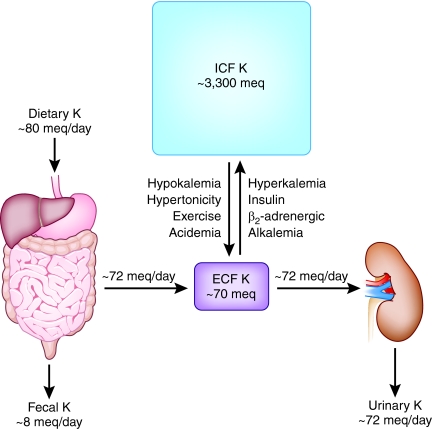
K+ concentration in the extracellular fluid (ECF) is affected by dietary intake, exchange with the intracellular fluid (ICF), and urinary excretion.
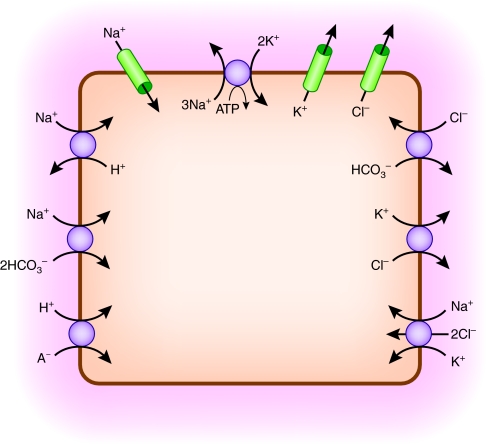
Multiple ion transport pathways directly or indirectly affect net K+ flux in skeletal muscle cells.
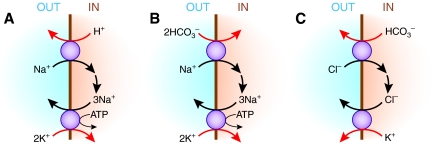
Apparent K+-H+ exchange (or K+-HCO3− cotransport) in skeletal muscle cells can arise from functional coupling between (A) Na+-H+ exchange and Na+,K+-ATPase, (B) Na+-HCO3− cotransport and Na+,K+-ATPase, or (C) Cl−-HCO3− exchange and K+-Cl− cotransport.
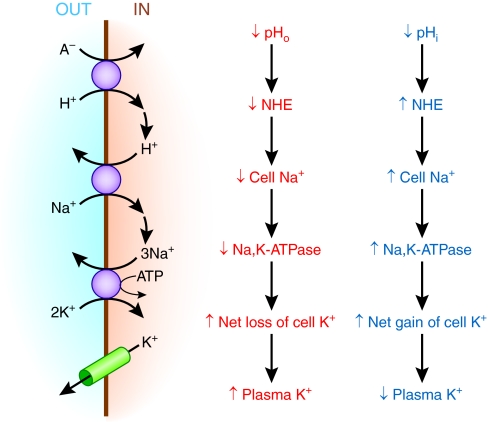
Opposing effects of extracellular and intracellular pH modify the influence of organic acidosis on plasma K+.
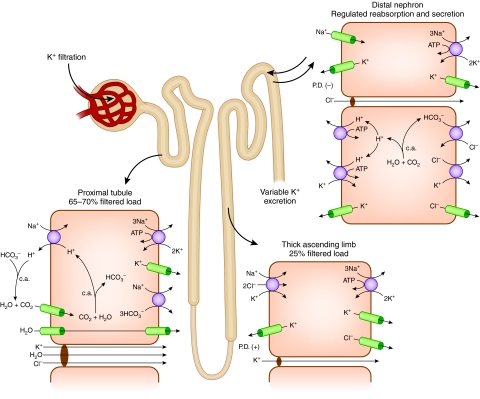
Urinary K+ excretion is the resultant of filtration, reabsorption and secretion along the nephron. Mechanisms of K+ transport in proximal tubule, thick ascending limb, and distal nephron (connecting and collecting tubule) are shown in the inset.
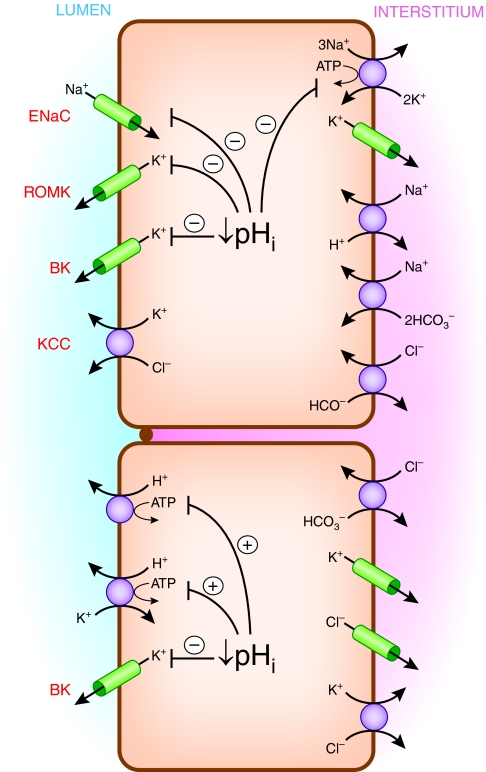
Multiple ion transport pathways directly or indirectly affect K+ transport in the connecting tubule and cortical collecting tubule and are affected by pH.
References
-
- Bia MJ, DeFronzo RA: Extrarenal potassium homeostasis. Am J Physiol 240: F257–F268, 1981 - PubMed
-
- Adrogue HJ, Madias NE: Changes in plasma potassium concentration during acute acid-base disturbances. Am J Med 71: 456–467, 1981 - PubMed
-
- Clausen T: Na+-K+ pump regulation and skeletal muscle contractility. Physiol Rev 83: 1269–1324, 2003 - PubMed
Publication types
MeSH terms
Substances
Grants and funding
LinkOut - more resources
Full Text Sources
Other Literature Sources
Medical