Randomized Controlled Trial
. 2011 Dec;42(12):3484-90.
doi: 10.1161/STROKEAHA.111.624155. Epub 2011 Oct 6.

Age and outcomes after carotid stenting and endarterectomy: the carotid revascularization endarterectomy versus stenting trial

Affiliations
Randomized Controlled Trial

Age and outcomes after carotid stenting and endarterectomy: the carotid revascularization endarterectomy versus stenting trial

Jenifer H Voeks et al. Stroke. 2011 Dec.

Abstract

Background and purpose: High stroke event rates among carotid artery stenting (CAS)-treated patients in the Carotid Revascularization Endarterectomy Versus Stenting Trial (CREST) lead-in registry generated an a priori hypothesis that age may modify the relative efficacy of CAS versus carotid endarterectomy (CEA). In the primary CREST report, we previously noted significant effect modification by age. Here we extend this investigation by examining the relative efficacy of the components of the primary end point, the treatment-specific impact of age, and contributors to the increasing risk in CAS-treated patients at older ages.

Methods: Among 2502 CREST patients with high-grade carotid stenosis, proportional hazards models were used to examine the impact of age on the CAS-to-CEA relative efficacy, and the impact of age on risk within CAS-treated and CEA-treated patients.

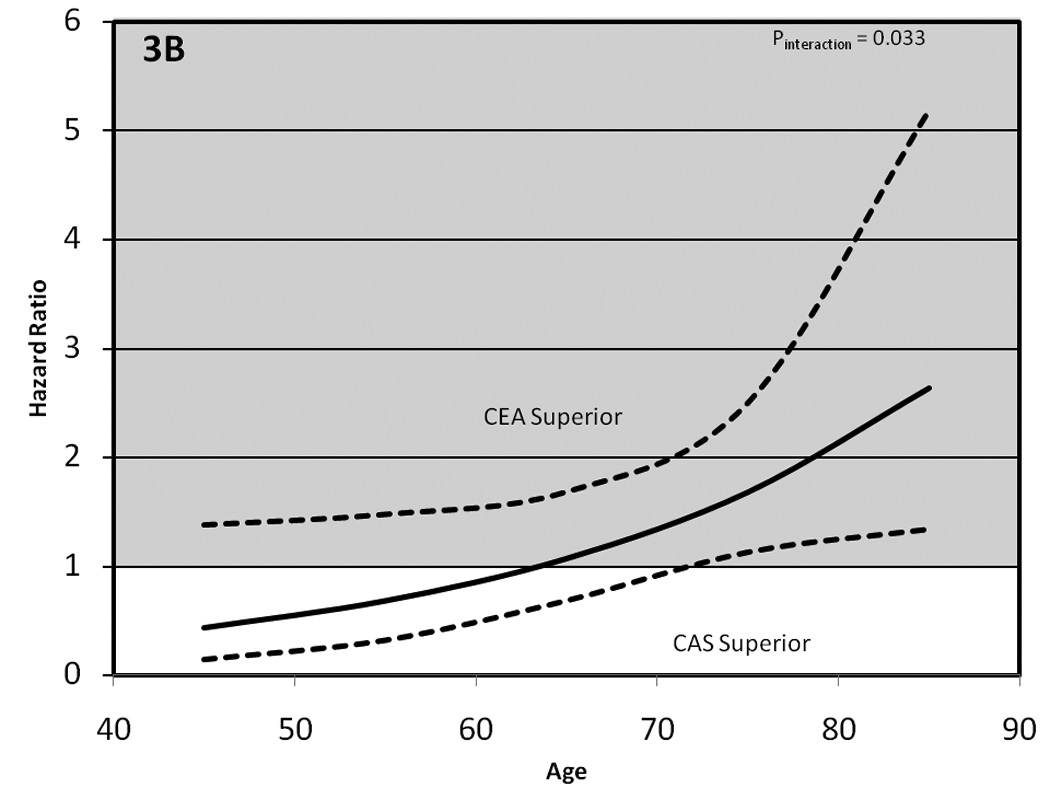
Results: Age acted as a treatment effect modifier for the primary end point (P interaction=0.02), with the efficacy of CAS and CEA approximately equal at age 70 years. For CAS, risk for the primary end point increased with age (P<0.0001) by 1.77-times (95% confidence interval, 1.38-2.28) per 10-year increment; however, there was no evidence of increased risk for CEA-treated patients (P=0.27). Stroke events were the primary contributor to the overall effect modification (P interaction=0.033), with equal risk at ≈64 years. The treatment-by-age interaction for CAS and CEA was not altered by symptomatic status (P=0.96) or by sex (P=0.45).

Conclusions: Outcomes after CAS versus CEA were related to patient age, attributable to increasing risk for stroke after CAS at older ages. Patient age should be an important consideration when choosing between the 2 procedures for treating carotid stenosis.

Clinical trial registration: URL: http://www.clinicaltrials.gov. Unique identifier: NCT00004732.


Figures
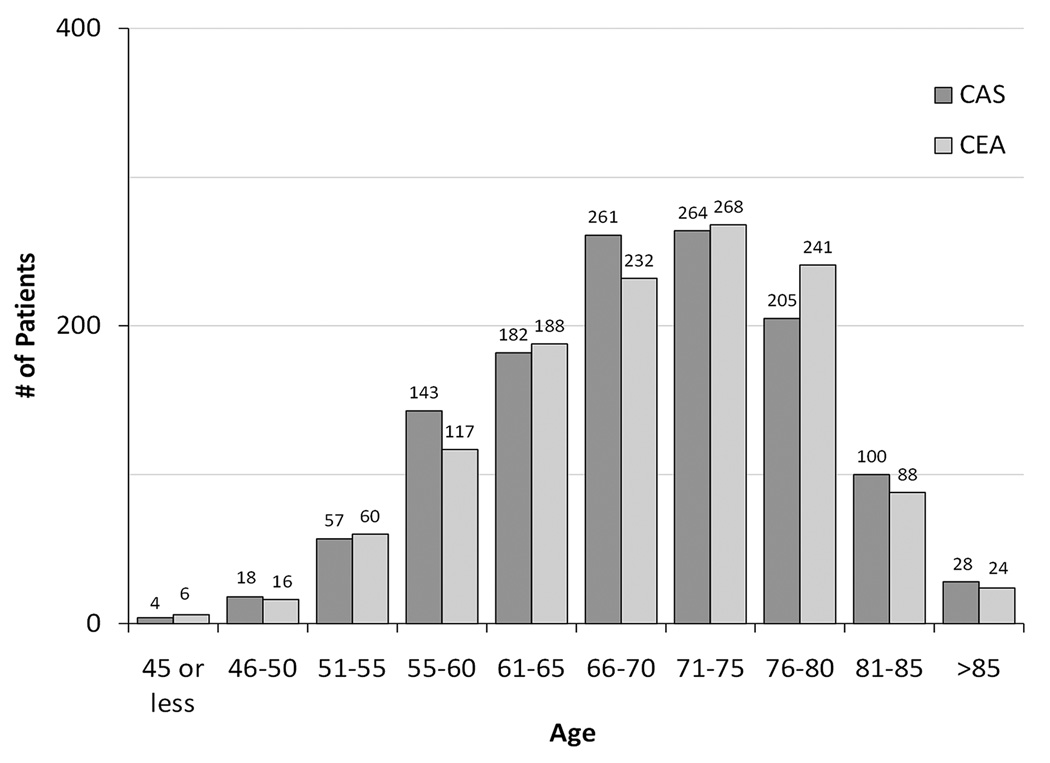
Figure 1
Figure 1
Histogram of the number of patients within age strata by treatment assignment. CAS indicates carotid artery stenting; CEA, carotid endarterectomy.
Figure 2
Figure 2
Kaplan-Meier estimates of the proportion of study participants with a primary endpoint. CAS indicates carotid artery stenting; CEA, carotid endarterectomy.
Figure 3
Figure 3
The impact of age on the relative efficacy of carotid artery stenting (CAS) vs carotid endarterectomy (CEA). 3A, hazard for the primary endpoint of any stroke, death, or MI during the periprocedural period, plus ipsilateral strokes over the subsequent 4-year period. Progressively better outcomes were seen with CAS in patients younger than 70 years old and with CEA in those older than 70 years old. 3B, hazard as a function of age for the stroke component of the primary endpoint (any stroke during the periprocedural period plus ipsilateral stroke over the subsequent 4-year period) Progressively better outcomes were seen with CAS in patients younger than 64 years old, and with CEA in those older than 64 years old. 3C, `hazard for the MI component of the primary endpoint (MI during the periprocedural period). The third component, deaths during the periprocedural period, is not provided because of the relatively small number of death events.
Figure 3
Figure 3
The impact of age on the relative efficacy of carotid artery stenting (CAS) vs carotid endarterectomy (CEA). 3A, hazard for the primary endpoint of any stroke, death, or MI during the periprocedural period, plus ipsilateral strokes over the subsequent 4-year period. Progressively better outcomes were seen with CAS in patients younger than 70 years old and with CEA in those older than 70 years old. 3B, hazard as a function of age for the stroke component of the primary endpoint (any stroke during the periprocedural period plus ipsilateral stroke over the subsequent 4-year period) Progressively better outcomes were seen with CAS in patients younger than 64 years old, and with CEA in those older than 64 years old. 3C, `hazard for the MI component of the primary endpoint (MI during the periprocedural period). The third component, deaths during the periprocedural period, is not provided because of the relatively small number of death events.
Figure 3
Figure 3
The impact of age on the relative efficacy of carotid artery stenting (CAS) vs carotid endarterectomy (CEA). 3A, hazard for the primary endpoint of any stroke, death, or MI during the periprocedural period, plus ipsilateral strokes over the subsequent 4-year period. Progressively better outcomes were seen with CAS in patients younger than 70 years old and with CEA in those older than 70 years old. 3B, hazard as a function of age for the stroke component of the primary endpoint (any stroke during the periprocedural period plus ipsilateral stroke over the subsequent 4-year period) Progressively better outcomes were seen with CAS in patients younger than 64 years old, and with CEA in those older than 64 years old. 3C, `hazard for the MI component of the primary endpoint (MI during the periprocedural period). The third component, deaths during the periprocedural period, is not provided because of the relatively small number of death events.

References

    1. McCrory D, Goldstein L, Samsa G, Oddone E, Landsman P, Moore W, et al. Predicting complications of carotid endarterectomy. Stroke. 1993;24:1285–1291. - PubMed
    1. Fisher ES, Malenka DJ, Solomon NA, Bubolz TA, Whaley FS, Wennberg JE. Risk of carotid endarterectomy in the elderly. Am J Public Health. 1989;79:1617–1620. - PMC - PubMed
    1. Rothwell PM, Slattery J, Warlow CP. Clinical and angiographic predictors of stroke and death from carotid endarterectomy: systematic review. BMJ. 1997;315:1571–1577. - PMC - PubMed
    1. Durward QJ, Ragnarsson TS, Reeder RF, Case JL, Hughes CA. Carotid endarterectomy in nonagenarians. Arch Surg. 2005;140:625–628. - PubMed
    1. Salameh JR, Myers JL, Mukherjee D. Carotid Endarterectomy in Elderly Patients: Low Complication Rate With Overnight Stay. Arch Surg. 2002;137:1284–1287. - PubMed

Publication types

Associated data