A genome-wide meta-analysis of six type 1 diabetes cohorts identifies multiple associated loci
- PMID: 21980299
- PMCID: PMC3183083
- DOI: 10.1371/journal.pgen.1002293
A genome-wide meta-analysis of six type 1 diabetes cohorts identifies multiple associated loci
Abstract
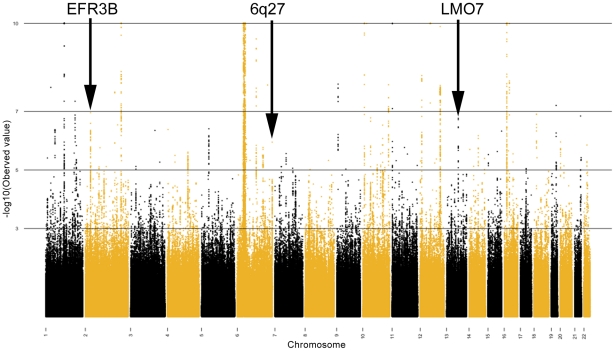
Diabetes impacts approximately 200 million people worldwide, of whom approximately 10% are affected by type 1 diabetes (T1D). The application of genome-wide association studies (GWAS) has robustly revealed dozens of genetic contributors to the pathogenesis of T1D, with the most recent meta-analysis identifying in excess of 40 loci. To identify additional genetic loci for T1D susceptibility, we examined associations in the largest meta-analysis to date between the disease and ∼2.54 million SNPs in a combined cohort of 9,934 cases and 16,956 controls. Targeted follow-up of 53 SNPs in 1,120 affected trios uncovered three new loci associated with T1D that reached genome-wide significance. The most significantly associated SNP (rs539514, P = 5.66×10⁻¹¹) resides in an intronic region of the LMO7 (LIM domain only 7) gene on 13q22. The second most significantly associated SNP (rs478222, P = 3.50×10⁻⁹ resides in an intronic region of the EFR3B (protein EFR3 homolog B) gene on 2p23; however, the region of linkage disequilibrium is approximately 800 kb and harbors additional multiple genes, including NCOA1, C2orf79, CENPO, ADCY3, DNAJC27, POMC, and DNMT3A. The third most significantly associated SNP (rs924043, P = 8.06×10⁻⁹ lies in an intergenic region on 6q27, where the region of association is approximately 900 kb and harbors multiple genes including WDR27, C6orf120, PHF10, TCTE3, C6orf208, LOC154449, DLL1, FAM120B, PSMB1, TBP, and PCD2. These latest associated regions add to the growing repertoire of gene networks predisposing to T1D.
Conflict of interest statement
The authors have declared that no competing interests exist.
Figures
References
-
- Steyn NP, Lambert EV, Tabana H. Conference on "Multidisciplinary approaches to nutritional problems". Symposium on "Diabetes and health". Nutrition interventions for the prevention of type 2 diabetes. Proc Nutr Soc. 2009;68:55–70. - PubMed
-
- EURODIAB ACE Study Group. Variation and trends in incidence of childhood diabetes in Europe. EURODIAB ACE Study Group. Lancet. 2000;355:873–876. - PubMed
-
- Onkamo P, Vaananen S, Karvonen M, Tuomilehto J. Worldwide increase in incidence of Type I diabetes-the analysis of the data on published incidence trends. Diabetologia. 1999;42:1395–1403. - PubMed
-
- Redondo MJ, Yu L, Hawa M, Mackenzie T, Pyke DA, et al. Heterogeneity of type I diabetes: analysis of monozygotic twins in Great Britain and the United States. Diabetologia. 2001;44:354–362. - PubMed
-
- Clayton DG. Prediction and interaction in complex disease genetics: experience in type 1 diabetes. PLoS Genet. 2009;5:e1000540. doi: 10.1371/journal.pgen.1000540. - DOI - PMC - PubMed
Publication types
MeSH terms
Substances
Grants and funding
LinkOut - more resources
Full Text Sources
Other Literature Sources
Medical
Molecular Biology Databases
Miscellaneous