


Event-related potentials in response to subjects' own names: A comparison between humans and a chimpanzee
- PMID: 21980569
- PMCID: PMC3187897
- DOI: 10.4161/cib.4.3.14841
Event-related potentials in response to subjects' own names: A comparison between humans and a chimpanzee
Abstract
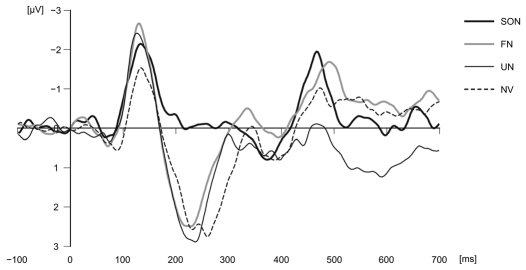
The sound of one's own name is one of the most salient auditory environmental stimuli. Several studies of human brain potentials have revealed some characteristic waveforms when we hear our own names. In a recent work, we investigated event-related potentials (ERPs) in a female chimpanzee and demonstrated that the ERP pattern generated when she heard her own name differed from that generated when she heard other sounds. However, her ERPs did not exhibit a prominent positive shift around 300 ms (P3) in response to her own name, as has been repeatedly shown in studies of human ERPs. The present study collected comparative data for adult humans using basically the same procedure as that used in our previous study of the chimpanzee. These results also revealed no prominent P3 to the human subjects' own names. The lack of increased P3 is therefore likely due to our experimental protocol, in which we presented the subject's own name relatively frequently. In contrast, our results revealed prominent negativity to the subject's own name at around 500 ms in the chimpanzee and around 200 ms in human subjects. This may indicate that initial orientation to the sound of one's own name is delayed in the chimpanzee.
Keywords: ERP; auditory processing; chimpanzee; name; self.
Figures
Comment on
-
Brain activity in an awake chimpanzee in response to the sound of her own name.Biol Lett. 2010 Jun 23;6(3):311-3. doi: 10.1098/rsbl.2009.0864. Epub 2009 Dec 16. Biol Lett. 2010. PMID: 20015859 Free PMC article.
References
-
- Lonsdorf EV, Ross SR, Matsuzawa T. The Mind of the Chimpanzee: Ecological and Experimental Perspectives. Chicago: The University of Chicago Press; 2010.
-
- Gallup GG., Jr Chimpanzees: self-recognition. Science. 1970;167:86–87. - PubMed
-
- Berlad I, Pratt H. P300 in response to the subject's own name. Electroencephalogr Clin Neurophysiol. 1995;96:472–474. - PubMed
LinkOut - more resources
Full Text Sources
