Comparative Study
. 2011 Nov 8;50(44):9616-27.
doi: 10.1021/bi201286p. Epub 2011 Oct 14.

Biophysical analysis of binding of WW domains of the YAP2 transcriptional regulator to PPXY motifs within WBP1 and WBP2 adaptors

Affiliations
Comparative Study

Biophysical analysis of binding of WW domains of the YAP2 transcriptional regulator to PPXY motifs within WBP1 and WBP2 adaptors

Caleb B McDonald et al. Biochemistry. .

Abstract

The YAP2 transcriptional regulator mediates a plethora of cellular functions, including the newly discovered Hippo tumor suppressor pathway, by virtue of its ability to recognize WBP1 and WBP2 signaling adaptors among a wide variety of other ligands. Herein, using isothermal titration calorimery and circular dichroism in combination with molecular modeling and molecular dynamics, we provide evidence that the WW1 and WW2 domains of YAP2 recognize various PPXY motifs within WBP1 and WBP2 in a highly promiscuous and subtle manner. Thus, although both WW domains strictly require the integrity of the consensus PPXY sequence, nonconsensus residues within and flanking this motif are not critical for high-affinity binding, implying that they most likely play a role in stabilizing the polyproline type II helical conformation of the PPXY ligands. Of particular interest is the observation that both WW domains bind to a PPXYXG motif with highest affinity, implicating a preference for a nonbulky and flexible glycine one residue to the C-terminal side of the consensus tyrosine. Importantly, a large set of residues within both WW domains and the PPXY motifs appear to undergo rapid fluctuations on a nanosecond time scale, suggesting that WW-ligand interactions are highly dynamic and that such conformational entropy may be an integral part of the reversible and temporal nature of cellular signaling cascades. Collectively, our study sheds light on the molecular determinants of a key WW-ligand interaction pertinent to cellular functions in health and disease.


Figures
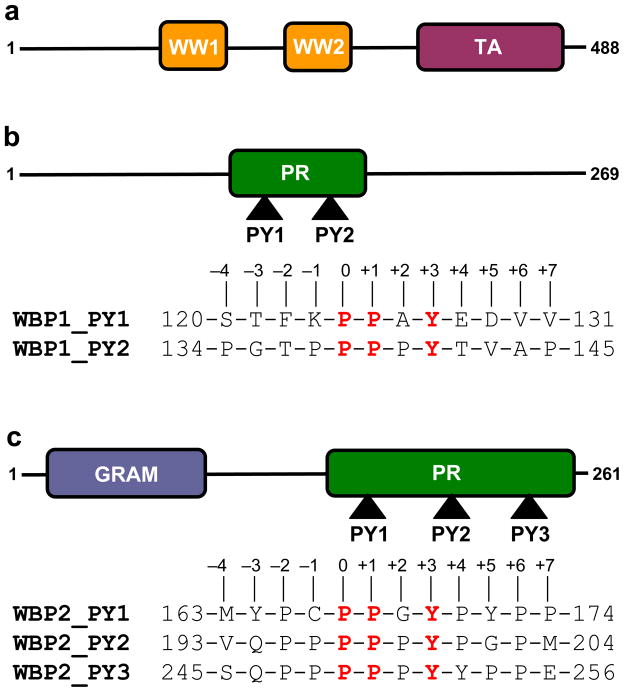
Figure 1
Figure 1
Modular organization of human YAP2 transcriptional regulator and human WBP proteins. (a) YAP2 is comprised of a tandem copy of WW domains, designated WW1 and WW2, located N-terminal to the trans-activation (TA) domain. (b) WBP1 contains a central proline-rich (PR) domain flanked between long stretches of uncharacterized regions. The PR domain of WBP1 contains two PPXY motifs, designated PY1 and PY2. (c) WBP2 contains the GRAM domain located N-terminal to the proline-rich (PR) domain. The PR domain of WBP2 contains three PPXY motifs, designated PY1, PY2 and PY3. Note that the amino acid sequences of peptides containing the PPXY motifs and flanking residues within both WBP1 and WBP2 are provided. The numerals indicate the nomenclature used in this study to distinguish residues within and flanking the motifs relative to the first proline within the PPXY motifs, which is arbitrarily assigned zero.
Figure 2
Figure 2
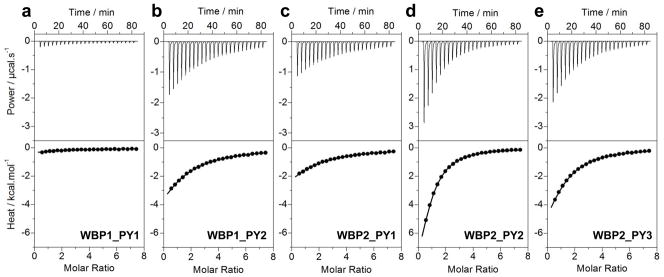
Representative ITC isotherms for the binding of WW1 domain of YAP2 to PPXY peptides containing WBP1_PY1 (a), WBP1_PY2 (b), WBP2_PY1 (c), WBP2_PY2 (d) and WBP2_PY3 (e) motifs. The upper panels show the raw ITC data expressed as change in thermal power with respect to time over the period of titration. In the lower panels, change in molar heat is expressed as a function of molar ratio of corresponding peptide to WW1 domain of YAP2. The solid lines in the lower panels show the fit of data to a one-site model, as embodied in Eq [1], using the ORIGIN software.
Figure 3
Figure 3
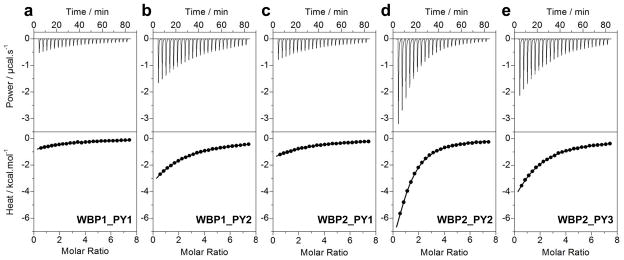
Representative ITC isotherms for the binding of WW2 domain of YAP2 to PPXY peptides containing WBP1_PY1 (a), WBP1_PY2 (b), WBP2_PY1 (c), WBP2_PY2 (d) and WBP2_PY3 (e) motifs. The upper panels show the raw ITC data expressed as change in thermal power with respect to time over the period of titration. In the lower panels, change in molar heat is expressed as a function of molar ratio of corresponding peptide to WW2 domain of YAP2. The solid lines in the lower panels show the fit of data to a one-site model, as embodied in Eq [1], using the ORIGIN software.
Figure 4
Figure 4
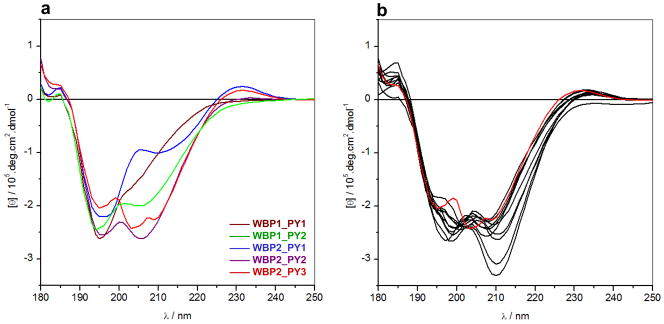
CD analysis of PPXY peptides derived from WBP1 and WBP2 proteins. (a) Comparison of far-UV CD spectra of WBP1_PY1 (brown), WBP1_PY2 (green), WBP2_PY1 (blue), WBP2_PY2 (purple) and WBP2_PY3 peptides (red). (b) Comparison of far-UV CD spectra of wildtype WBP2_PY3 peptide (red) and single-alanine mutant peptides thereof (black).
Figure 5
Figure 5
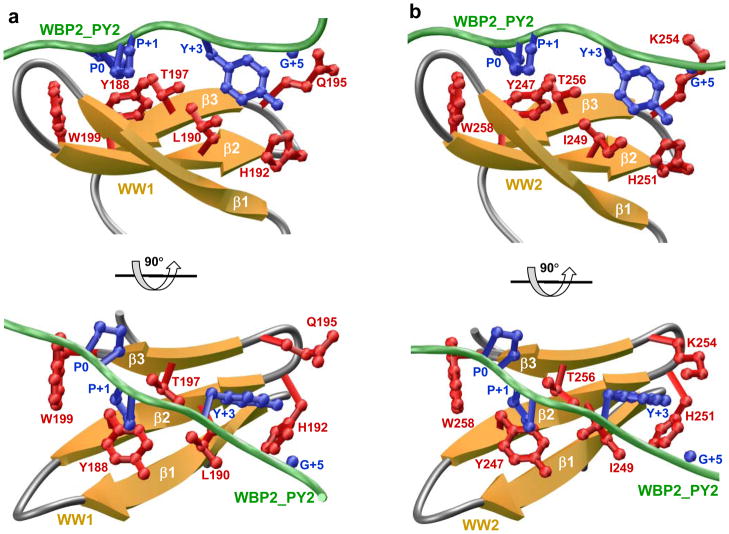
3D structural models of the WW1 (a) and WW2 (b) domains of YAP2 in complex with WBP2_PY2 peptide. The β-strands in the WW domains are shown in yellow with loops depicted in gray and the peptide is colored green. The sidechain moities of residues within WW domains engaged in key intermolecular contacts with the peptide are shown in red. The sidechain moieties of residues within the peptide colored blue correspond to the PPXYXG motif.
Figure 6
Figure 6
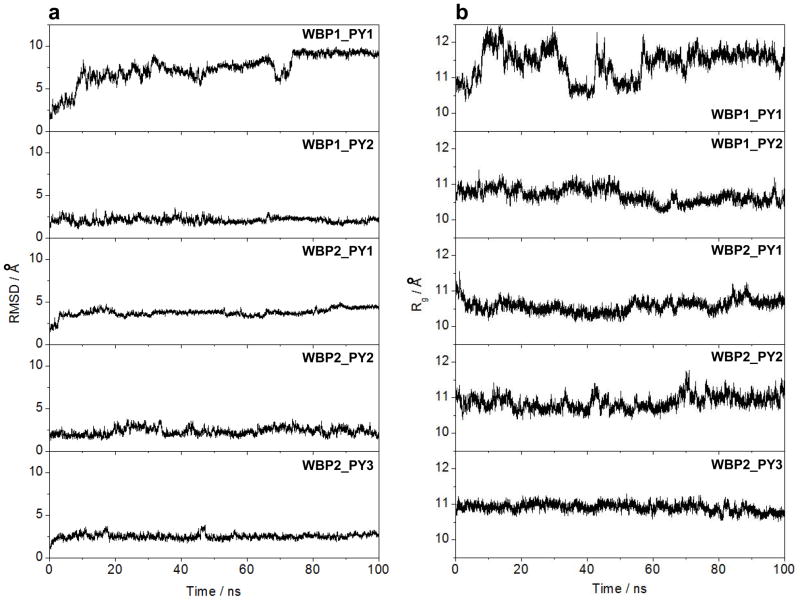
Global behavior of the WW1 domain of YAP2 in complex with various PPXY peptides derived from WBP1 and WBP2 across the corresponding MD trajectory. (a) Root mean square deviation (RMSD) of backbone atoms (N, Cα and C) within each simulated structure relative to the initial modeled structure of the WW1 domain of YAP2 in complex with various peptides as a function of simulation time. (b) Dependence of radius of gyration (Rg) of the WW1 domain of YAP2 in complex with various peptides as a function of simulation time.
Figure 7
Figure 7
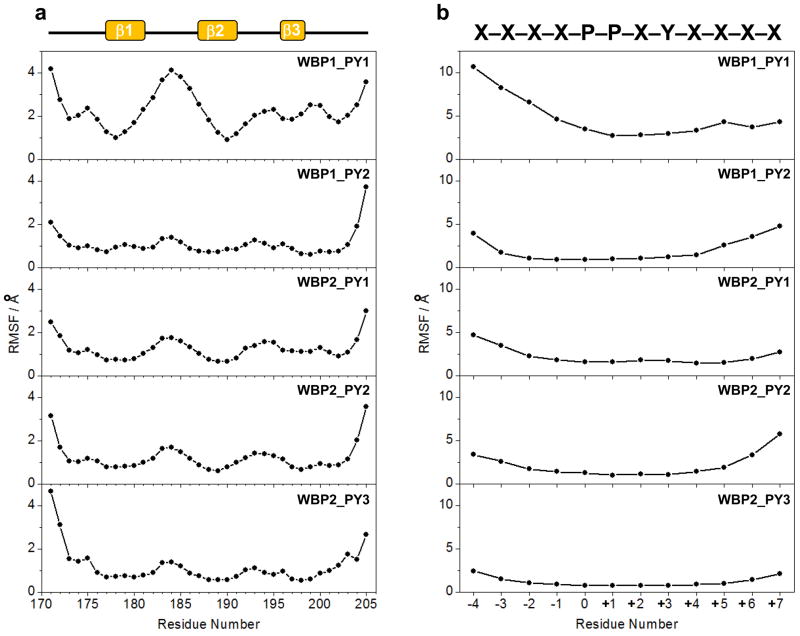
Root mean square fluctuation (RMSF) of backbone atoms (N, Cα and C) averaged over the entire course of corresponding MD trajectory for the WW1 domain of YAP2 in complex with various PPXY peptides derived from WBP1 and WBP2. (a) RMSF within backbone atoms of the WW1 domain in complex with various peptides as a function of WW1 residue number. The β1-β3 strands within the WW1 domain are overlayed for reference. (b) RMSF within backbone atoms of the various peptides in complex with the WW1 domain as a function of peptide residue number. The PPXY motif and the flanking residues are overlayed for reference.
Figure 8
Figure 8
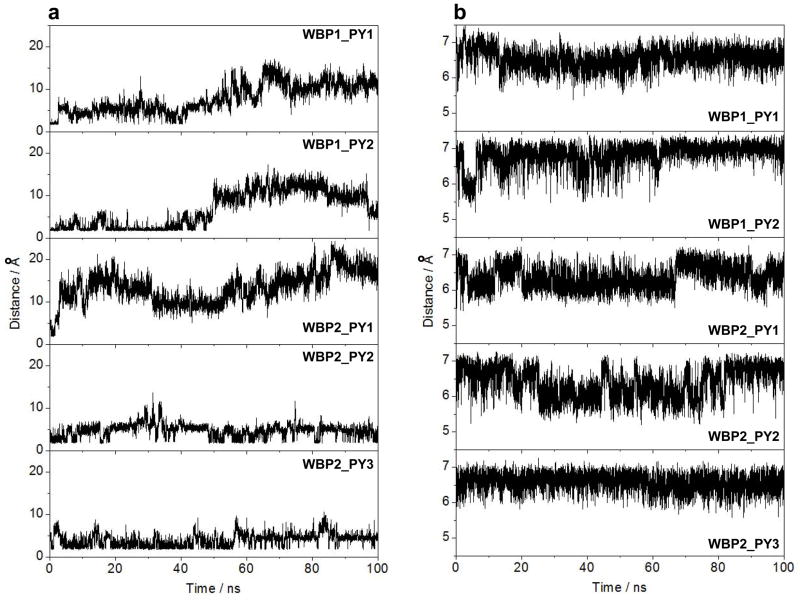
Dependence of local distances between specific atoms of the WW1 domain of YAP2 in complex with various PPXY peptides derived from WBP1 and WBP2 across the corresponding MD trajectory. (a) Distance between the Nδ1 imidazole nitrogen of H192 within the WW1 domain of YAP2 and the Hη phenolic hydrogen of the consensus tyrosine within the PPXY motif of various peptides as a function of simulation time. (b) Distance between the Cα backbone carbon of consensus tyrosine within the PPXY motif (Y+3) and the Cα backbone carbon of the residue at +5 position (D+5 in WBP1_PY1, V+5 in WBP1_PY2, Y+5 in WBP2_PY1, G+5 in WBP2_PY2 and P+5 in WBP2_PY3) within various peptides as a function of simulation time.

References

    1. Sudol M. Yes-associated protein (YAP65) is a proline-rich phosphoprotein that binds to the SH3 domain of the Yes proto-oncogene product. Oncogene. 1994;9:2145–2152. - PubMed
    1. Sudol M, Bork P, Einbond A, Kastury K, Druck T, Negrini M, Huebner K, Lehman D. Characterization of the mammalian YAP (Yes-associated protein) gene and its role in defining a novel protein module, the WW domain. J Biol Chem. 1995;270:14733–14741. - PubMed
    1. Yagi R, Chen LF, Shigesada K, Murakami Y, Ito Y. A WW domain-containing yes-associated protein (YAP) is a novel transcriptional co-activator. Embo J. 1999;18:2551–2562. - PMC - PubMed
    1. Komuro A, Nagai M, Navin NE, Sudol M. WW domain-containing protein YAP associates with ErbB-4 and acts as a co-transcriptional activator for the carboxyl-terminal fragment of ErbB-4 that translocates to the nucleus. J Biol Chem. 2003;278:33334–33341. - PubMed
    1. Zhao B, Ye X, Yu J, Li L, Li W, Li S, Lin JD, Wang CY, Chinnaiyan AM, Lai ZC, Guan KL. TEAD mediates YAP-dependent gene induction and growth control. Genes Dev. 2008;22:1962–1971. - PMC - PubMed

Publication types

MeSH terms

Associated data