


Variants near FOXE1 are associated with hypothyroidism and other thyroid conditions: using electronic medical records for genome- and phenome-wide studies
- PMID: 21981779
- PMCID: PMC3188836
- DOI: 10.1016/j.ajhg.2011.09.008
Variants near FOXE1 are associated with hypothyroidism and other thyroid conditions: using electronic medical records for genome- and phenome-wide studies
Abstract
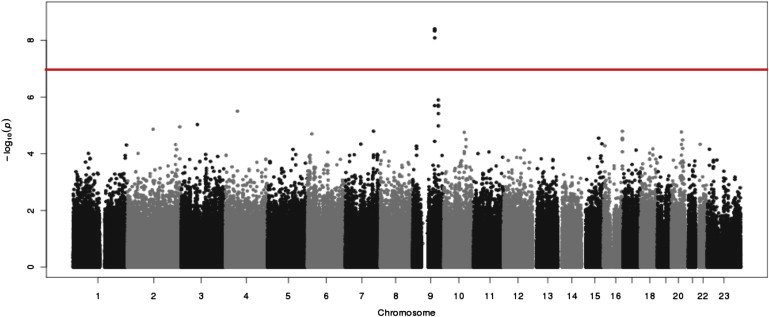
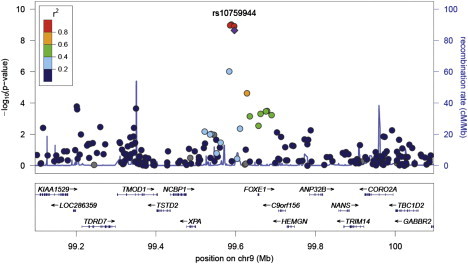
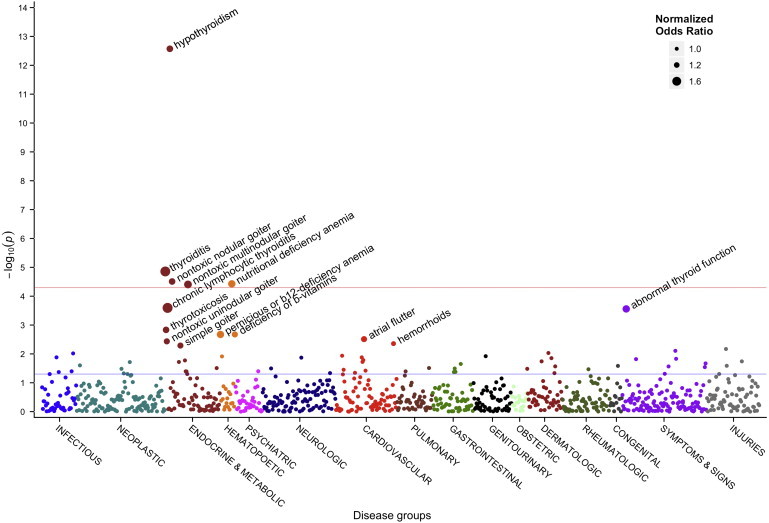
We repurposed existing genotypes in DNA biobanks across the Electronic Medical Records and Genomics network to perform a genome-wide association study for primary hypothyroidism, the most common thyroid disease. Electronic selection algorithms incorporating billing codes, laboratory values, text queries, and medication records identified 1317 cases and 5053 controls of European ancestry within five electronic medical records (EMRs); the algorithms' positive predictive values were 92.4% and 98.5% for cases and controls, respectively. Four single-nucleotide polymorphisms (SNPs) in linkage disequilibrium at 9q22 near FOXE1 were associated with hypothyroidism at genome-wide significance, the strongest being rs7850258 (odds ratio [OR] 0.74, p = 3.96 × 10(-9)). This association was replicated in a set of 263 cases and 1616 controls (OR = 0.60, p = 5.7 × 10(-6)). A phenome-wide association study (PheWAS) that was performed on this locus with 13,617 individuals and more than 200,000 patient-years of billing data identified associations with additional phenotypes: thyroiditis (OR = 0.58, p = 1.4 × 10(-5)), nodular (OR = 0.76, p = 3.1 × 10(-5)) and multinodular (OR = 0.69, p = 3.9 × 10(-5)) goiters, and thyrotoxicosis (OR = 0.76, p = 1.5 × 10(-3)), but not Graves disease (OR = 1.03, p = 0.82). Thyroid cancer, previously associated with this locus, was not significantly associated in the PheWAS (OR = 1.29, p = 0.09). The strongest association in the PheWAS was hypothyroidism (OR = 0.76, p = 2.7 × 10(-13)), which had an odds ratio that was nearly identical to that of the curated case-control population in the primary analysis, providing further validation of the PheWAS method. Our findings indicate that EMR-linked genomic data could allow discovery of genes associated with many diseases without additional genotyping cost.
Copyright © 2011 The American Society of Human Genetics. Published by Elsevier Inc. All rights reserved.
Figures
References
-
- McCarty C.A., Chisholm R.L., Chute C.G., Kullo I.J., Jarvik G.P., Larson E.B., Li R., Masys D.R., Ritchie M.D., Roden D.M., eMERGE Team The eMERGE Network: A consortium of biorepositories linked to electronic medical records data for conducting genomic studies. BMC Med. Genomics. 2011;4:13. - PMC - PubMed
Publication types
MeSH terms
Substances
Grants and funding
- U01-HG-004610/HG/NHGRI NIH HHS/United States
- P50CA102701/CA/NCI NIH HHS/United States
- U01 HG006375/HG/NHGRI NIH HHS/United States
- HG-004735/HG/NHGRI NIH HHS/United States
- R01 LM010685/LM/NLM NIH HHS/United States
- U01 HG004603/HG/NHGRI NIH HHS/United States
- U01 HG004609/HG/NHGRI NIH HHS/United States
- U01 HG004599/HG/NHGRI NIH HHS/United States
- P50 CA102701/CA/NCI NIH HHS/United States
- U01-HG-004609/HG/NHGRI NIH HHS/United States
- U01-HG-004599/HG/NHGRI NIH HHS/United States
- U01 HG004735/HG/NHGRI NIH HHS/United States
- U01 HG004610/HG/NHGRI NIH HHS/United States
- U01 HG004608/HG/NHGRI NIH HHS/United States
- U01-HG-004603/HG/NHGRI NIH HHS/United States
- U01-HG-004608/HG/NHGRI NIH HHS/United States
LinkOut - more resources
Full Text Sources
Other Literature Sources
Medical
Molecular Biology Databases
