


High-density lipoprotein cholesterol in diabetes: is higher always better?
- PMID: 21981840
- PMCID: PMC3190122
- DOI: 10.1016/j.jacl.2011.06.011
High-density lipoprotein cholesterol in diabetes: is higher always better?
Abstract
Background: Recent data suggest that highly elevated high-density lipoprotein cholesterol (HDL-C) may not always protect against cardiovascular disease. To what degree this is true in type 1 diabetes is unknown, although cardiovascular risk is increased despite elevated mean HDL-C.
Objective: To reassess the association between HDL-C and its subfractions with coronary artery disease (CAD) in childhood-onset type 1 diabetes.
Methods: Epidemiology of Diabetes Complications study participants free of CAD at baseline (301 men, 298 women; mean age, 27.1 and diabetes duration, 18.9 years) were studied. CAD was defined as angina, ischemic electrocardiogram changes, confirmed myocardial infarction, angiographic stenosis ≥50%, revascularization, or CAD death. Cholesterol in the HDL fraction and HDL3 cholesterol subfraction was measured enzymatically after precipitation with heparin/manganese and dextran sulfate, respectively.
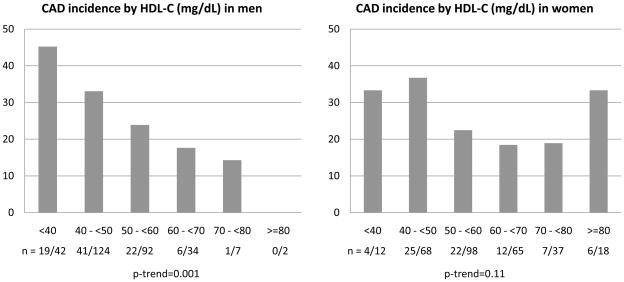
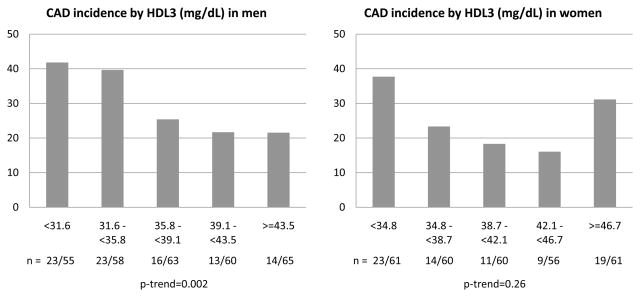
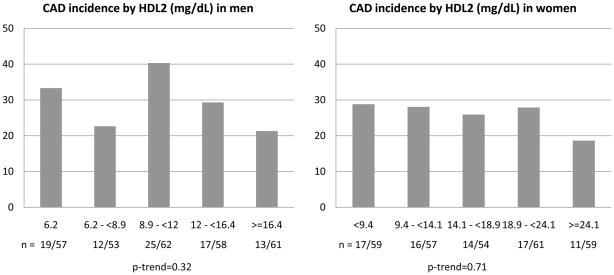
Results: During 18 years of follow-up, 29.5% of men and 25.5% of women developed CAD. Although a linear decrease in incidence was observed with increasing HDL-C concentration in men, incidence increased in women at less than 47 mg/dL and greater than 80 mg/dL. These patterns largely reflected the HDL3 cholesterol-CAD association. After multivariable adjustment, the linear, inverse, HDL-C/CAD association persisted in men (hazard ratio [HR] 0.97, 95% confidence interval [CI] 0.94-0.99); in women, the U-shaped relationship lost significance. HDL3 cholesterol remained multivariably associated with CAD in both men (linear association, P = .03) and women (HR 2.31 (95% CI 1.31-4.08) and HR 1.80 (95% CI 1.01-3.23) for the lowest and highest versus the middle quintiles, respectively).
Conclusion: The increased CAD risk in women for an HDL-C >80 mg/dL in type 1 diabetes merits further study. Gender specificity could not be determined as only two men had HDL-C >80 mg/dL.
Copyright © 2011 National Lipid Association. Published by Elsevier Inc. All rights reserved.
Conflict of interest statement
The authors declare no conflicts of interest related to this research paper
Figures
Comment in
-
High HDL and ATD.J Clin Lipidol. 2012 Jan-Feb;6(1):92. doi: 10.1016/j.jacl.2011.11.001. Epub 2011 Nov 20. J Clin Lipidol. 2012. PMID: 22264580 No abstract available.
References
-
- Barter PJ, Caulfield M, Eriksson M, Grundy SM, Kastelein JJ, Komajda M, Lopez-Sendon J, Mosca L, Tardif JC, Waters DD, Shear CL, Revkin JH, Buhr KA, Fisher MR, Tall AR, Brewer B ILLUMINATE Investigators. Effects of torcetrapib in patients at high risk for coronary events. N Engl J Med. 2007;357:2109–2122. - PubMed
-
- Kastelein JJ, van Leuven SI, Burgess L, Evans GW, Kuivenhoven JA, Barter PJ, Revkin JH, Grobbee DE, Riley WA, Shear CL, Duggan WT, Bots ML RADIANCE 1 Investigators. Effect of torcetrapib on carotid atherosclerosis in familial hypercholesterolemia. N Engl J Med. 2007;356:1620–1630. - PubMed
-
- Nissen SE, Tardif JC, Nicholls SJ, Revkin JH, Shear CL, Duggan WT, Ruzyllo W, Bachinsky WB, Lasala GP, Tuzcu EM ILLUSTRATE Investigators. Effect of torcetrapib on the progression of coronary atherosclerosis. N Engl J Med. 2007;356:1304–16. - PubMed
-
- Vergeer M, Bots ML, van Leuven SI, Basart DC, Sijbrands EJ, Evans GW, Grobbee DE, Visseren FL, Stalenhoef AF, Stroes ES, Kastelein JJ. Cholesteryl ester transfer protein inhibitor torcetrapib and off-target toxicity: a pooled analysis of the rating atherosclerotic disease change by imaging with a new CETP inhibitor (RADIANCE) trials. Circulation. 2008;118:2515–2522. - PubMed
-
- Nicholls SJ, Tuzcu EM, Brennan DM, Tardif JC, Nissen SE. Cholesteryl ester transfer protein inhibition, high-density lipoprotein raising, and progression of coronary atherosclerosis: insights from ILLUSTRATE (Investigation of Lipid Level Management Using Coronary Ultrasound to Assess Reduction of Atherosclerosis by CETP Inhibition and HDL Elevation) Circulation. 2008;118:2506–2514. - PubMed
Publication types
MeSH terms
Substances
Grants and funding
LinkOut - more resources
Full Text Sources
Medical
Miscellaneous
