. 2011 Oct 7;44(1):160-6.
doi: 10.1016/j.molcel.2011.06.037.

Acetylation regulates the stability of a bacterial protein: growth stage-dependent modification of RNase R

Affiliations

Acetylation regulates the stability of a bacterial protein: growth stage-dependent modification of RNase R

Wenxing Liang et al. Mol Cell. .

Abstract

RNase R, an Escherichia coli exoribonuclease important for degradation of structured RNAs, increases 3- to 10-fold under certain stress conditions, due to an increased half-life for this usually unstable protein. Components of the trans-translation machinery, tmRNA, and its associated protein, SmpB, are essential for RNase R instability. However, it is not understood why exponential phase RNase R is unstable or how it becomes stabilized in stationary phase. Here, we show that these phenomena are regulated by acetylation catalyzed by YfiQ protein. One residue, Lys544, is acetylated in exponential phase RNase R, but not in the stationary phase protein, resulting in tighter binding of tmRNA-SmpB to the C-terminal region of exponential phase RNase R and subsequent proteolytic degradation. Removal of the positive charge at Lys544 or a negative charge in the C-terminal region likely disrupts their interaction, facilitating tmRNA-SmpB binding. These findings indicate that acetylation can regulate the stability of a bacterial protein.


Figures

Figure 1
Figure 1
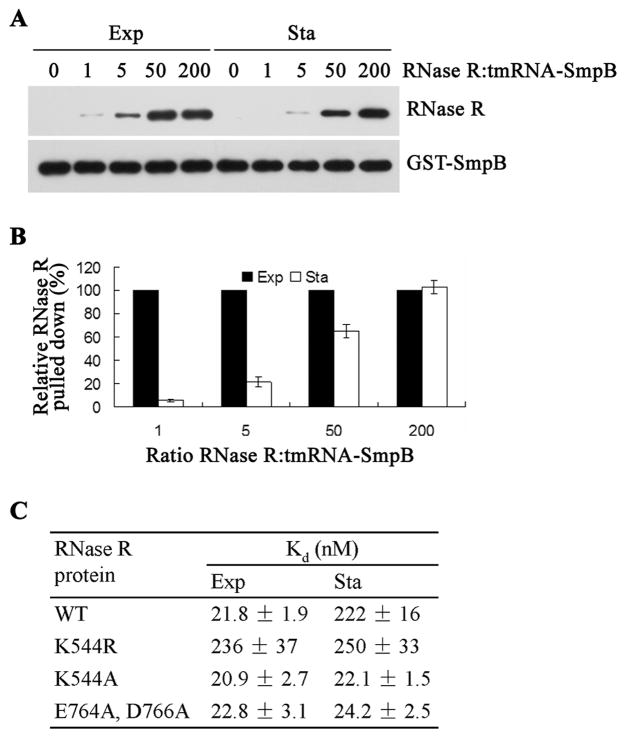
Binding of exponential phase (Exp) and stationary phase (Sta) RNase R to tmRNA-SmpB complex. (A) Increasing amounts of purified RNase R were mixed with a constant amount of GST-SmpB and tmRNA for pull-down assays as described in “Experimental Prodedures”. RNase R and GST-SmpB in the eluant from each pull-down were resolved on 8% SDS-PAGE and detected by purified RNase R antibody and anti-GST mAb, respectively. (B) Quantification of 3 independent experiments carried out as shown in Panel (A). The amount of exponential phase RNase R pulled-down was set at 100% for each amount of RNase R added, and the corresponding value for the stationary phase protein is shown. Error bars indicate SEM. (C) Binding of exponential or stationary phase RNase R to tmRNA-SmpB complex. The Kd values for the wild type or the mutant RNase R proteins were determined from data as in panel (A). The Kd values shown represent the mean of three independent experiments for WT and two for the mutant proteins. Kd values were calculated using only the two lowest ratios (1:1 and 5:1) of RNase R:tmRNA-SmpB from the concentrations of bound and free RNase R and tmRNA-SmpB.
Figure 2
Figure 2
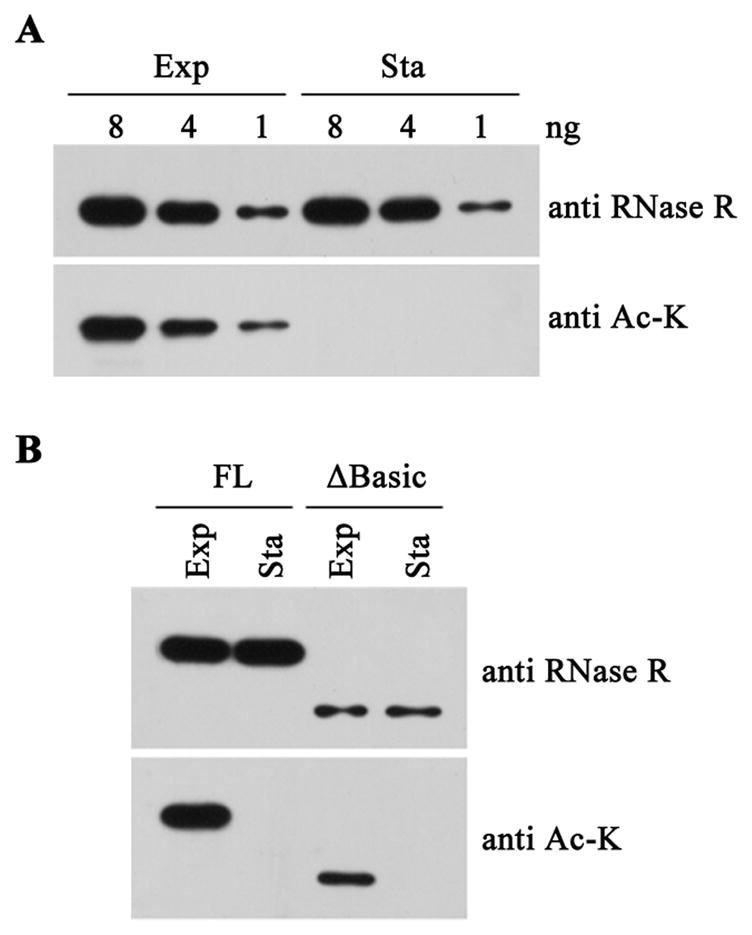
Structural analysis of exponential phase (Exp) and stationary phase (Sta) RNase R. (A) Immunological analysis for acetyl-lysine. Varying amounts of purified exponential and stationary phase RNase R were resolved on 8% SDS-PAGE and probed with RNase R antibody and anti acetylated-lysine monoclonal antibody (Ac-K). (B) Analysis of acetylation in C-terminal-truncated RNase R. Truncated RNase R (ΔBasic) was immunoprecipitated from extracts of exponential phase and stationary phase cells using purified RNase R antibody and then detected with RNase R antibody and anti acetylated-lysine monoclonal antibody, respectively, after separation on 8% SDS-PAGE. Purified full-length (FL) exponential and stationary phase RNase R were loaded as controls. Note that different amounts of RNase R were present in the FL purified protein lanes and the ΔBasic extract lanes. Shown are representative gels from experiments carried out twice.
Figure 3
Figure 3
Amount and stability of RNase R mutant proteins. (A) Amount of wild type (WT) and K544R mutant RNase R protein in exponential phase (Exp) and stationary phase (Sta) cells. (B) Half-life of wild type and K544R mutant RNase R in exponential and stationary phase cells. (C) Amount of wild type and K544A mutant RNase R protein in exponential phase and stationary phase cells. (D) Half-life of K544A mutant RNase R in exponential and stationary phase cells. (E) Amount of wild type and E764A, D766A mutant RNase R protein in exponential phase and stationary phase cells. (F) Half-life of E764A, D766A mutant RNase R in exponential and stationary phase cells. The indicated cells were grown in YT medium, treated with chloramphenicol and assayed for RNase R protein by immunoblotting as described in “Experimental Procedures”. For panels (A) through (F), 5 μg of total protein were added to each lane. (G) Acetylation analysis of RNase R mutant proteins. Equal amounts of purified exponential phase and stationary phase wild type, K544R, K544A and E764A, D766A mutant proteins (1 ng) were resolved on 8% SDS-PAGE and then probed with RNase R antibody and anti acetylated-lysine monoclonal antibody (Ac-K), respectively. Each gel shown in panels (A) through (G) is a representative experiment carried out at least twice.
Figure 4
Figure 4
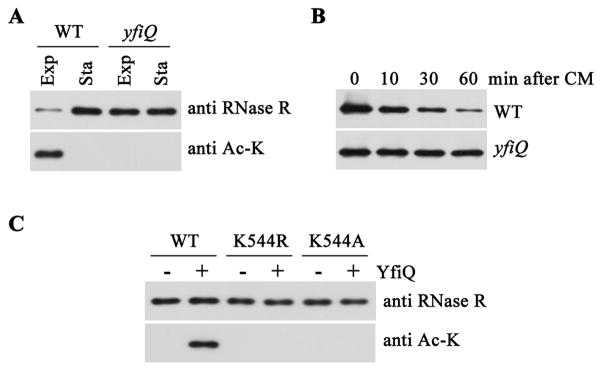
Acetylation of RNase R by YfiQ. (A) Amount (top panel) and acetylation (bottom panel) of RNase R in wild type and yfiQ mutant strains. Exponential (Exp) and stationary (Sta) phase cells were lysed and subjected to immunoprecipitation with RNase R antibody. Precipitates were then analyzed by immunoblotting using RNase R antibodies or anti acetylated-lysine monoclonal antibody (Ac-K). (B) Half-life of RNase R in wild type and yfiQ mutant strains. Cells were grown in YT medium to exponential phase, and the half-life of RNase R was determined as in Figure 3. Five μg of total protein was added to each lane in panels (A) and (B). (C) YfiQ directly acetylates RNase R in vitro. Purified stationary phase WT, K544R or K544A mutant RNase R proteins (50 ng) were incubated with or without 50 ng of purified YfiQ. Products were then analyzed by immunoblotting using RNase R antibodies or anti acetylated-lysine monoclonal antibody. Each gel shown is a representative experiment carried out twice.

References

    1. Andrade JM, Cairrão F, Arraiano CM. RNase R affects gene expression in stationary phase: Regulation of ompA. Mol Microbiol. 2006;60:219–228. - PubMed
    1. Andrade JM, Pobre V, Silva IJ, Domingues S, Arraiano CM. The role of 3′-5′ exoribonucleases in RNA degradation. Prog Mol Biol Transl Sci. 2009;85:187–229. - PubMed
    1. Blander G, Guarente L. The Sir2 family of protein deacetylases. Annu Rev Biochem. 2004;73:417–435. - PubMed
    1. Bordone L, Guarente L. Calorie restriction, SIRT1 and metabolism: understanding longevity. Nat Rev Mol Cell Biol. 2005;6:298–305. - PubMed
    1. Cairrão F, Cruz A, Mori H, Arraiano CM. Cold shock induction of RNase R and its role in the maturation of the quality control mediator SsrA/tmRNA. Mol Microbiol. 2003;50:1349–1360. - PubMed

Publication types

LinkOut - more resources