. 2011 Oct 4;9(4):366-73.
doi: 10.1016/j.stem.2011.07.018.

Genome sequencing of mouse induced pluripotent stem cells reveals retroelement stability and infrequent DNA rearrangement during reprogramming

Affiliations

Genome sequencing of mouse induced pluripotent stem cells reveals retroelement stability and infrequent DNA rearrangement during reprogramming

Aaron R Quinlan et al. Cell Stem Cell. .

Abstract

The biomedical utility of induced pluripotent stem cells (iPSCs) will be diminished if most iPSC lines harbor deleterious genetic mutations. Recent microarray studies have shown that human iPSCs carry elevated levels of DNA copy number variation compared with those in embryonic stem cells, suggesting that these and other classes of genomic structural variation (SV), including inversions, smaller duplications and deletions, complex rearrangements, and retroelement transpositions, may frequently arise as a consequence of reprogramming. Here we employ whole-genome paired-end DNA sequencing and sensitive mapping algorithms to identify all classes of SV in three fully pluripotent mouse iPSC lines. Despite the improved scope and resolution of this study, we find few spontaneous mutations per line (one or two) and no evidence for endogenous retroelement transposition. These results show that genome stability can persist throughout reprogramming, and argue that it is possible to generate iPSCs lacking gene-disrupting mutations using current reprogramming methods.


Figures

Figure 1
Figure 1. Structural variant detection
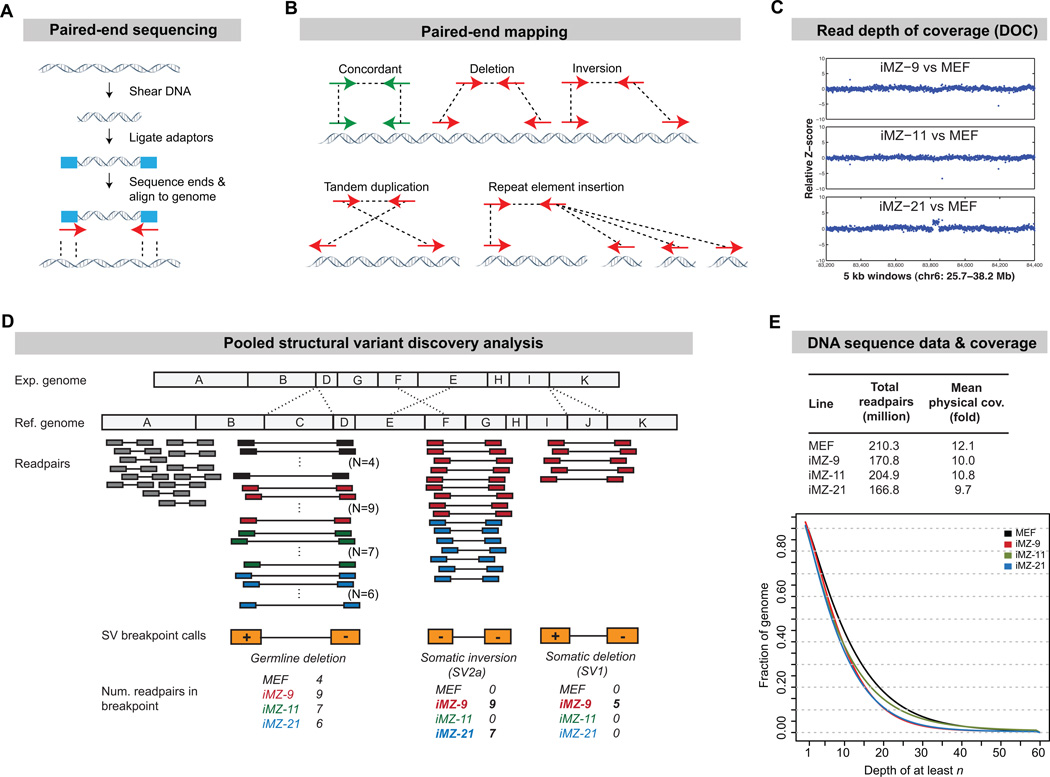
(A) Schematic of Illumina paired-end DNA sequencing. (B) Breakpoint detection by PEM. Most readpairs are concordant (green) and map to the reference genome with the expected size and orientation (arrows), but readpairs that span SV breakpoints map in "discordant" fashion (red). Each breakpoint class yields a distinctive pattern. (C) CNV detection by read depth of coverage analysis (DOC). DOC uses local read depth to measure DNA copy number in a manner that is analogous to array-CGH. Shown is 12.5 mb region that harbors the lone de novo CNV identified by DOC. Each data point is a 5 kb window, shown in genome order (X-axis), and DNA copy number is expressed as the Z-score (Y-axis) of the indicated iPSC line relative to the donor MEF sample. Note that iMZ-21 clearly shows a 358 kb duplication (SV3) relative to the MEF sample (D) A multi-sample PEM method using pooled data. A hypothetical region from an experimental genome (Exp.) is shown above the reference genome (Ref.). In this schematic segment C is deleted, E and F are inverted and J is deleted. HYDRA screens for clusters of discordant readpairs (colored) that support the same breakpoint. Germline SVs will be present in all four lines. De novo SVs will be present in a subset of iPSC lines. With our method, the 4 samples are combined into a single HYDRA analysis and breakpoint “genotypes” are inferred from the number of readpairs contributed by each. The origin of each readpair is indicated by its color, which corresponds to the colors of the labeled samples below. Shown are SV1, SV2a and one germline variant. (E) The total number of readpairs and genome coverage collected for each strain (top) and a plot showing the fraction of the genome in each line having greater than or equal to various levels of physical coverage.
Figure 2
Figure 2. iPSC lineages
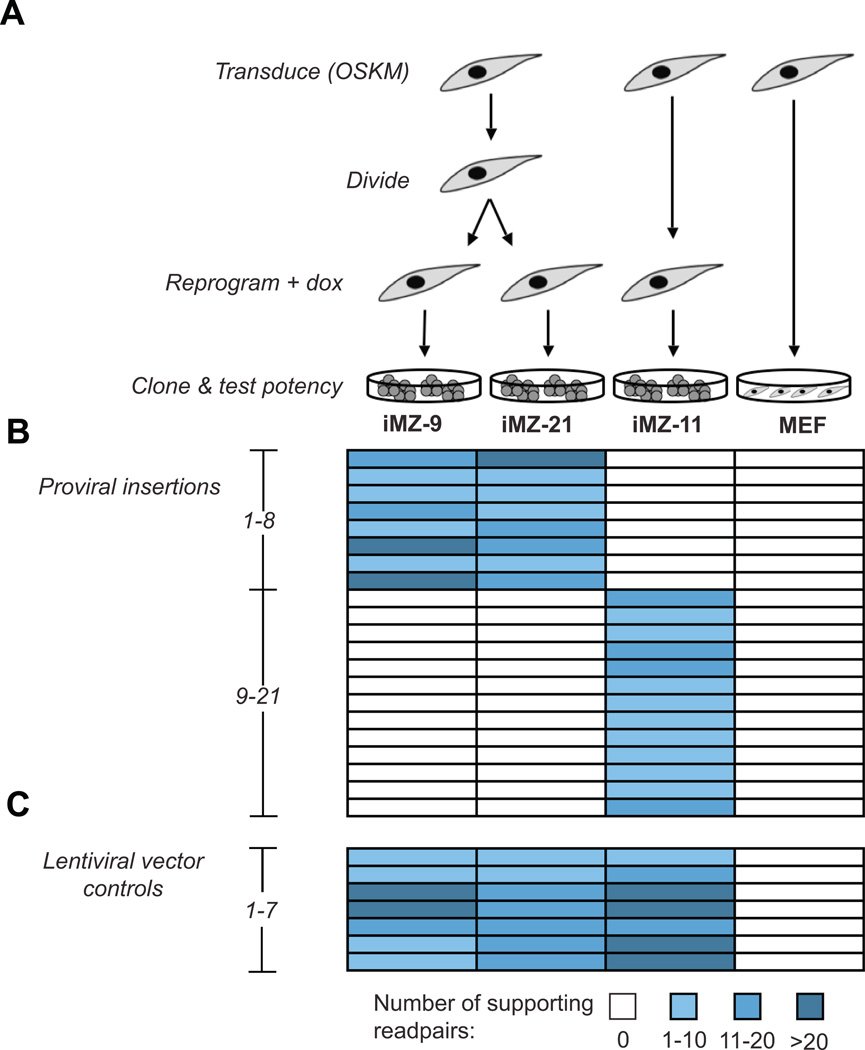
(A) iPSC lineages. MEFs were transduced with five lentiviruses encoding the four reprogramming factors and a drug inducible transcriptional activator (rTTAM2.2). After viral transduction MEFs were split and allowed to divide one time prior to induction of reprogramming. This scheme produces clonally transduced fibroblasts that undergo different reprogramming events and produce distinct iPSC lines. (B) The patterns of proviral integration events identified by HYDRA demonstrate that iMZ-9 and iMZ-21 have identical proviral insertions while iMZ-11 is distinct. Thus, iMZ-9 and iMZ-21 are derived from the same original fibroblast cell. Genomic differences between these lines represent post-transduction changes while shared SVs likely represent somatic mutations present in the donor cell. (C) Positive control “variant” calls resulting from the structure of the lentiviral vectors. The vectors contain the 4 reprogramming genes. The junctions between vector and transgene sequences manifest as 4 SVs. In addition, 3 of the 4 transgenes lack introns relative to the their copies in the reference genome, which produces 3 control variants.
Figure 3
Figure 3. SVs arise prior to and during reprogramming and contribute to tissues
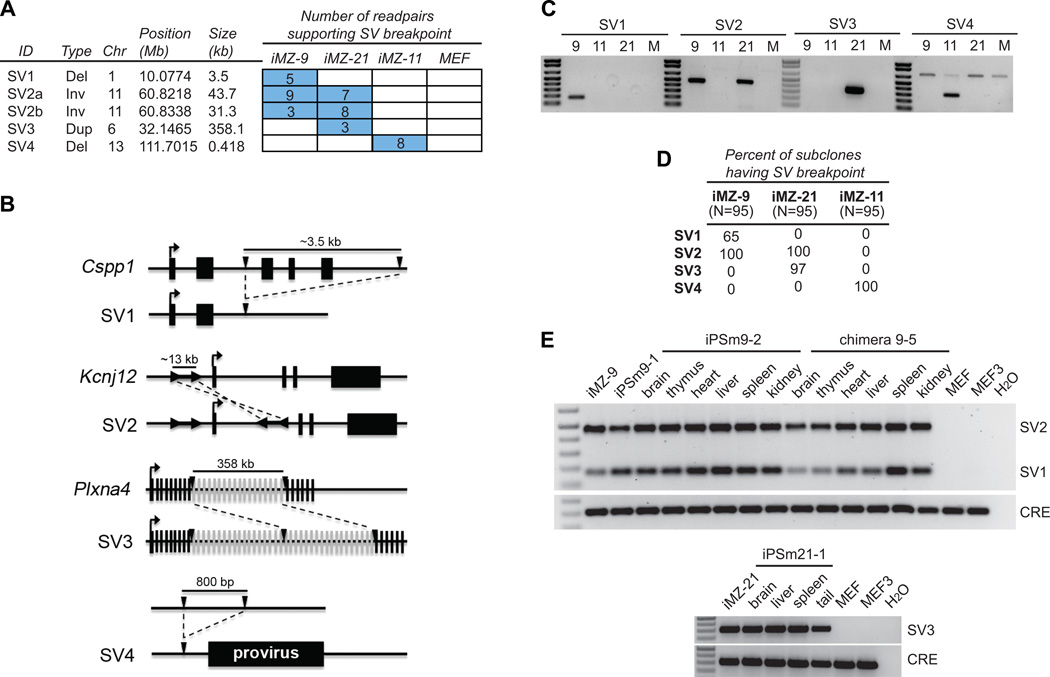
(A) The number of supporting readpairs per breakpoint call are indicated by the numbers in the boxes. The table at left describes the type, size and location of each SV and associated breakpoint. (B) Schematic diagrams of SV1-4. Three of four SVs interrupt genic regions. Black lines denote non-exonic DNA and black or gray boxes represent exons or the proviral insertion near SV4. Transcription start sites are denoted by arrows above exons. Breakpoints are denoted by inverted black triangles for SV1,3 and 4 and by the black arrows flanking the inverted duplication in SV2. The schematics are not to scale but the size of each region is shown. Dashed lines indicate the change between the wild type and mutated chromosome. (C) PCR confirmation of 3 SVs. Primers were designed to amplify breakpoint-spanning PCR products that produce a unique band in the line(s) harboring the SV. (D) The percentage of 95 iPSC subclones for each line that are positive for a given SV by PCR assays. (E) Tissues from iPSC mice (iPSm 9-1, 9-2 and iPSm 21-1) and a chimeric mouse with iMZ-9 contribution were examined for the presence of SV1-2 (upper panel) and SV3 (lower panel). All SVs are present in all tested tissues, but not the parental MEFs (MEF) or those harvested at the same time from a sibling embryo (MEF3). PCR for the Cre recombinase gene (CRE) present in the iMZ iPSCs serves as a control for iPSC contribution.
Figure 4
Figure 4. Analysis of repetitive element insertions
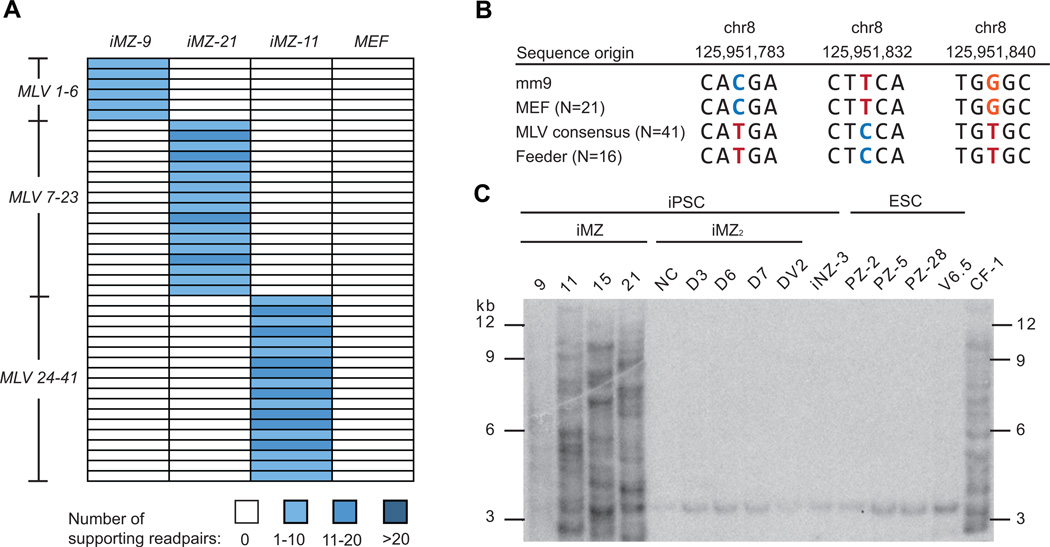
(A) No endogenous transposon insertions were detected, however, multiple MLV insertions were apparent in each iPSC line. The 41 MLV insertions are shown in a heatmap, following the conventions outlined in Figure 1. Since each MLV insertion is private to a given cell line, they occurred during or after reprogramming. (B) A portion of the MLV element was amplified by PCR and individual clones were sequenced and analyzed for diagnostic SNPs. Non-reference genome (mm9) alleles are found in the MLV consensus sequence, which was assembled from 41 MLV copies present in the iPSC lines, and in the CF-1 feeder cells (“feeder”), which demonstrates that the additional iPSC MLV copies originate from the feeders. (C) MLV Southern blot analysis of iPSCs and ESCs. A PCR fragment was used to probe DNA isolated from iMZ iPSCs and iPSCs derived by the same method on different lots of feeders (iMZ2 and iMZ3) as well as ESCs derived on CF-1 feeders. The CF-1 primary MEFs used to generate feeders contain multiple copies of the MLV element as do the iMZ iPSCs, but the other iPSCs and ESCs possess only the chr8 band.

References

    1. Akagi K, Li J, Stephens RM, Volfovsky N, Symer DE. Extensive variation between inbred mouse strains due to endogenous L1 retrotransposition. Genome Res. 2008;18:869–880. - PMC - PubMed
    1. Asiedu M, Wu D, Matsumura F, Wei Q. Centrosome/spindle pole-associated protein regulates cytokinesis via promoting the recruitment of MyoGEF to the central spindle. Molecular biology of the cell. 2009;20:1428–1440. - PMC - PubMed
    1. Beck CR, Collier P, Macfarlane C, Malig M, Kidd JM, Eichler EE, Badge RM, Moran JV. LINE-1 retrotransposition activity in human genomes. Cell. 2010;141:1159–1170. - PMC - PubMed
    1. Bentley DR, Balasubramanian S, Swerdlow HP, Smith GP, Milton J, Brown CG, Hall KP, Evers DJ, Barnes CL, Bignell HR, et al. Accurate whole human genome sequencing using reversible terminator chemistry. Nature. 2008;456:53–59. - PMC - PubMed
    1. Boland MJ, Hazen JL, Nazor KL, Rodriguez AR, Gifford W, Martin G, Kupriyanov S, Baldwin KK. Adult mice generated from induced pluripotent stem cells. Nature. 2009;461:91–94. - PubMed

Publication types

MeSH terms