Review
. 2011 Sep-Oct;2(5):358-69.
doi: 10.4161/nucl.2.5.17860. Epub 2011 Sep 1.

Roles of chromatin insulator proteins in higher-order chromatin organization and transcription regulation

Affiliations
Review

Roles of chromatin insulator proteins in higher-order chromatin organization and transcription regulation

Jutta Vogelmann et al. Nucleus. 2011 Sep-Oct.

Abstract

Eukaryotic chromosomes are condensed into several hierarchical levels of complexity: DNA is wrapped around core histones to form nucleosomes, nucleosomes form a higher-order structure called chromatin, and chromatin is subsequently compartmentalized in part by the combination of multiple specific or unspecific long-range contacts. The conformation of chromatin at these three levels greatly influences DNA metabolism and transcription. One class of chromatin regulatory proteins called insulator factors may organize chromatin both locally, by setting up barriers between heterochromatin and euchromatin, and globally by establishing platforms for long-range interactions. Here, we review recent data revealing a global role of insulator proteins in the regulation of transcription through the formation of clusters of long-range interactions that impact different levels of chromatin organization.


Figures
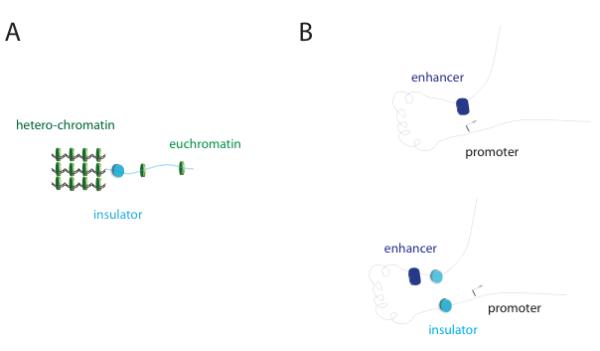
Figure 1
Figure 1. Insulator mechanisms
A) Barrier insulators (cyan cylinder) physically confine heterochromatin regions (condensed green discs, left) to avoid their spreading to parts of the genome that have to be actively expressed (sparse green discs, right); B) enhancer-blocker insulators (cyan cylinder) positioned between an enhancer (blue) and a promoter (arrow) affect gene expression by avoiding that these two regions get in close contact (left: enhancer contacts promoter, right: insulator prevents enhancer-promoter interactions).
Figure 2
Figure 2. Enhancer-blocking activity and long-range interactions
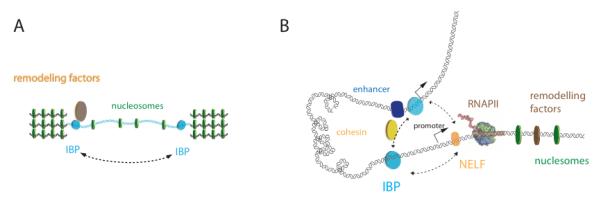
(A) The barrier activity of insulators depend on local chromatin structure (nucleosomes, green disks) and on interactions of IBPs with chromatin remodeling factors (brown disk). (B) The enhancer blocking activity may depend on long-range interactions between insulators, mediated by insulator binding proteins (IBP, cyan cylinders). Alternatively, long-range interactions may occur between insulator sequences and RNAPII complexes (atomic model) that are paused upon NELF (orange circle) recruitment. These interactions may involve co-factors such as i.e. cohesin (yellow circle).
Figure 3
Figure 3. Insulator bodies
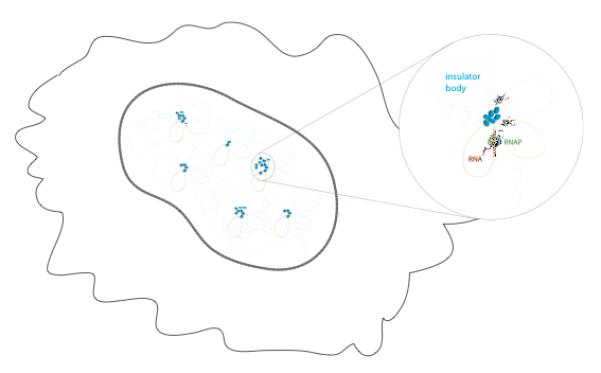
Several insulator bodies are assembled in the nucleus (solid line) of a cell (membrane as thin wiggly line). An insulator body (top right) consists of a clustering of chromatin loops held together through a network of interactions between IPBs and related factors and involve the formation of higher-order long-range interactions and the co-regulation of multiple genes. Different insulator bodies may regulate distinct gene ontologies, and they may thus vary in size (represented in figure by a different number of IBPs).

References

    1. Elgin SC, Grewal SI. Heterochromatin: silence is golden. Curr Biol. 2003;13:R895–8. - PubMed
    1. Probst AV, Dunleavy E, Almouzni G. Epigenetic inheritance during the cell cycle. Nat Rev Mol Cell Biol. 2009;10:192–206. - PubMed
    1. Sexton T, Bantignies F, Cavalli G. Genomic interactions: chromatin loops and gene meeting points in transcriptional regulation. Semin Cell Dev Biol. 2009;20:849–55. - PubMed
    1. Chang HY, Cuvier O, Dekker J. Gene dates, parties and galas. Symposium on Chromatin Dynamics and Higher Order Organization. EMBO Rep. 2009;10:689–93. - PMC - PubMed
    1. Mechali M. Eukaryotic DNA replication origins: many choices for appropriate answers. Nat Rev Mol Cell Biol. 2010;11:728–38. - PubMed

Publication types

LinkOut - more resources