


Serum concentrations of organochlorine pesticides and growth among Russian boys
- PMID: 21984531
- PMCID: PMC3279441
- DOI: 10.1289/ehp.1103743
Serum concentrations of organochlorine pesticides and growth among Russian boys
Abstract
Background: Limited human data suggest an association of organochlorine pesticides (OCPs) with adverse effects on children's growth.
Objective: We evaluated the associations of OCPs with longitudinally assessed growth among peripubertal boys from a Russian cohort with high environmental OCP levels.
Methods: A cohort of 499 boys enrolled in the Russian Children's Study between 2003 and 2005 at 8-9 years of age were followed prospectively for 4 years. At study entry, 350 boys had serum OCPs measured. Physical examinations were conducted at entry and annually. The longitudinal associations of serum OCPs with annual measurements of body mass index (BMI), height, and height velocity were examined by multivariate mixed-effects regression models for repeated measures, controlling for potential confounders.
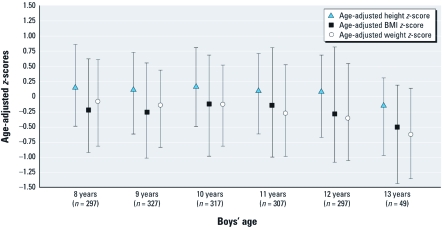
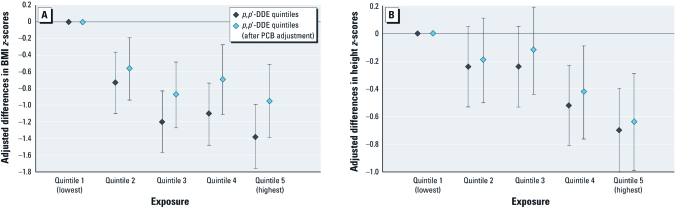
Results: Among the 350 boys with OCP measurements, median serum hexachlorobenzene (HCB), β-hexachlorocyclohexane (βHCH), and p,p´-dichlorodiphenyldichloroethylene (p,p´-DDE) concentrations were 159 ng/g lipid, 168 ng/g lipid, and 287 ng/g lipid, respectively. Age-adjusted BMI and height z-scores generally fell within the normal range per World Health Organization standards at entry and during follow-up. However, in adjusted models, boys with higher serum HCB, βHCH, and p,p´-DDE had significantly lower mean [95% confidence interval (CI)] BMI z-scores, by -0.84 (-1.23, -0.46), -1.32 (-1.70, -0.95), and -1.37 (-1.75, -0.98), respectively, for the highest versus lowest quintile. In addition, the highest quintile of p,p´-DDE was associated with a significantly lower mean (95% CI) height z-score, by -0.69 (-1.00, -0.39) than that of the lowest quintile.
Conclusions: Serum OCP concentrations measured at 8-9 years of age were associated with reduced growth, particularly reduced BMI, during the peripubertal period, which may affect attainment of optimal adult body mass and height.
Conflict of interest statement
The opinions expressed in this article are those of the authors and do not necessarily reflect the official opinion of the Centers for Disease Control and Prevention.
L.A. is employed by Environmental Health and Engineering, Inc. (Needham, MA, USA). D.G.P. is employed by Axys Analytical Solutions (Sidney, BC, Canada), EnviroSolutions Consulting, Inc. (Auburn, GA, USA), Exponent, Inc. (Maynard, MA, USA), and Fluid Management Systems (Boston, MA, USA). The other authors declare they have no actual or potential competing financial interests.
Figures
References
-
- Barr JR, Maggio VL, Barr DB, Turner WE, Sjodin A, Sandau CD, et al. New high-resolution mass spectrometric approach for the measurement of polychlorinated biphenyls and organochlorine pesticides in human serum. J Chromatogr B. 2003;794(1):137–148. - PubMed
-
- Carrizo D, Grimalt JO, Ribas-Fito N, Sunyer J, Torrent M. Physical-chemical and maternal determinants of the accumulation of organochlorine compounds in four-year-old children. Environ Sci Technol. 2006;40(5):1420–1426. - PubMed
-
- CDC (Centers for Disease Control and Prevention) Growth Charts. 2009. Available: http://www.cdc.gov/growthcharts/zscore.htm [accessed 22 June 2011]
Publication types
MeSH terms
Substances
Grants and funding
LinkOut - more resources
Full Text Sources
Medical