. 2012 Jan;63(1):229-39.
doi: 10.1093/jxb/err275. Epub 2011 Oct 6.

Translocation and the alternative D-galacturonate pathway contribute to increasing the ascorbate level in ripening tomato fruits together with the D-mannose/L-galactose pathway

Affiliations

Translocation and the alternative D-galacturonate pathway contribute to increasing the ascorbate level in ripening tomato fruits together with the D-mannose/L-galactose pathway

Adebanjo Ayobamidele Badejo et al. J Exp Bot. 2012 Jan.

Abstract

The D-mannose/L-galactose pathway for the biosynthesis of vitamin C (L-ascorbic acid; AsA) has greatly improved the understanding of this indispensable compound in plants, where it plays multifunctional roles. However, it is yet to be proven whether the same pathway holds for all the different organs of plants, especially the fruit-bearing plants, at different stages of development. Micro-Tom was used here to elucidate the mechanisms of AsA accumulation and regulation in tomato fruits. The mRNA expression of the genes in the D-mannose/L-galactose pathway were inversely correlated with increasing AsA content of Micro-Tom fruits during ripening. Feeding L-[6-(14)C]AsA to Micro-Tom plants revealed that the bulk of the label from AsA accumulated in the source leaf was transported to the immature green fruits, and the rate of translocation decreased as ripening progressed. L-Galactose feeding, but neither D-galacturonate nor L-gulono-1,4-lactone, enhanced the content of AsA in immature green fruit. On the other hand, L-galactose and D-galacturonate, but not L-gulono-1,4-lactone, resulted in an increase in the AsA content of red ripened fruits. Crude extract prepared from insoluble fractions of green and red fruits showed D-galacturonate reductase- and aldonolactonase-specific activities, the antepenultimate and penultimate enzymes, respectively, in the D-galacturonate pathway, in both fruits. Taken together, the present findings demonstrated that tomato fruits could switch between different sources for AsA supply depending on their ripening stages. The translocation from source leaves and biosynthesis via the D-mannose/L-galactose pathway are dominant sources in immature fruits, while the alternative D-galacturonate pathway contributes to AsA accumulation in ripened Micro-Tom fruits.


Figures
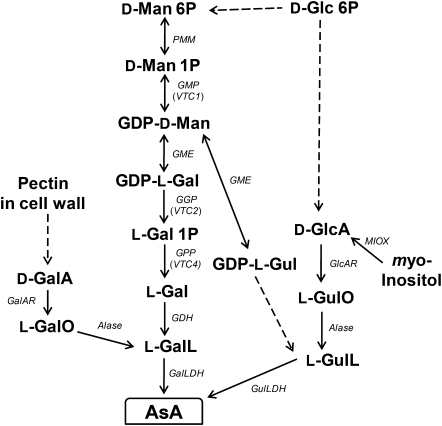
Fig. 1.
Fig. 1.
A network for the biosynthesis of AsA. L-GaL, L-galactose; L-GalO, L-galactonic acid; D-GalA, D-galacturonic acid; L-GalL, L-galactono-1,4-lactone; D-Glc, D-glucose; D-GlcA, D-glucuronate; L-Gul, L-gulose; L-GulO, L-gulonate; L-GulL, L-gulono-1,4- lactone; D-Man, D-mannose. Enzymes catalysing the reactions are: Alase, aldonolactonase; GalLDH, L-galactono-1,4-lactone dehydrogenase; GalAR, D-galacturonate reductase; GDH, L-galactose dehydrogenase; GlcAR, D-glucuronate reductase; GME, GDP-D-mannose -3',5'-epimerase; GulLDH, L-gulono-1,4-lactone dehydrogenase; MIOX, myo-inositol oxygenase; PMM, phosphomannomutase; GMP, GDP-D-mannose pyrophosphorylase; GGP, GDP-L-galactose phosphorylase; GPP, L-galactose 1-P phosphatase. Broken arrows show more than one enzymatic reaction step.
Fig. 2.
Fig. 2.
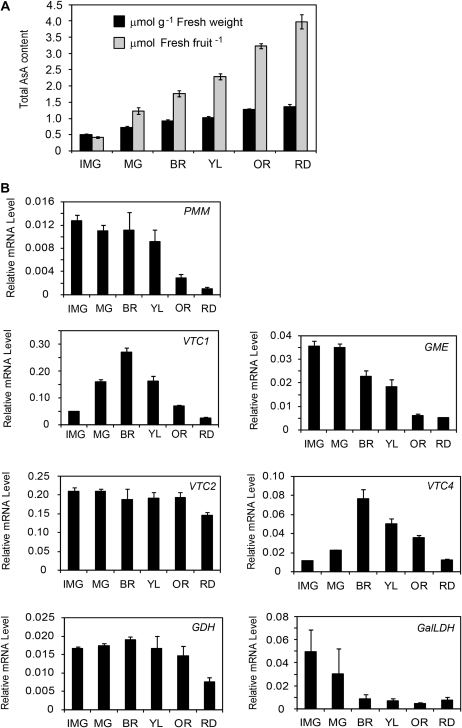
The AsA content and expression of AsA biosynthesis genes in Micro-Tom fruits during ripening. (A) Fruits were harvested at six different stages of ripening: immature green (IMG), mature green (MG), breaker (BR), yellow (YL), orange (OR), and red (RD), and the total AsA content measured as μmol per fresh fruit and μmol per gram fresh weight. (B) The expression levels of the genes in the D-Man/l-Gal pathway for AsA biosynthesis. Total RNAs were isolated from the fruits above and transcribed into cDNA for use as template in the real-time PCR; the results were normalized to the expression of EF1α. Values are the mean ±SE (n=3).
Fig. 3.
Fig. 3.
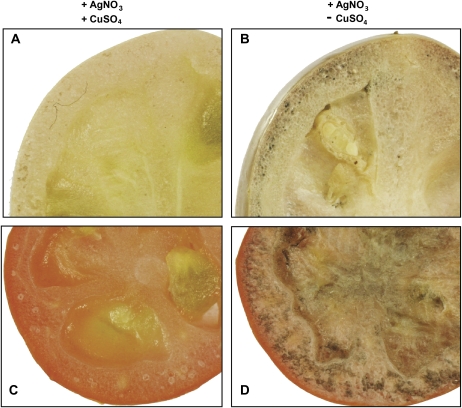
Localization of AsA within Micro-Tom fruits. The control images of green (A) and red (C) fruits pre-treated with 5% CuSO4·5H2O and the methanolic AgNO3 stains showing dark patches around the membrane of the green (B) and red (D) fruits. The pictures shown are representative of three repetitions.
Fig. 4.
Fig. 4.
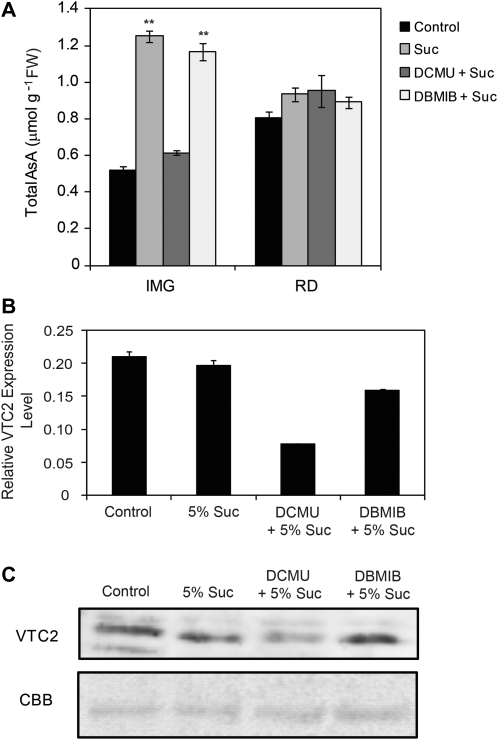
Effect of inhibitors of photosynthetic electron transport, DCMU and DBMIB, and sucrose feeding on AsA levels. Fruits were treated with 10 μM of either DCMU or DBMIB, first in the dark for 30 min and then in the light for 3 h followed by subsequent transfer of the fruits to 5% sucrose solution for the next 48 h under continuous light. (A) The total AsA content of the immature green (IMG) and ripened red (RD) treated fruits. Values are the mean ±SE (n=3). The statistical significance of AsA was compared with the control (fed with water) fruits using the t-test, **P <0.01. (B) The transcript level of the VTC2 gene in the IMG fruits subjected to different treatments. The transcript levels were normalized to EF1α. (C) VTC2 protein content determined by immunoblot of 1 mg of protein from immature green fruits treated as described above. The Coomassie Brilliant Blue R250 (CBB) stain is shown as a loading control.
Fig. 5.
Fig. 5.
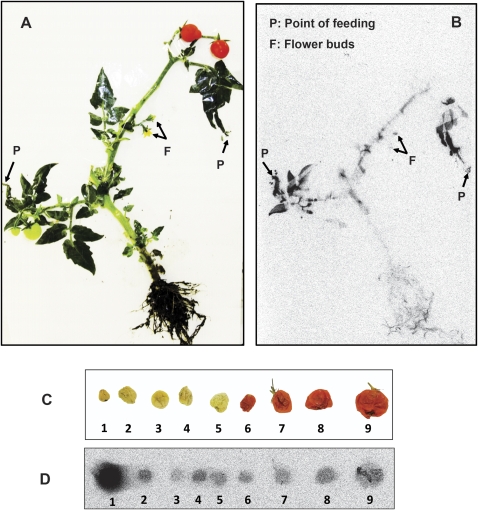
AsA translocation in a fruit-bearing Micro-Tom plant. The whole plant (A) and its autoradiograph (B) showing the distribution of labelled L-[6-14C]AsA after 24 h. The fruits were cut off before autoradiography of the whole plant so that the distribution could be viewed without distortion. Label from L-[6-14C]AsA was transported to the fruits, developing flowers, and roots, but not the source leaves. Tomato fruits (C) were dried in the oven at 55 °C for 8 h to minimize the flow of juice out of the fruits, before being exposed to Fuji film and autoradiographed (D) after 24 h of labelling with L-[6-14C]AsA. 1, Immature green fruit; 2–5, mature green fruits; and 6–9, mature red fruits. The pictures shown are representative of three repetitions.
Fig. 6.
Fig. 6.
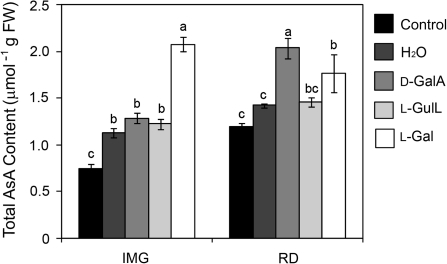
Effect of feeding D-Man/l-Gal and alternative pathway precursors to Micro-Tom fruits. The immature green fruits (IMG) and red fruits (RD) were fed with 5 mM L-GaL, D-GalA, or L-GulL and incubated under light (100 μmol photons m−2 s−1) for 24 h. The AsA content of the fruits at the start of the feeding experiment was used as control. Values are the mean ±SE (n=3). Different letters are used to show means that differ significantly (P <0.05).

References

    1. Agius F, Gonzalez-Lamonthe R, Caballero JL, Munoz-Blanco J, Botella MA, Valpuesta V. Engineering increased vitamin C levels in plants by over-expression of a D-galacturonic acid reductase. Nature Biotechnology. 2003;21:177–181. - PubMed
    1. Aoki K, Yano K, Suzuki A, et al. Large-scale analysis of full-length cDNAs from the tomato (Solanum lycopersicum) cultivar Micro-Tom, a reference system for the Solanaceae genomics. BMC Genomics. 2010;11:210. - PMC - PubMed
    1. Badejo AA, Fujikawa Y, Esaka M. Gene expression of ascorbic acid biosynthesis related enzymes of the Smirnoff–Wheeler pathway in acerola (Malpighia glabra) Journal of Plant Physiology. 2009;166:652–660. - PubMed
    1. Barth C, Moeder W, Klessig DF, Conklin PL. The timing of senescence and response to pathogens is altered in the ascorbate-deficient Arabidopsis mutant vitamin C-1. Plant Physiology. 2004;134:1784–1792. - PMC - PubMed
    1. Bulley SM, Rassam M, Hoser D, Otto W, Schunemann N, Wright M, MacRae E, Gleave A, Laing W. Gene expression studies in kiwifruit and gene over-expression in Arabidopsis indicates that GDP-L-galactose guanyltransferase is a major control point of vitamin C biosynthesis. Journal of Experimental Botany. 2009;60:765–778. - PMC - PubMed

Publication types