


Effects of anxiety on the long-term course of depressive disorders
- PMID: 21984801
- PMCID: PMC3290796
- DOI: 10.1192/bjp.bp.110.081992
Effects of anxiety on the long-term course of depressive disorders
Abstract
Background: It is well established that the presence of prominent anxiety within depressive episodes portends poorer outcomes. Important questions remain as to which anxiety features are important to outcome and how sustained their prognostic effects are over time.
Aims: To examine the relative prognostic importance of specific anxiety features and to determine whether their effects persist over decades and apply to both unipolar and bipolar conditions.
Method: Participants with unipolar (n = 476) or bipolar (n = 335) depressive disorders were intensively followed for a mean of 16.7 years (s.d. = 8.5).
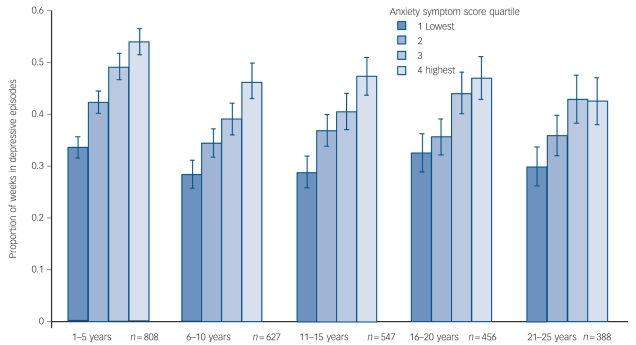
Results: The number and severity of anxiety symptoms, but not the presence of pre-existing anxiety disorders, showed a robust and continuous relationship to the subsequent time spent in depressive episodes in both unipolar and bipolar depressive disorder. The strength of this relationship changed little over five successive 5-year periods.
Conclusions: The severity of current anxiety symptoms within depressive episodes correlates strongly with the persistence of subsequent depressive symptoms and this relationship is stable over decades.
Conflict of interest statement
A.C.L. has served on Data Safety Monitoring Boards for AstraZeneca, Dainippon Sumitomo Pharma America, Pfizer, Merck, Neuronetics and Vanda, and served as a consultant to the FDA, NIMH, Avera, Cyberonics, Eli Lilly, Schering Plough and Takeda. M.B.K. has received honoraria from and/or served as a consultant or on advisory boards with: Abbott, CENEREX, Cephalon, Cypress Bioscience, Cyberonics, Forest Laboratories, Medtronic, Organon, Neuronetics, Novartis, Pfizer, Solvay, Wyeth, Shire; he has received great support from Pfizer and Wyeth.
Figures
Comment in
-
Comorbid anxiety and depression: bête noire or quick fix?Br J Psychiatry. 2012 Mar;200(3):179-81. doi: 10.1192/bjp.bp.111.097022. Br J Psychiatry. 2012. PMID: 22383763 Free PMC article.
References
-
- Henry C, Van den Bulke D, Bellivier F, Etain B, Rouillon F, Leboyer M. Anxiety disorders in 318 bipolar patients: prevalence and impact on illness severity and response to mood stabilizer. J Clin Psychiatry 2003; 64: 331–5 - PubMed
-
- Fava M, Rush AJ, Alpert JE, Balasubramani GK, Wisniewski SR, Carmin CN, et al. Difference in treatment outcome in outpatients with anxious versus nonanxious depression: a STAR*D report. Am J Psychiatry 2008; 165: 342–51 - PubMed
-
- Fava M, Uebelacker LA, Alpert JE, Nierenberg AA, Pava JA, Rosenbaum JF. Major depressive subtypes and treatment response. Biol Psychiatry 1997; 42: 568–76 - PubMed
-
- Feske U, Frank E, Kupfer DJ, Shear MK, Weaver E. Anxiety as a predictor of response to interpersonal psychotherapy for recurrent major depression: an exploratory investigation. Depress Anxiety 1998; 8: 135–41 - PubMed
-
- Feske U, Frank E, Mallinger AG, Houck PR, Fagiolini A, Shear MK, et al. Anxiety as a correlate of response to the acute treatment of bipolar I disorder. Am J Psychiatry 2000; 157: 956–62 - PubMed
Publication types
MeSH terms
Grants and funding
LinkOut - more resources
Full Text Sources
Other Literature Sources
Medical
