. 2011 Sep;6(9):1045-1058.
doi: 10.2217/fvl.11.76.

Oncolytic poliovirus against malignant glioma

Affiliations

Oncolytic poliovirus against malignant glioma

Christian Goetz et al. Future Virol. 2011 Sep.

Abstract

In cancerous cells, physiologically tight regulation of protein synthesis is lost, contributing to uncontrolled growth and proliferation. We describe a novel experimental cancer therapy approach based on genetically recombinant poliovirus that targets an intriguing aberration of translation control in malignancy. This strategy is based on the confluence of several factors enabling specific and efficacious cancer cell targeting. Poliovirus naturally targets the vast majority of ectodermal/neuroectodermal cancers expressing its cellular receptor. Evidence from glioblastoma patients suggests that the poliovirus receptor is ectopically upregulated on tumor cells and may be associated with stem cell-like cancer cell populations and proliferating tumor vasculature. We exploit poliovirus' reliance on an unorthodox mechanism of protein synthesis initiation to selectively drive viral translation, propagation and cytotoxicity in glioblastoma. PVSRIPO, a prototype nonpathogenic poliovirus recombinant, is scheduled to enter clinical investigation against glioblastoma.


Figures
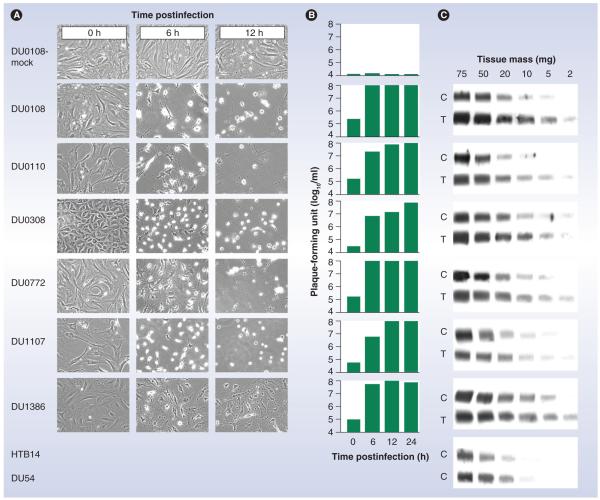
Figure 1
Figure 1. Expression of nectin-like molecule-5 in glioblastoma
(A) A panel of six primary-explant glioblastoma (GBM) cultures were infected with PVSRIPO and images of the infected cultures were acquired at the indicated time points of hours postinfection. At a total of 12 h postinfection, all cells were lysed in all samples. The cytopathic effects of PVSRIPO in laboratory glioma cell lines (e.g., HTB14 or DU54) have been reported previously (Figure 5D) [26,27]. (B) Quantification of PVSRIPO levels in infected cultures indicates proficient propagation of the virus in infected primary-explant GBM cells. (C) Immunoblot analyses of nectin-like molecule-5 in homogenates obtained from primary explant cells (C) or in homogenates from GBM tissues directly (T). HTB14 and DU54 are established laboratory glioma cell lines. Abundant nectin-like molecule-5 expression in primary-explant GBM cultures equals the observed levels in GBM patient tissues or in established laboratory cell lines. C: Cell; T: Tissue. Reproduced from [27] by permission of Oxford University Press.
Figure 2
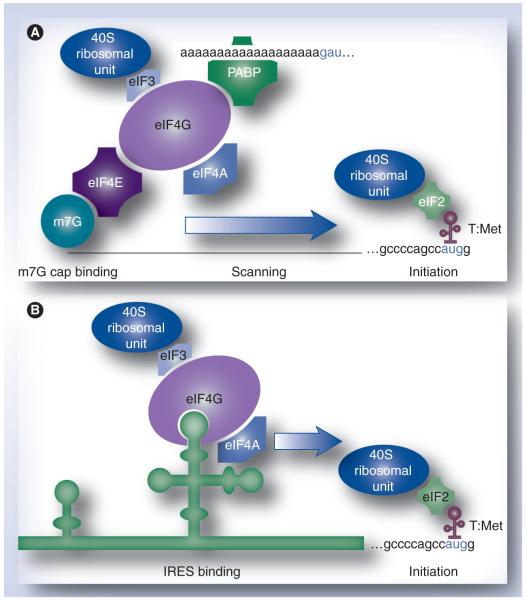
Figure 2. Mechanisms of translation initiation
(A) Conventional, cap-dependent translation occurs upon binding of eIF4E to the canonical m7G cap on eukaryotic mRNAs. This enables recruitment of the preinitiation complex, including 40S ribosomal subunits, to mRNAs. Assembly of the preinitiation complex at the 5′ cap precedes scanning of the 5′ untranslated region and initiation proper at the initiation codon. (B) Cap-independent translation at the poliovirus genome occurs upon direct recruitment of eIF4G to the IRES element in the viral 5′ untranslated region. eIF: Eukaryotic initiation factor; IRES: Internal ribosomal entry site; m7G: 7-methyl-guanidine; PABP: Poly(A) binding protein; T:Met: Initiator (Met) tRNA.
Figure 3
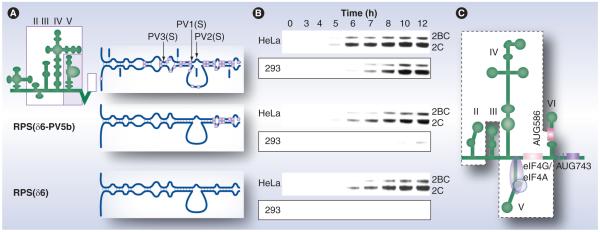
Figure 3. Stem-loop domain V in the human rhinovirus type 2 internal ribosomal entry site harbors neuronal incompetence
(A) PVSRIPO constructs featuring diverse stem-loop domain (SLD) V with variable sequence content derived from human rhinovirus type 2 or wild-type PV type 1 (MAHONEY; gray boxes). (B) Viral translation in universally permissive HeLa cells or in PSVRIPO nonpermissive HEK293 cells (boxed). The loss of internal ribosomal entry site competence in HEK293 cells coincides with a discrete region of SLD V comprising the portion containing the attenuating point mutations in the SABIN vaccines. Viral translation in HeLa cells occurs at similar levels with all constructs, independent of the primary sequence of SLD V. (C) The eIF4G ‘landing pad’ on SLD V of the poliovirus internal ribosomal entry site is schematically indicated [46]. 2BC: Poliovirus protein 2BC; 2C: Poliovirus protein 2C; eIF: Eukaryotic initiation factor; PV: Poliovirus. Data taken from [49].
Figure 4
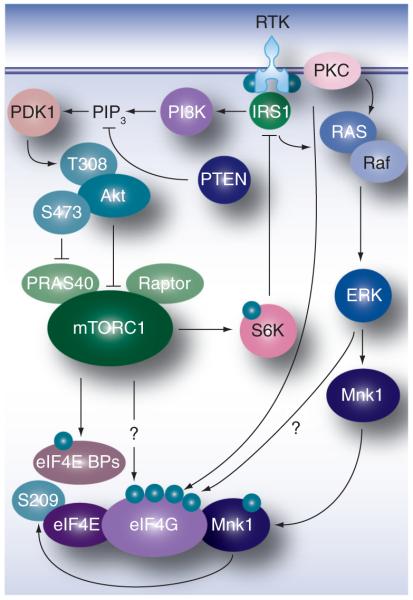
Figure 4. Mitogenic signaling pathways via PI3K–mTOR and Ras–Erk1/2 converge on translation machinery
BP: Binding protein; eIF: Eukaryotic initiation factor; RTK: Receptor tyrosine kinase.
Figure 5
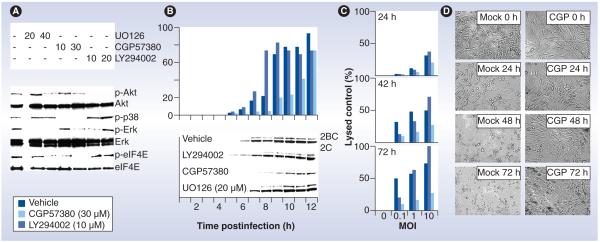
Figure 5. Protein kinase inhibitors modulate PVSRIPO oncolysis in glioblastoma cells
(A) Immunoblots of kinase substrates in the PI3K (Akt) and Ras (p38, Erk and eIF4E) pathways 2 h after treatment with vehicle, the Mek1 inhibitor UO126, the Mnk1 inhibitor CGP57380 or the PI3K inhibitor LY294002 (concentrations in µM are shown at the top). (B) Kinetics of viral growth (top) and translation (bottom) in mock- or inhibitor-treated U-118 cells infected with PVSRIPO. Progeny was quantified by plaque assay and viral translation was measured by immunoblot of the viral nonstructural proteins 2BC/2C. Viral propagation in mock- and UO126-treated cells was similar (data not shown). (C) PVSRIPO cytotoxicity in mock- or inhibitor-treated U-118 cells at the indicated intervals. (D) Photomicrographs of PVSRIPO-infected (MOI = 1) and vehicle (mock)- or CGP57380 (CGP; 30 μM)-treated U-118 cells at the indicated intervals. 2BC: Poliovirus protein 2BC; 2C: Poliovirus protein 2C; eIF: Eukaryotic initiation factor; MOI: Multiplicity of infection. Reproduced with permission from [61].
Figure 6
Figure 6. Oncogenic H-Ras rescues PVSRIPO growth in nonpermissive HEK293 cells
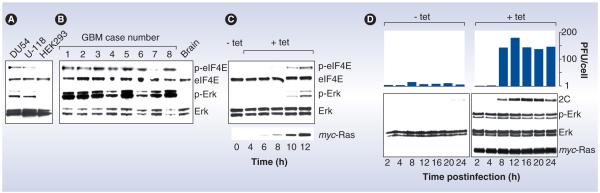
(A) Erk1/2 signaling and inherent phosphorylation of eIF4E in HEK293 cells is reduced compared with DU54 and U-118 GBM cells. (B) Universally active Erk1/2 and eIF4E phosphorylation in GBM patients and absent signal in the normal primate brain. (C) tet-inducible expression of oncogenic Ras in HEK293 cells produces Erk1/2 and eIF4E phosphorylation, and a signaling signature similar to U-118 GBM cells or GBM patient tissues. (D) PVSRIPO growth (top) and translation (bottom) in mock- or tet-induced cells. Immunoblots confirm myc-Ras expression and Erk1/2 signaling. Poliovirus 1(S) progeny recovered from infected (multiplicity of infection = 10) mock- or tet-induced cells are shown at the indicated intervals. 2C: Poliovirus protein 2C; eIF: Eukaryotic initiation factor; GBM: Glioblastoma; PFU: Plaque-forming unit; tet: Tetracycline. Reproduced with permission from [61].
Figure 7
Figure 7. Testing PVSRIPO and PI3K inhibitor synergy in vivo
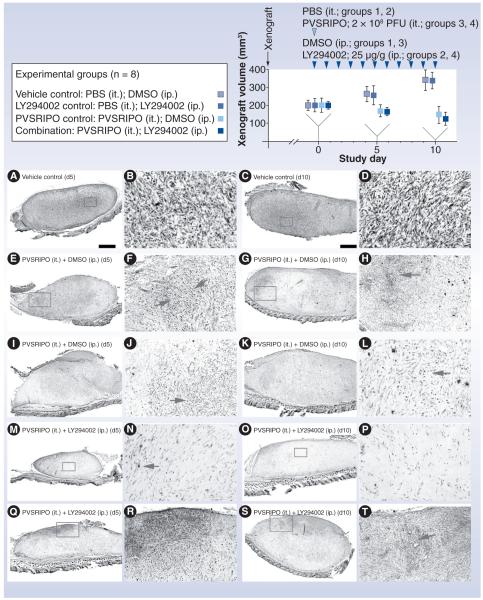
Experimental groups and the study regimen are indicated at the top. U-118 xenografts were measured at study days 0 (when PVSRIPO/vehicle and LY294002/vehicle treatment was initiated), 5 and 10. Four animals from each group were euthanized at study days 5 and 10 for histology and virus recovery. The bottom panels show histology from xenografts recovered at day 5 (left columns) and 10 (right columns). Low-magnification images in the left columns are accompanied by higher-magnification images from the same section (inserts) in the column to their right. (A–D) Tumor histology of a representative xenograft from group 1 shows the characteristic dense arrangement of tumor cells. (E–L) Histology of two representative tumors from group 3 at study days 5 and 10 as indicated. Note extensive tumor cell loss and ‘empty’ appearance of the former xenograft in all cases. Arrows point to areas of intense tumor cell killing and active tissue rearrangement. (M–T) Histology of four representative tumors from group 4 at study days 5 and 10 as indicated. (M & N) Complete tumor regression at study day 5. (N & P) The area of the former tumor was invaded by cells with fibroblast morphology surrounded by dense extracellular matrix. Isolated viable tumor cells (arrow [N]) may remain. (Q & R) Active tumor, which was still present in three out of four animals of group 4. DMSO: Dimethyl sulfoxide; ip.: Intraperitoneal; it.: Intratumoral; PBS: Phosphate-buffered saline; PFU: Plaque-forming unit. Reproduced with permission from [61].

References

    1. Bluming AZ, Ziegler JL. Regression of Burkitt’s lymphoma in association with measles infection. Lancet. 1971;2(7715):105–106. - PubMed
    1. De Pace N. Sulla scomparsa di un enorme cancro vegetante del callo dell’utero senze cura chirurgica. Ginecologia. 1912;9:82–88.
    1. Coffey MC, Strong JE, Forsyth PA, Lee PW. Reovirus therapy of tumors with activated Ras pathway. Science. 1998;282(5392):1332–1334. - PubMed
    1. Stojdl DF, Lichty B, Knowles S, et al. Exploiting tumor-specific defects in the interferon pathway with a previously unknown oncolytic virus. Nat. Med. 2000;6(7):821–825. - PubMed
    1. Martuza RL, Malick A, Markert JM, Ruffner KL, Coen DM. Experimental therapy of human glioma by means of a genetically engineered virus mutant. Science. 1991;252(5007):854–856. - PubMed

LinkOut - more resources