


Oxytocin and social motivation
- PMID: 21984889
- PMCID: PMC3185363
- DOI: 10.1016/j.dcn.2011.07.007
Oxytocin and social motivation
Abstract
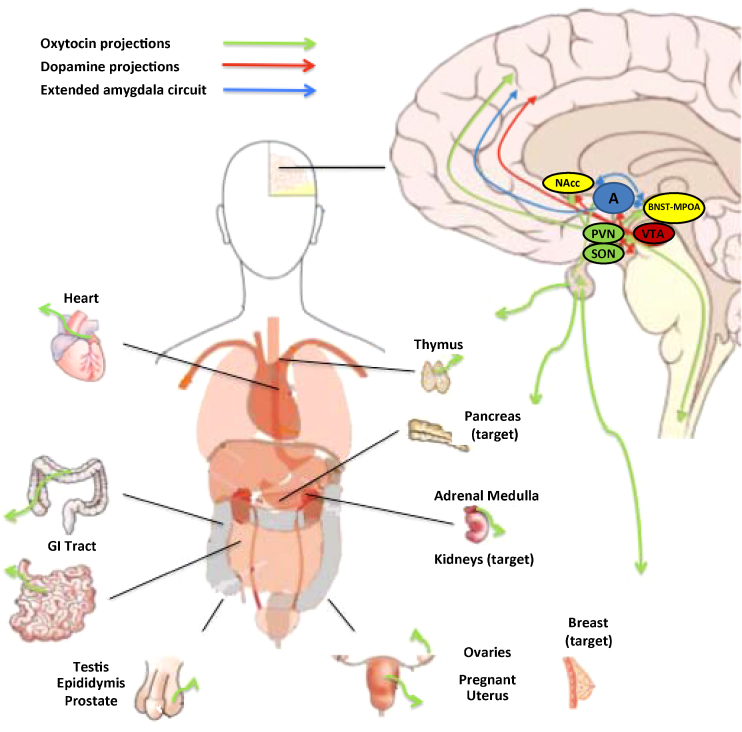
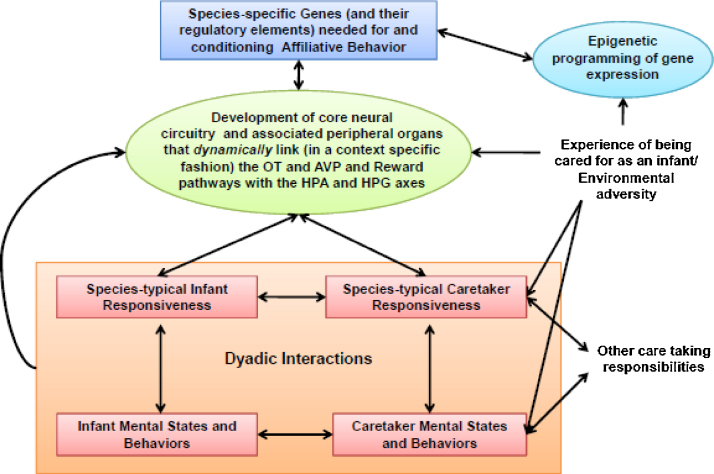
Humans are fundamentally social creatures who are ‘motivated’ to be with others. In this review we examine the role of oxytocin (OT) as it relates to social motivation. OT is synthesized in the brain and throughout the body, including in the heart, thymus, gastrointestinal tract, as well as reproductive organs. The distribution of the OT receptor (OTR) system in both the brain and periphery is even more far-reaching and its expression is subject to changes over the course of development. OTR expression is also sensitive to changes in the external environment and the internal somatic world. The OT system functions as an important element within a complex, developmentally sensitive biobehavioral system. Other elements include sensory inputs, the salience, reward, and threat detection pathways, the hypothalamic-pituitary-gonadal axis, and the hypothalamic-pituitary-adrenal stress response axis. Despite an ever expanding scientific literature, key unresolved questions remain concerning the interplay of the central and peripheral components of this complex biobehavioral system that dynamically engages the brain and the body as humans interact with social partners over the course of development.
Keywords: cortisol; dopamine; dyadic social interactions; epigenetics; estrogen; motivation; oxytocin; parenting; reward; salience; sexual behavior; stress; testosterone; vasopressin.
Figures
References
-
- Ainsworth M.D.S., Blehar M.C., Waters E., Wall S. Erlbaum; Hillsdale, NJ: 1978. Patterns of Attachment: A Psychological Study of the Strange Situation.
-
- Akaishi T., Sakuma Y. Estrogen excites oxytocinergic, but not vasopressinergic cells in the paraventricular nucleus of female rat hypothalamus. Brain Res. 1985;335(2):302–305. - PubMed
-
- Altemus M., Deuster P.A., Galliven E., Carter C.S., Gold P.W. Suppression of hypothalmic-pituitary-adrenal axis responses to stress in lactating women. J. Clin. Endocrinol. Metab. 1995;80(10):2954–2959. - PubMed
-
- Amaral D.G., Schumann C.M., Nordahl C.W. Neuroanatomy of autism. Trends Neurosci. 2008;31(3):137–145. - PubMed
-
- Amico J.A., Finley B.E. Breast stimulation in cycling women, pregnant women and a woman with induced lactation: pattern of release of oxytocin, prolactin and luteinizing hormone. Clin. Endocrinol. 1986;25(2):97–106. - PubMed
Publication types
MeSH terms
Substances
Grants and funding
LinkOut - more resources
Full Text Sources
