. 2011 Nov;166(2):218-26.
doi: 10.1111/j.1365-2249.2011.04474.x.

Proinflammatory and regulatory cytokines and chemokines in infants with uncomplicated and severe Plasmodium falciparum malaria

Affiliations

Proinflammatory and regulatory cytokines and chemokines in infants with uncomplicated and severe Plasmodium falciparum malaria

E Ayimba et al. Clin Exp Immunol. 2011 Nov.

Abstract

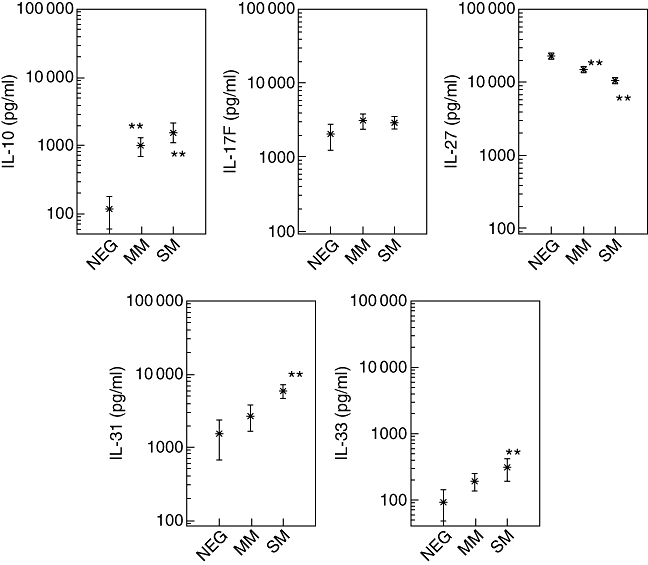
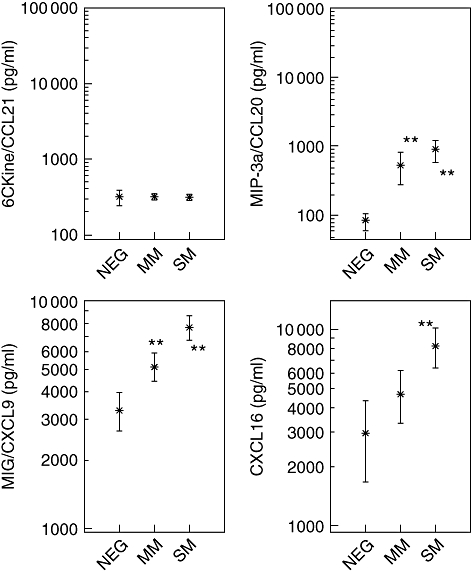
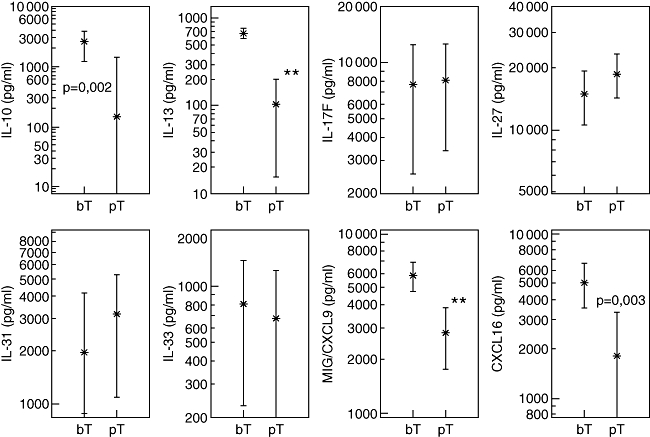
Cytokine and chemokine levels were studied in infants (<5 years) with uncomplicated (MM) and severe malaria tropica (SM), and in Plasmodium falciparum infection-free controls (NEG). Cytokine plasma levels of interleukin (IL)-10, IL-13, IL-31 and IL-33 were strongly elevated in MM and SM compared to NEG (P<0·0001). Inversely, plasma concentrations of IL-27 were highest in NEG infants, lower in MM cases and lowest in those with SM (P<0·0001, NEG compared to MM and SM). The levels of the chemokines macrophage inflammatory protein (MIP3)-α/C-C ligand 20 (CCL20), monokine induced by gamma interferon (MIG)/CXCL9 and CXCL16 were enhanced in those with MM and SM (P<0·0001 compared to NEG), and MIP3-α/CCL20 and MIG/CXCL9 were correlated positively with parasite density, while that of IL-27 were correlated negatively. The levels of 6Ckine/CCL21 were similar in NEG, MM and SM. At 48-60 h post-anti-malaria treatment, the plasma concentrations of IL-10, IL-13, MIG/CXCL9, CXCL16 and MIP3-α/CCL20 were clearly diminished compared to before treatment, while IL-17F, IL-27, IL-31 and IL-33 remained unchanged. In summary, elevated levels of proinflammatory and regulatory cytokines and chemokines were generated in infants during and after acute malaria tropica. The proinflammatory type cytokines IL-31 and IL-33 were enhanced strongly while regulatory IL-27 was diminished in those with severe malaria. Similarly, MIP3-α/CCL20 and CXCL16, which may promote leucocyte migration into brain parenchyma, displayed increased levels, while CCL21, which mediates immune surveillance in central nervous system tissues, remained unchanged. The observed cytokine and chemokine production profiles and their dynamics may prove useful in evaluating either the progression or the regression of malarial disease.


Figures

Fig. 1
Fig. 1
Plasma concentrations of cytokines interleukin (IL)-10, IL-17F, IL-27, IL-31 and IL-33 were quantified in Plasmodium falciparum-infected infants (<5 years) and in non-infected endemic controls (<5 years). Cytokine concentrations are shown as means in pg/ml with the 95% lower and upper confidence interval. Infants with severe malaria (SM) were characterized by parasitaemias of higher than 250 000 parasites/µl and/or haemoglobin concentrations of less than 5 g/dl. Uncomplicated malaria (MM) patients were defined by parasitaemias of lower than 250 000 parasites/µl and haemoglobin concentrations equal or higher than 5 g/dl and the absence of any signs or symptoms of severe malaria. P. falciparum-exposed infants negative for parasites in thick blood film, and negative in rapid detection test kits for P. falciparum were defined as participants with previous malaria episode(s) and the actual absence of illness due to malaria within the last 2 weeks. Significant differences (**P < 0·0001) between infection-free controls (NEG) and MM or SM patients are indicated. **P < 0·0001 compared to NEG.
Fig. 2
Fig. 2
Plasma concentrations of chemokines 6Ckine/CCL21, macrophage inflammatory protein (MIP)3-α/C–C ligand 20 (CCL20), CXCL16 and MIG/CXCL9 were quantified in Plasmodium falciparum-infected infants (<5 years) and in non-infected endemic controls (<5 years). Chemokine concentrations are shown as means in pg/ml with the 95% lower and upper confidence interval. Infants with severe malaria (SM) were characterized by parasitaemias of higher than 250 000 parasites/µl and/or haemoglobin concentrations of less that 5 g/dl. Uncomplicated malaria (MM) patients were defined by parasitaemias of lower than 250 000 parasites/µl and haemoglobin concentrations equal or higher than 5 g/dl and the absence of any signs or symptoms of severe malaria. P. falciparum exposed infants negative for parasites in thick blood film, and negative in rapid detection test kits for P. falciparum were defined as participants with previous malaria episode(s) and the actual absence of illness due to malaria within the last 2 weeks. Significant differences (**P < 0·0001) between infection-free controls (NEG) and MM or SM patients are indicated.
Fig. 3
Fig. 3
Plasma concentrations of cytokines interleukin (IL)-10, IL-13, IL-17F, IL-27, IL-31, IL-33 and chemokines monokine induced by gamma interferon (MIG)/C–X–C ligand 9 (CXCL9) and CXCL16 were quantified in Plasmodium falciparum-infected infants (<5 years) before treatment (bT) with anti-malarials and/or anti-pyretics and at 48–60 h post-treatment (pT). Chemokine concentrations are shown as means in pg/ml with the 95% lower and upper confidence interval. Significant differences (**P < 0·0001, paired observations) between bT and pT are indicated.

References

    1. Clark IA, Budd AC, Alleva LM, et al. Human malarial disease: a consequence of inflammatory cytokine release. Malar J. 2006;5:85–117. - PMC - PubMed
    1. Clark IA, Alleva LM, Mills AC, et al. Pathogenesis of malaria and clinically similar conditions. Clin Microbiol Rev. 2004;17:509–39. - PMC - PubMed
    1. Luster AD. The role of chemokines in linking innate and adaptive immunity. Curr Opin Immunol. 2002;14:129–35. - PubMed
    1. Sharma M, Vohra H, Bhasin D. Enhanced pro-inflammatory chemokine/cytokine response triggered by pathogenic Entamoeba histolytica: a basis of invasive disease. Parasitology. 2005;131:783–96. - PubMed
    1. Benevides L, Milanezi CM, Yamauchi LM, et al. CCR2 receptor is essential to activate microbicidal mechanisms to control Toxoplasma gondii infection in the central nervous system. Am J Pathol. 2008;173:741–51. - PMC - PubMed