


Evaluation of bleach-sedimentation for sterilising and concentrating Mycobacterium tuberculosis in sputum specimens
- PMID: 21985457
- PMCID: PMC3213181
- DOI: 10.1186/1471-2334-11-269
Evaluation of bleach-sedimentation for sterilising and concentrating Mycobacterium tuberculosis in sputum specimens
Abstract
Background: Bleach-sedimentation may improve microscopy for diagnosing tuberculosis by sterilising sputum and concentrating Mycobacterium tuberculosis. We studied gravity bleach-sedimentation effects on safety, sensitivity, speed and reliability of smear-microscopy.
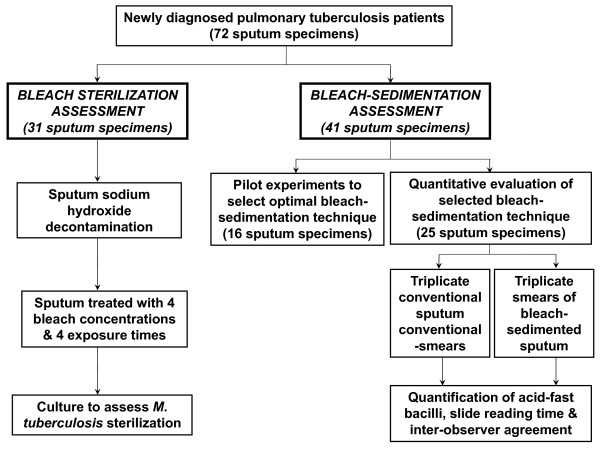
Methods: This blinded, controlled study used sputum specimens (n = 72) from tuberculosis patients. Bleach concentrations and exposure times required to sterilise sputum (n = 31) were determined. In the light of these results, the performance of 5 gravity bleach-sedimentation techniques that sterilise sputum specimens (n = 16) were compared. The best-performing of these bleach-sedimentation techniques involved adding 1 volume of 5% bleach to 1 volume of sputum, shaking for 10-minutes, diluting in 8 volumes distilled water and sedimenting overnight before microscopy. This technique was further evaluated by comparing numbers of visible acid-fast bacilli, slide-reading speed and reliability for triplicate smears before versus after bleach-sedimentation of sputum specimens (n = 25). Triplicate smears were made to increase precision and were stained using the Ziehl-Neelsen method.
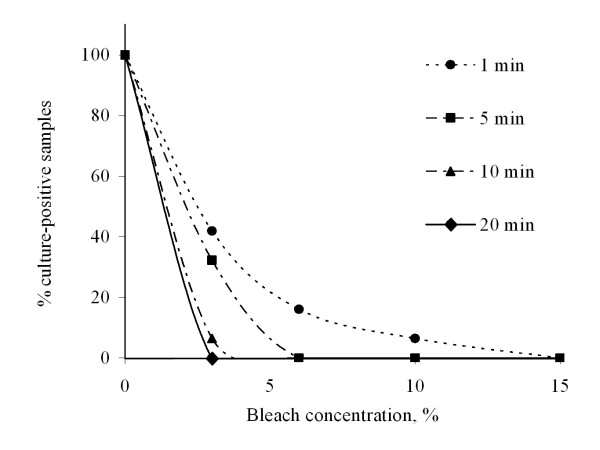
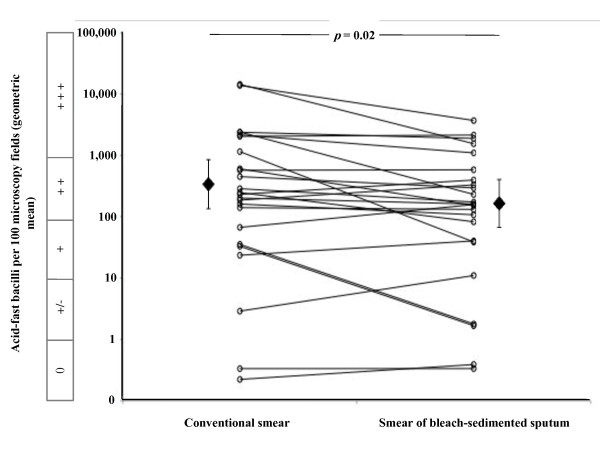
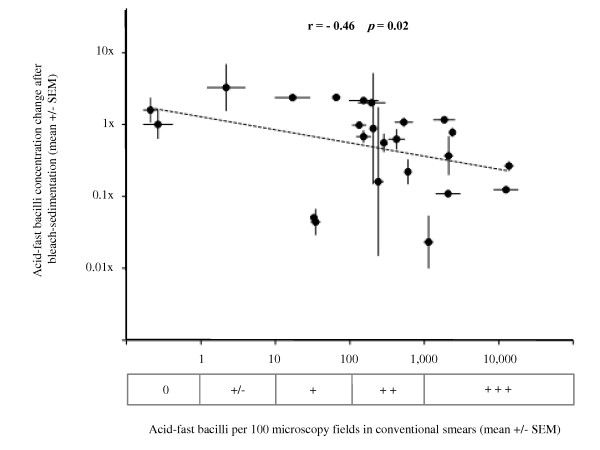
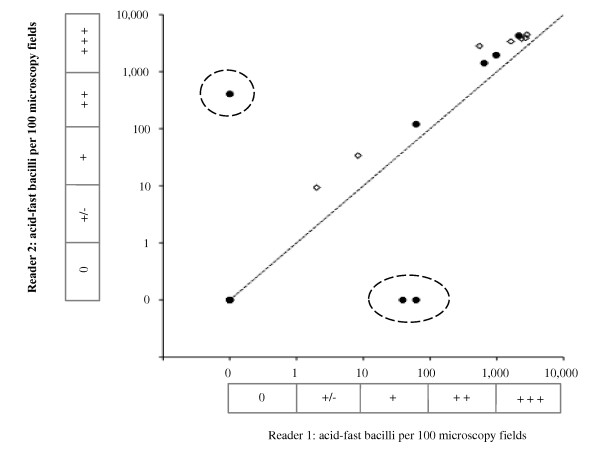
Results: M. tuberculosis in sputum was successfully sterilised by adding equal volumes of 15% bleach for 1-minute, 6% for 5-minutes or 3% for 20-minutes. Bleach-sedimentation significantly decreased the number of acid-fast bacilli visualised compared with conventional smears (geometric mean of acid-fast bacilli per 100 microscopy fields 166, 95%CI 68-406, versus 346, 95%CI 139-862, respectively; p = 0.02). Bleach-sedimentation diluted paucibacillary specimens less than specimens with higher concentrations of visible acid-fast bacilli (p = 0.02). Smears made from bleach-sedimented sputum were read more rapidly than conventional smears (9.6 versus 11.2 minutes, respectively, p = 0.03). Counting conventional acid-fast bacilli had high reliability (inter-observer agreement, r = 0.991) that was significantly reduced (p = 0.03) by bleach-sedimentation (to r = 0.707) because occasional strongly positive bleach-sedimented smears were misread as negative.
Conclusions: Gravity bleach-sedimentation improved laboratory safety by sterilising sputum but decreased the concentration of acid-fast bacilli visible on microscopy, especially for sputum specimens containing high concentrations of M. tuberculosis. Bleach-sedimentation allowed examination of more of each specimen in the time available but decreased the inter-observer reliability with which slides were read. Thus bleach-sedimentation effects vary depending upon specimen characteristics and whether microscopy was done for a specified time, or until a specified number of microscopy fields had been read. These findings provide an explanation for the contradictory results of previous studies.
Figures
References
-
- Nyirenda TE, Mundy CJ, Harries AD, Banerjee A, Salaniponi FM. Safety in laboratories carrying out sputum smear microscopy: a dilemma for resource-poor countries. Int J Tuberc Lung Dis. 1998;2:690–3. - PubMed
-
- Kent PT, Kubica GP. Public health mycobacteriology: A guide for the level III laboratory. Atlanta: Centers for Disease Control; 1985.
-
- Ängeby KAK, Alvarado-Galvez C, Pineda-Garcia L, Hoffner SE. Improved microscopy for a more sensitive diagnosis of pulmonary tuberculosis. Int J Tuberc Lung Dis. 2000;4:684–687. - PubMed
Publication types
MeSH terms
Substances
Grants and funding
LinkOut - more resources
Full Text Sources
Other Literature Sources
Medical
