Review
. 2011 Oct;9(10):1315-30.
doi: 10.1586/erc.11.120.

Symptomatic and asymptomatic carotid artery plaque

Affiliations
Review

Symptomatic and asymptomatic carotid artery plaque

Majid M Mughal et al. Expert Rev Cardiovasc Ther. 2011 Oct.

Abstract

Carotid atherosclerotic plaques represent both stable and unstable atheromatous lesions. Atherosclerotic plaques that are prone to rupture owing to their intrinsic composition such as a large lipid core, thin fibrous cap and intraplaque hemorrhage are associated with subsequent thromboembolic ischemic events. At least 15-20% of all ischemic strokes are attributable to carotid artery atherosclerosis. Characterization of plaques may enhance the understanding of natural history and ultimately the treatment of atherosclerotic disease. MRI of carotid plaque and embolic signals during transcranial Doppler have identified features beyond luminal stenosis that are predictive of future transient ischemic attacks and stroke. The value of specific therapies to prevent stroke in symptomatic and asymptomatic patients with severe carotid artery stenosis are the subject of current research and analysis of recently published clinical trials that are discussed in this article.


Conflict of interest statement

Financial & competing interests disclosure The authors have no other relevant affiliations or financial involvement with any organization or entity with a financial interest in or financial conflict with the subject matter or materials discussed in the manuscript apart from those disclosed.

No writing assistance was utilized in the production of this manuscript.

Figures
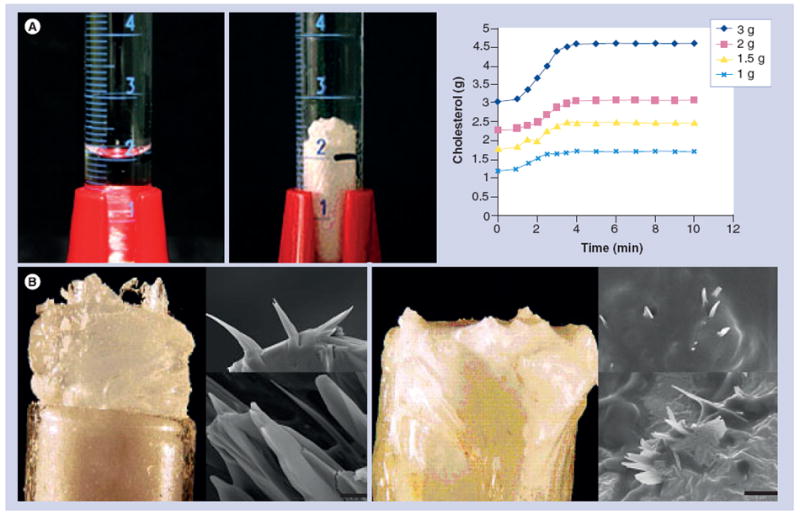
Figure 1
Figure 1. Demonstration of volume expansion of cholesterol during crystallization
(A) Dissolved cholesterol in graduated cylinder expands in volume above the meniscus line. Graph of volume expansion is greater with increasing amounts of cholesterol (1–3 g). (B) Cholesterol crystals are seen growing above the edge of the test tube after crystallization. Scanning electron micrographs demonstrate sharp-tipped crystal geometries. When a fibrous membrane is placed over the mouth of the test tube, crystals perforate the membrane as noted by scanning electron microscopy (bar = 5 μm). Reproduced with permission from [18].
Figure 2
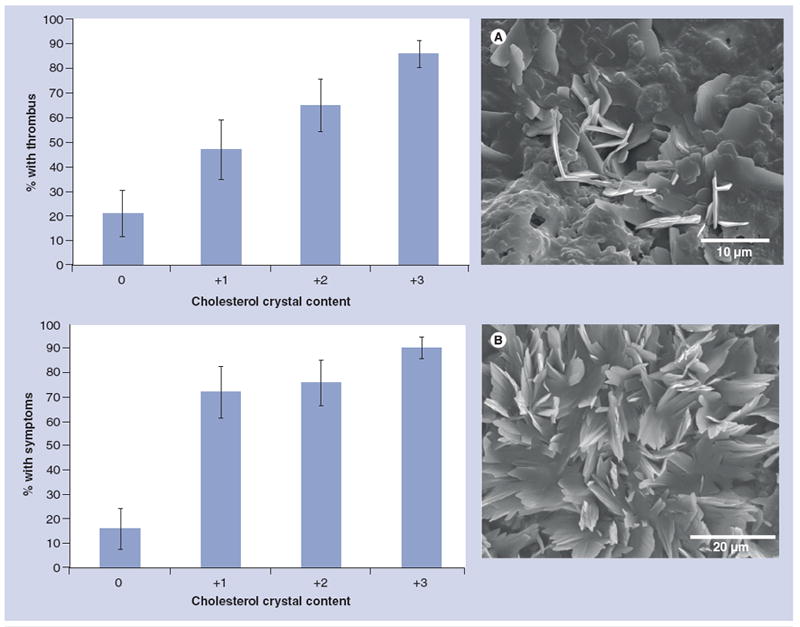
Figure 2. Neurological symptoms increase with cholesterol crystal content in plaque
(A) Both neurological symptoms and thrombus are increased with increasing cholesterol crystal content in plaques. (B) Examples of carotid plaques from patients with transient ischemic attack. Reproduced with permission from [12].
Figure 3
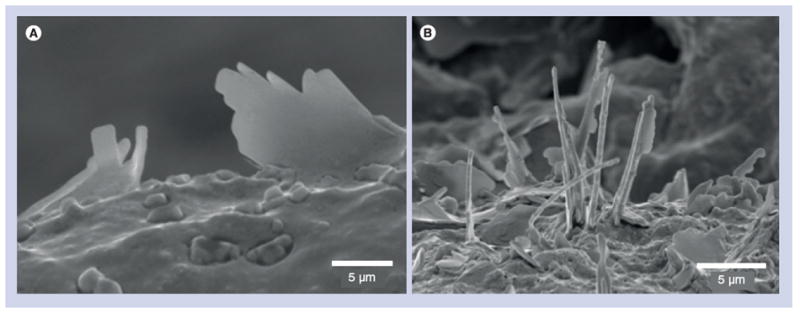
Figure 3. Dissolving cholesterol crystals in patients on oral statins
(A) Scanning electron micrograph of carotid plaque from carotid endarterectomy of a patient with transient ischemic attack not on statins demonstrating intact cholesterol crystals. (B) Scanning electron micrograph of carotid plaque from a patient with transient ischemic attack on statins demonstrating dissolving crystals. Reproduced with permission from [22].
Figure 4
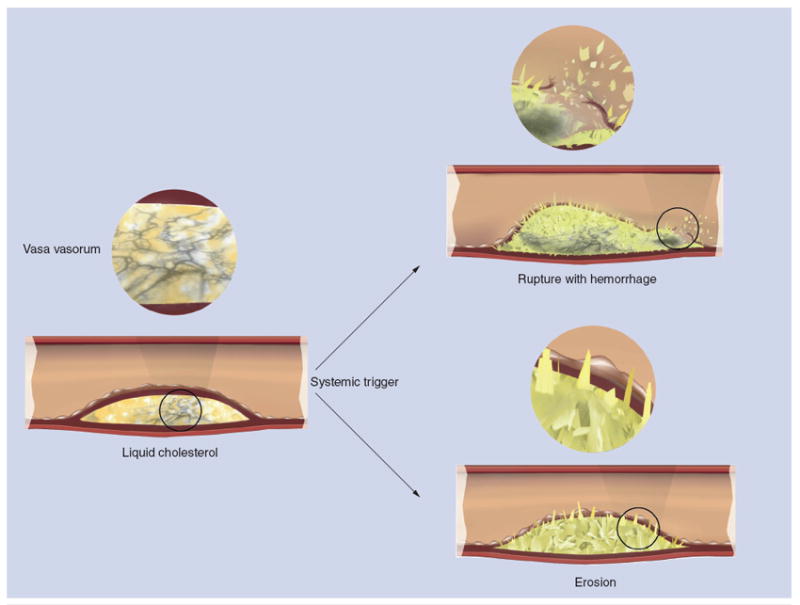
Figure 4. Mechanism of plaque hemorrhage, rupture and/or erosion induced by cholesterol crystallization with volume expansion of the necrotic core
In the case of a large necrotic core, the plaque cap is torn leading to rupture, whereas in the case of a small necrotic core, it leads to erosion. Furthermore, trauma to the vasa vasorum by expanding cholesterol crystals within the plaque causes intraplaque hemorrhage. Modified with permission from [18].
Figure 5
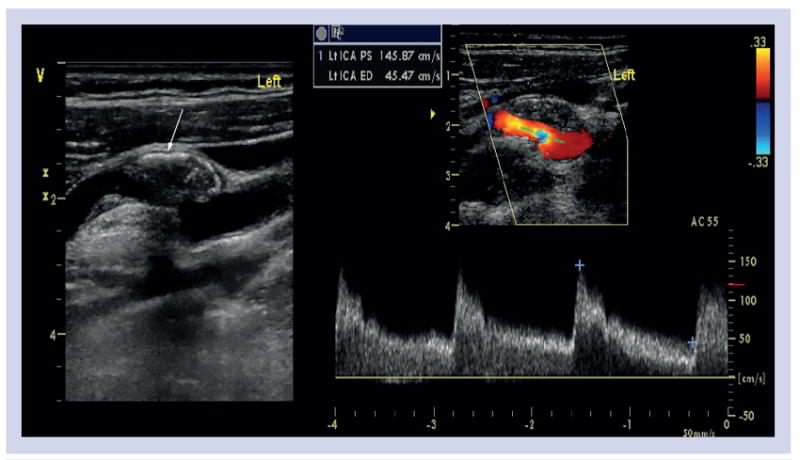
Figure 5. Ultrasound and Doppler of left carotid artery in a patient with an asymptomatic stenosis demonstrating a complex intramural lesion suggestive of plaque hemorrhage (arrow)
Figure 6
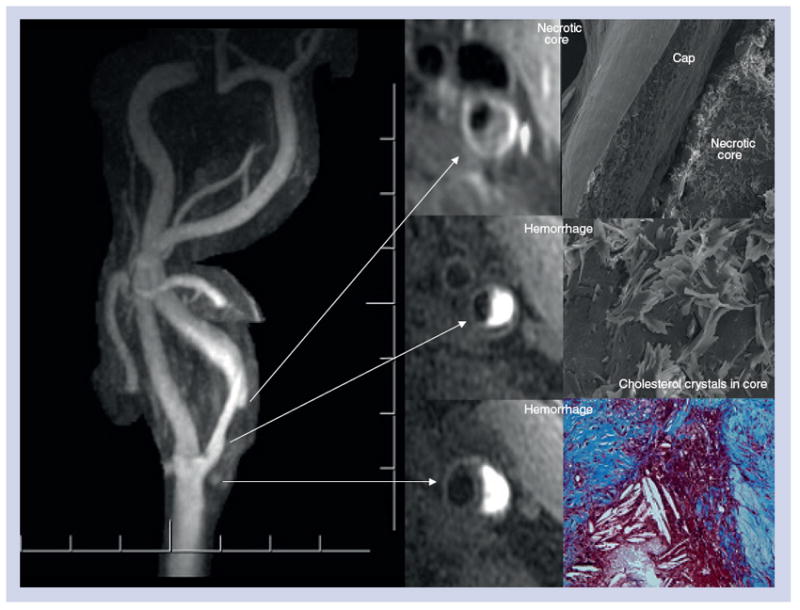
Figure 6. Same case as in Figure 5 (with 500-μm resolution contrast-enhanced MR angiogram) of left carotid artery confirming intraplaque hemorrhage by black-blood T1-weighted cross-sectional images using 3D magnetization-prepared rapid acquisition gradient echo sequence, where the intraplaque hemorrhage is bright
Along the inferior aspect of the intraplaque hemorrhage there is a 1-mm thick fibrous cap between the dark lumen and the bright deep intraplaque hemorrhage. Superiorly there is a well-defined fibrous cap (<500 μm) between the lumen and lipid core. Following endarterectomy, light and scanning electron microscopy demonstrate extensive cholesterol crystals with intraplaque hemorrhage and thin fibrous cap.

References

    1. Lloyd-Jones D, Adams RJ, Brown TM, et al. Executive summary: heart disease and stroke statistics: 2010 update: a report from the American Heart Association. Circulation. 2010;121(7):948–954. - PubMed
    1. Lloyd-Jones D, Adams RJ, Brown TM, et al. Heart disease and stroke statistics: 2010 update: a report from the American Heart Association. Circulation. 2010;121(12):e46–e215. - PubMed
    1. Petty G, Brown RD, Jr, Whisnant JP, Sicks JD, O’Fallon WM, Wiebers DO. Ischemic stroke subtypes: a population-based study of incidence and risk factors. Stroke. 1999;30(12):2513–2516. - PubMed
    1. Mineva PP, Manchev IC, Hadjiev DI. Prevalence and outcome of asymptomatic carotid stenosis: a population-based ultrasonographic study. Eur J Neurol. 2002;9(4):383–388. - PubMed
    1. Risk of stroke in the distribution of an asymptomatic carotid artery. The European Carotid Surgery Trialists Collaborative Group. Lancet. 1995;345(8944):209–212. - PubMed

Publication types

MeSH terms