Review
. 2012 Jan;14(1):19-27.
doi: 10.1111/j.1462-5822.2011.01713.x. Epub 2011 Nov 10.

Legionella secreted effectors and innate immune responses

Affiliations
Review

Legionella secreted effectors and innate immune responses

Zhao-Qing Luo. Cell Microbiol. 2012 Jan.

Abstract

Legionella pneumophila is a facultative intracellular pathogen capable of replicating in a wide spectrum of cells. Successful infection by Legionella requires the Dot/Icm type IV secretion system, which translocates a large number of effector proteins into infected cells. By co-opting numerous host cellular processes, these proteins function to establish a specialized organelle that allows bacterial survival and proliferation. Even within the vacuole, L. pneumophila triggers robust immune responses. Recent studies reveal that a subset of Legionella effectors directly target some basic components of the host innate immunity systems such as phagosome maturation. Others play essential roles in engaging the host innate immune surveillance system. This review will highlight recent progress in our understanding of these interactions and discuss implications for the study of the immune detection mechanisms.


Figures

Figure 1
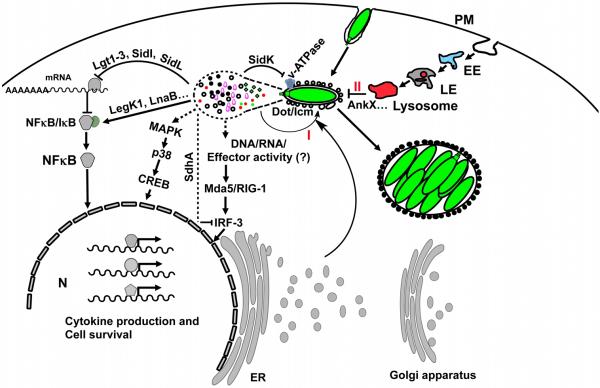
Figure 1. Innate immunity pathways modulated by Dot/Icm substrates
L. pneumophila translocates a large number of effectors into host cytosol via the Dot/Icm type IV secretion system to facilitate its intracellular replication. Host protein synthesis inhibition by 5 effectors, including three glucosyltransferases (Lgt1-3), SidL and SidL led to inefficient resynthesis of the NF-κB inhibitor IκB and NFκB activation. LegK1 and LnaB activate NF-κB, most likely by initiating the kinase cascade that ultimately causes phosphorylation and subsequent degradation of IκB. Nuclear translocation of NF-κB leads to cytokine production and the induction of anti-apoptotic genes. A yet unidentified set of effectors induces the MAP kinase pathway, leading to similar effects. Undefined effectors or DNA/RNA released by the Dot/Icm transporter induce expression of type I interferon, a process which is inhibited by the effector SdhA. Membrane remodeling of the bacterial phagosome (I) is achieved by a set of effectors, some of which are well-characterized, including RalF, SidM/DrrA, LepB, SidD, AnkX, SidJ and LegK2. Inhibition of phagolysosomal fusion (II) probably is mediated by AnkX, and very likely other yet unidentified effectors. Dashed lines indicate undefined effectors involved in the specified pathway. For clarity, pyroptotic cell death caused by flagellin, which reaches the cytosol probably via the Dot/Icm transporter is not shown. CREB, cAMP response element-binding protein; EE, early endosome; LE, late endosome; ER, endoplasmic reticulum; MAPK, mitogen-activated protein (MAP) kinases; N, nucleus; PM, plasma membrane.

References

    1. Abu-Zant A, Jones S, Asare R, Suttles J, Price C, Graham J, Kwaik YA. Anti apoptotic signalling by the Dot/Icm secretion system of L. pneumophila. Cell Microbiol. 2007;9:246–264. - PubMed
    1. Akira S, Uematsu S, Takeuchi O. Pathogen recognition and innate immunity. Cell. 2006;124:783–801. - PubMed
    1. Ang DK, Oates CV, Schuelein R, Kelly M, Sansom FM, Bourges D, et al. Cutting edge:pulmonary Legionella pneumophila is controlled by plasmacytoid dendritic cells but not type I IFN. J Immunol. 2010;184:5429–5433. - PubMed
    1. Archer KA, Ader F, Kobayashi KS, Flavell RA, Roy CR. Cooperation between multiple microbial pattern recognition systems is important for host protection against the intracellular pathogen Legionella pneumophila. Infect Immun. 2010;78:2477–2487. - PMC - PubMed
    1. Archer KA, Alexopoulou L, Flavell RA, Roy CR. Multiple MyD88-dependent responses contribute to pulmonary clearance of Legionella pneumophila. Cell Microbiol. 2009;11:21–36. - PMC - PubMed

Publication types

MeSH terms