


Constraints for control of the human hand
- PMID: 21986205
- PMCID: PMC3249034
- DOI: 10.1113/jphysiol.2011.217810
Constraints for control of the human hand
Abstract
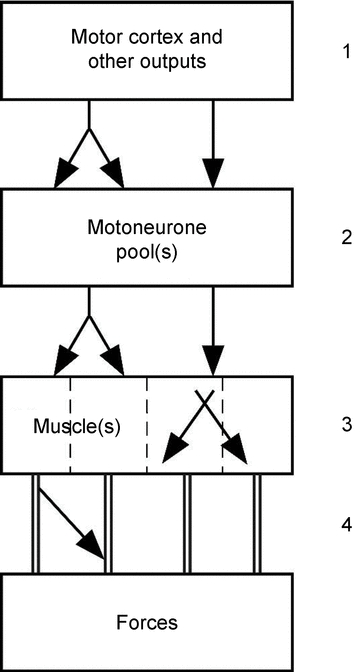
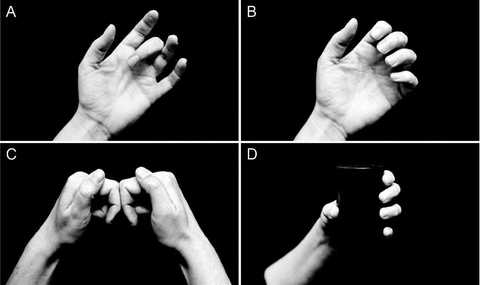
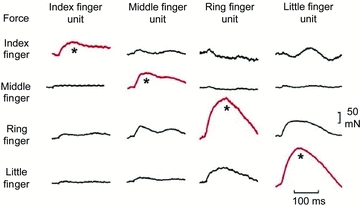
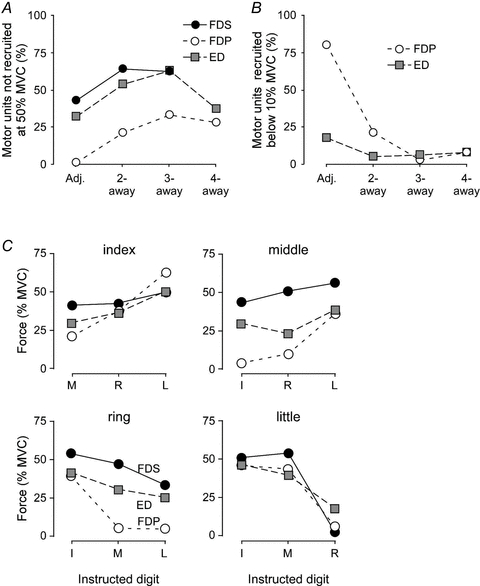
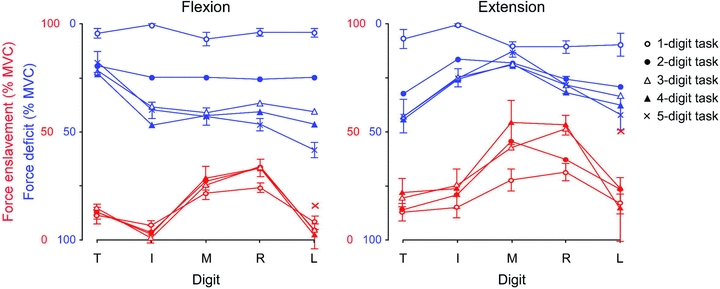
More than 30 muscles drive the hand to perform a multitude of essential dextrous tasks. Here we consider new views on the evolution of hand structure and on peripheral and central constraints for independent control of the digits of the hand. The human hand is widely assumed to have evolved from hands like those of African apes, yet recent studies have shown that our hands and those of the earliest hominids are very similar and unlike those of living apes. Understanding the limits of hand function may come from investigation of our last common ancestor with the great apes, rather than the great apes themselves. In the periphery, movement across the full range of joint space can be limited by mechanical linkages among the extrinsic muscles. Further, peripheral limits occur when the hand adopts some positions in which the contraction of muscles fails to move the joints on which they usually act; there is muscle 'disengagement' and functional paralysis for some actions. Surprisingly, the central nervous system drives the hand seamlessly through this landscape of mechanical limits. Central constraints on control of the individual digits include the spillover of neural drive to neighbouring muscles and their 'compartments', and the inability to make maximal muscle forces when multiple digits contract strongly which produces a force deficit. The pattern of these latter constraints correlates with amounts of daily use of each digit and favours enslaved extension to lift fingers from an object but selective flexion of fingers to contact it.
Figures

References
-
- Andersen P, Hagan PJ, Phillips CG, Powell TP. Mapping by microstimulation of overlapping projections from area 4 to motor units of the baboon's hand. Proc R Soc Lond B Biol Sci. 1975;188:31–36. - PubMed
-
- Aoki T, Francis PR, Kinoshita H. Differences in the abilities of individual fingers during the performance of fast, repetitive tapping movements. Exp Brain Res. 2003;152:270–280. - PubMed
-
- Beisteiner R, Windischberger C, Lanzenberger R, Edward V, Cunnington R, Erdler M, Gartus A, Streibl B, Moser E, Deecke L. Finger somatotopy in human motor cortex. Neuroimage. 2001;13:1016–1026. - PubMed
-
- Bell C. The Hand, Its Mechanism and Vital Endowments as Evincing Design. London: W. Pickering; 1833.
Publication types
MeSH terms
LinkOut - more resources
Full Text Sources
