. 2011 Nov;204 Suppl 3(Suppl 3):S1066-74.
doi: 10.1093/infdis/jir348.

Vesicular stomatitis virus-based Ebola vaccines with improved cross-protective efficacy

Affiliations

Vesicular stomatitis virus-based Ebola vaccines with improved cross-protective efficacy

Andrea Marzi et al. J Infect Dis. 2011 Nov.

Abstract

For Ebola virus (EBOV), 4 different species are known: Zaire, Sudan, Côte d'Ivoire, and Reston ebolavirus. The newly discovered Bundibugyo ebolavirus has been proposed as a 5th species. So far, no cross-neutralization among EBOV species has been described, aggravating progress toward cross-species protective vaccines. With the use of recombinant vesicular stomatitis virus (rVSV)-based vaccines, guinea pigs could be protected against Zaire ebolavirus (ZEBOV) infection only when immunized with a vector expressing the homologous, but not a heterologous, EBOV glycoprotein (GP). However, infection of guinea pigs with nonadapted wild-type strains of the different species resulted in full protection of all animals against subsequent challenge with guinea pig-adapted ZEBOV, showing that cross-species protection is possible. New vectors were generated that contain EBOV viral protein 40 (VP40) or EBOV nucleoprotein (NP) as a second antigen expressed by the same rVSV vector that encodes the heterologous GP. After applying a 2-dose immunization approach, we observed an improved cross-protection rate, with 5 of 6 guinea pigs surviving the lethal ZEBOV challenge if vaccinated with rVSV-expressing SEBOV-GP and -VP40. Our data demonstrate that cross-protection between the EBOV species can be achieved, although EBOV-GP alone cannot induce the required immune response.


Figures

Figure 1.
Figure 1.
Recombinant vesicular stomatitis virus vector development, antigen expression, and virus-like particle formation. A, Illustration of the newly designed single or dual recombinant vesicular stomatitis virus (rVSV) vectors encoding different Ebola virus (EBOV) antigens. The vesicular stomatitis virus glycoprotein (VSV-G) gene was excised using Mlu I and Avr II digestion. The first antigen was cloned into the genome backbone using the same restriction enzymes used to delete the VSV-G gene. The second antigen was inserted downstream of the VSV-G gene as an additional transcriptional unit using the restriction enzymes Xho I and Nhe I. B, Expression of foreign antigens. Western blot analysis was performed on cell lysates and supernatant of rVSVwt/S-NP–, rVSV-S-GP/VP40–, or rVSVwt/S-VP24–infected Vero cells. Expression of the EBOV antigens was detected using monoclonal antibodies directed against the nucleoprotein (NP), viral protein 40 (VP40), or viral protein 24 (VP24). C, Release of recombinant viral particles and virus-like particles. Supernatants of cells infected with rVSVwt/S-VP40 (top) and rVSV-S-GP/VP40 (bottom) were purified through a 20% sucrose cushion and analyzed by electron microscopy for production of rVSV particles (bullet-shape smaller particles) and Sudan ebolavirus (SEBOV)–like particles (long filamentous particles; indicated by arrow).
Figure 2.
Figure 2.
Detection of mouse-adapted Zaire ebolavirus (MA-ZEBOV) genome equivalents in mice immunized with recombinant vesicular stomatitis virus (rVSV) vectors expressing different Ebola virus glycoproteins (EBOV-GPs). Mice (n = 5) were vaccinated with a single dose of rVSV vectors and challenged 3 weeks later with 1000 median lethal dose (LD50) of MA-ZEBOV. Animals were killed 5 days postchallenge, blood samples were collected, and RNA was extracted. Quantitative real-time reverse-transcriptase polymerase chain reaction (RT-PCR) data are shown as genome equivalents per 1 mL blood. Error bars represent the standard error of the mean.
Figure 3.
Figure 3.
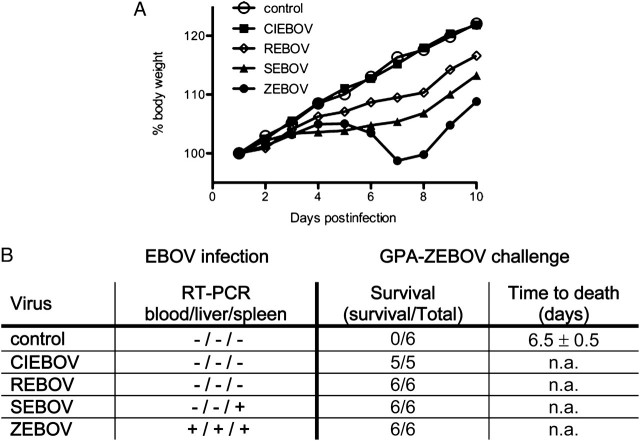
Ebola virus infection induces cross-protective immunity against heterologous lethal challenge in guinea pigs. Guinea pigs (n = 6) were infected with Dulbecco’s modified Eagle’s medium (DMEM; control) or nonadapted viruses representing the different Ebola virus (EBOV) species and monitored daily for weight loss (A). In addition, we analyzed the presence of viral RNA in blood, liver, and spleen at day 5 postinfection (B). Survival was monitored following guinea pig–adapted Zaire ebolavirus (GPA-ZEBOV) challenge (B). +, RT-PCR positive; −, RT-PCR negative; n.a., not applicable.
Figure 4.
Figure 4.
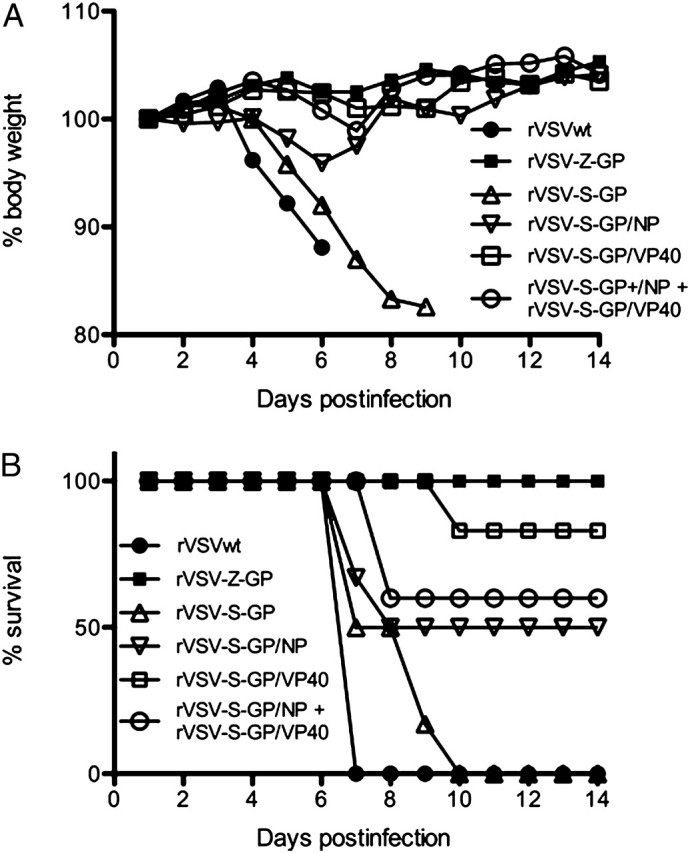
Cross-species protection following a 2-dose vaccination regime using a dual recombinant vesicular stomatitis virus (rVSV) vector expressing Sudan ebolavirus antigens. Guinea pigs (n = 6) were vaccinated twice (day 0, day 21) with the indicated rVSV vaccine vectors and challenged 42 days after the initial immunization with 1000 median lethal dose (LD50) of guinea pig–adapted Zaire ebolavirus. Animals were monitored for weight loss (A) and survival (B).
Figure 5.
Figure 5.
Humoral immune responses following vaccination with rVSV-S-GP/VP40. Guinea pigs were vaccinated twice (day 0, day 21) with the indicated recombinant vesicular stomatitis virus (rVSV) vaccine vectors and challenged 42 days after the initial immunization with 1000 median lethal dose (LD50) of guinea pig–adapted Zaire ebolavirus (GPA-ZEBOV). Humoral immune responses to vaccination were analyzed on day 21 (prior to second immunization), day 42 (prior to challenge), and day 66 (convalescence) using (A) enzyme-linked immunosorbent assay (ELISA) and (B) focus reduction neutralization titration assay (FRNT). A, Sudan ebolavirus glycoprotein (SEBOV-GP)–specific antibodies were detected using purified recombinant expressed SEBOV-GPΔTM. Viral protein 40 (VP40)–specific antibodies were detected using SEBOV-VP40 virus-like particles (VLPs). Error bars represent the standard error of the mean (SEM; n = 6). B, FRNT assay was performed to detect neutralizing antibodies against Zaire ebolavirus (ZEBOV) in the sera of rVSV-S-GP/VP40 (top; n = 6) and rVSV-Z-GP (bottom; n = 2) immunized guinea pigs. Error bars represent SEM.

References

    1. Sanchez A, Geisbert TW, Feldmann H. Filoviridae: Marburg and Ebola viruses. In: Knipe DM, Howley PM, editors. Fields virology. Philadelphia, PA: Lippincott Williams & Wilkins; 2006. pp. 1409–48.
    1. Towner JS, Sealy TK, Khristova ML, et al. Newly discovered Ebola virus associated with hemorrhagic fever outbreak in Uganda. PLoS Pathog. 2008;4:e1000212. - PMC - PubMed
    1. Le Guenno B, Formenty P, Wyers M, Gounon P, Walker F, Boesch C. Isolation and partial characterisation of a new strain of Ebola virus. Lancet. 1995;345:1271–4. - PubMed
    1. Geisbert TW, Jahrling PB, Hanes MA, Zack PM. Association of Ebola-related Reston virus particles and antigen with tissue lesions of monkeys imported to the United States. J Comp Pathol. 1992;106:137–52. - PubMed
    1. Rollin PE, Williams RJ, Bressler DS, et al. Ebola (subtype Reston) virus among quarantined nonhuman primates recently imported from the Philippines to the United States. J Infect Dis. 1999;179:S108–14. - PubMed

Publication types

MeSH terms