. 2011 Nov;204 Suppl 3(Suppl 3):S776-84.
doi: 10.1093/infdis/jir364.

Emergence of divergent Zaire ebola virus strains in Democratic Republic of the Congo in 2007 and 2008

Affiliations

Emergence of divergent Zaire ebola virus strains in Democratic Republic of the Congo in 2007 and 2008

Gilda Grard et al. J Infect Dis. 2011 Nov.

Abstract

Background: Zaire ebolavirus was responsible for 2 outbreaks in Democratic Republic of the Congo (DRC), in 1976 and 1995. The virus reemerged in DRC 12 years later, causing 2 successive outbreaks in the Luebo region, Kasai Occidental province, in 2007 and 2008.

Methods: Viruses of each outbreak were isolated and the full-length genomes were characterized. Phylogenetic analysis was then undertaken to characterize the relationships with previously described viruses.

Results: The 2 Luebo viruses are nearly identical but are not related to lineage A viruses known in DRC or to descendants of the lineage B viruses encountered in the Gabon-Republic of the Congo area, with which they do, however, share a common ancestor.

Conclusions: Our findings strongly suggest that the Luebo 2007 outbreak did not result from viral spread from previously identified foci but from an independent viral emergence. The previously identified epidemiological link with migratory bat species known to carry Zaire ebolavirus RNA support the hypothesis of viral spillover from this widely dispersed reservoir. The high level of similarity between the Luebo2007 and Luebo2008 viruses suggests that local wildlife populations (most likely bats) became infected and allowed local viral persistence and reemergence from year to year.


Figures
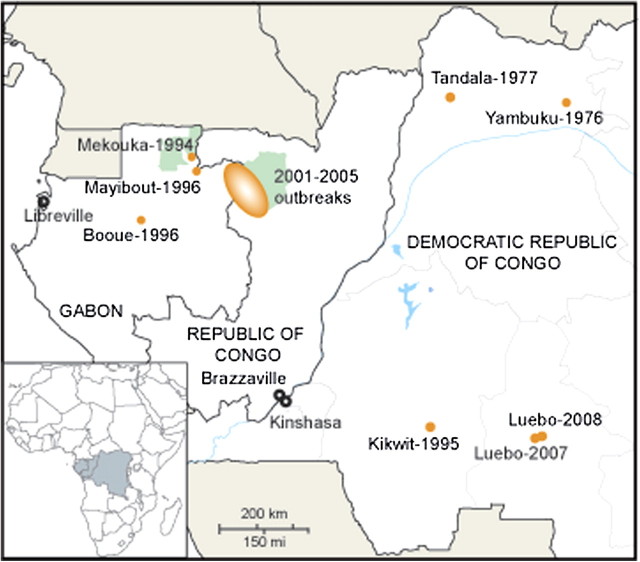
Figure 1.
Figure 1.
Zaire ebolavirus (ZEBOV) outbreak locations since 1976. The Minkebe National Park (Gabon) and Odzala National Park (Republic of the Congo) are in green.
Figure 2.
Figure 2.
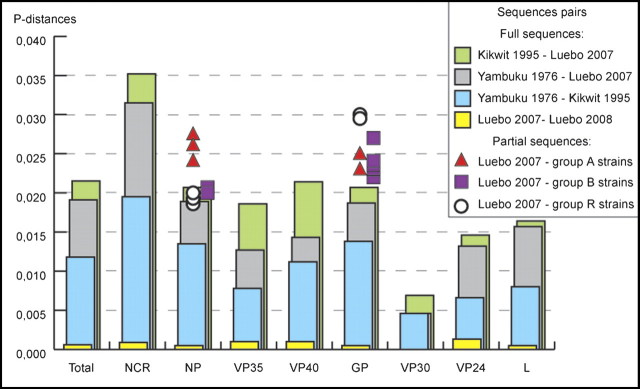
Zaire ebolavirus (ZEBOV) p-distances with respect to Luebo 2007 and Luebo 2008 sequences. Available complete sequences were first aligned for comparison with Luebo viruses. The p-distances between Yambuku 1976 and Kikwit 1995 are reported for reference (in blue). Complete GP coding sequences and partial NP coding sequences were then added to compare distances between Luebo viruses and other group A, B, and R partially characterized strains. NCR:, noncoding regions.
Figure 3.
Figure 3.
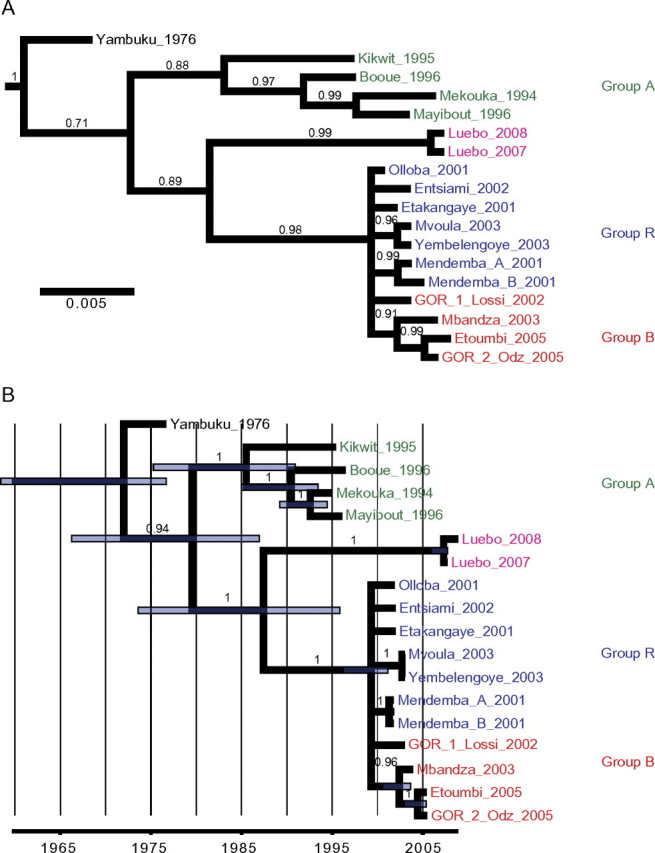
Bayesian phylogenies inferred from NP sequences, representing a consensus tree without molecular clock assumption (A) and a maximum clade credibility tree inferred under a ’dated tips’ molecular clock model (B ). Côte d’Ivoire ebolavirus (CIEBOV) and Bundibugyo Ebola virus (BEBOV) sequences were included as outgroups. Green: group A strains; red: group B strains; blue: group R strains. Branch support in form of Bayesian posterior probabilities is indicated above branches. In panel B, purple bars indicate the upper and lower limits of the 95% highest posterior density interval for estimated node ages.
Figure 4.
Figure 4.
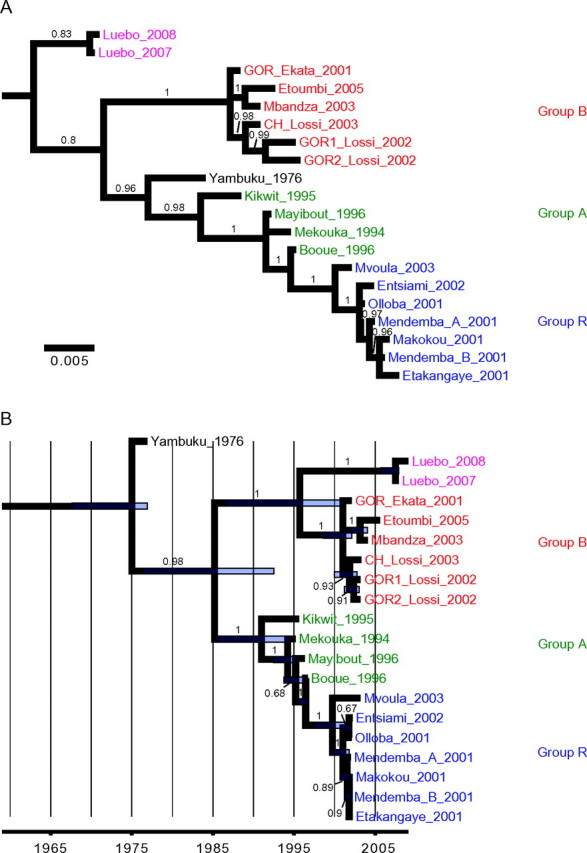
Bayesian phylogenenies inferred from GP sequences, representing a consensus tree without molecular-clock assumption (A) and a maximum clade credibility tree inferred under a ’dated tips’ molecular-clock model (B ). Côte d’Ivoire ebolavirus (CIEBOV) and Bundibugyo Ebola virus (BEBOV) sequences were included as outgroups. Green: group A strains; red: group B strains; blue: group R strains. Bayesian posterior probabilities are indicated above branches. In panel B, purple bars indicate the upper and lower limits of the 95% highest posterior density interval for estimated node ages.
Figure 5.
Figure 5.
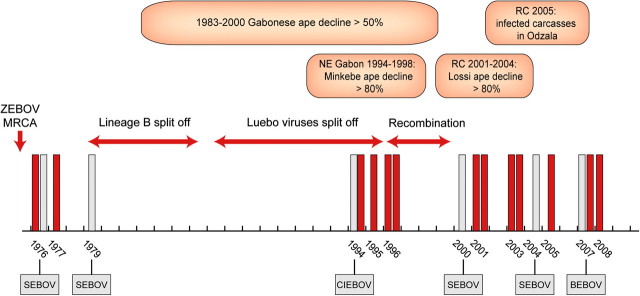
Zaire ebolavirus (ZEBOV) epizootics and human outbreaks (red line) are reported, along with outbreaks due to other Ebolavirus species (grey line). Time of occurrence of the main genetic events in Zaire ebolavirus (ZEBOV) evolution are reported in red; MRCA: most recent common ancestor. SEBOV: Sudan ebolavirus; CIEBOV: Côte d’Ivoire ebolavirus; BEBOV: Bundibugyo Ebola virus.

References

    1. Fauquet CM, Mayo MA, Maniloff J, Desselberger U, Ball LA, eds. Virus taxonomy, Eighth report of the International Committee on Taxonomy of Viruses. San Diego, California: Elsevier Academic Press; 2005.
    1. Towner JS, Sealy TK, Khristova ML, et al. Newly discovered Ebola virus associated with hemorrhagic fever outbreak in Uganda. PLoS Pathog. 2008;4:e1000212. - PMC - PubMed
    1. Johnson KM. Ebola haemorrhagic fever in Zaire, 1976. Bull World Health Organ. 1978;56:271–93. - PMC - PubMed
    1. Heymann DL, Weisfeld JS, Webb PA, Johnson KM, Cairns T, Berquist H. Ebola hemorrhagic fever: Tandala, Zaire, 1977–1978. J Infect Dis. 1980;142:372–6. - PubMed
    1. Georges-Courbot MC, Sanchez A, Lu CY, et al. Isolation and phylogenetic characterization of Ebola viruses causing different outbreaks in Gabon. Emerg Infect Dis. 1997;3:59–62. - PMC - PubMed

Publication types