


Acute sleep restriction effects on emotion responses in 30- to 36-month-old children
- PMID: 21988087
- PMCID: PMC3258474
- DOI: 10.1111/j.1365-2869.2011.00962.x
Acute sleep restriction effects on emotion responses in 30- to 36-month-old children
Abstract
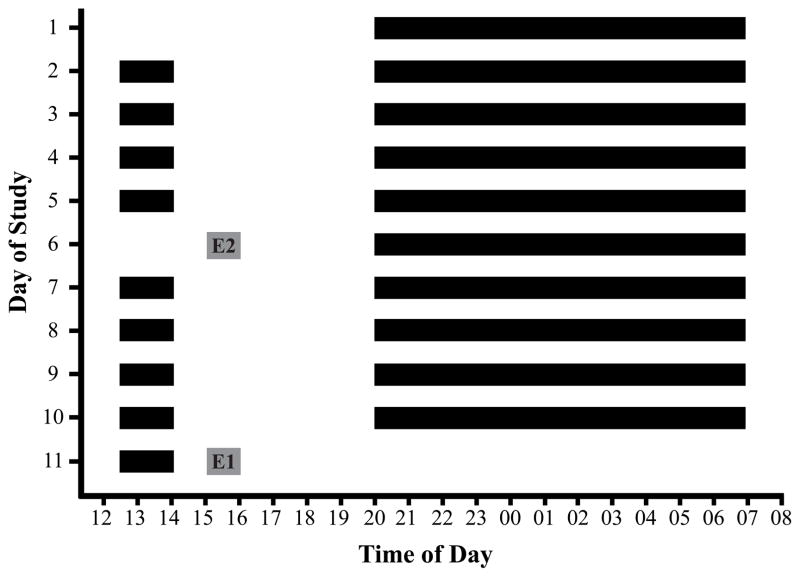
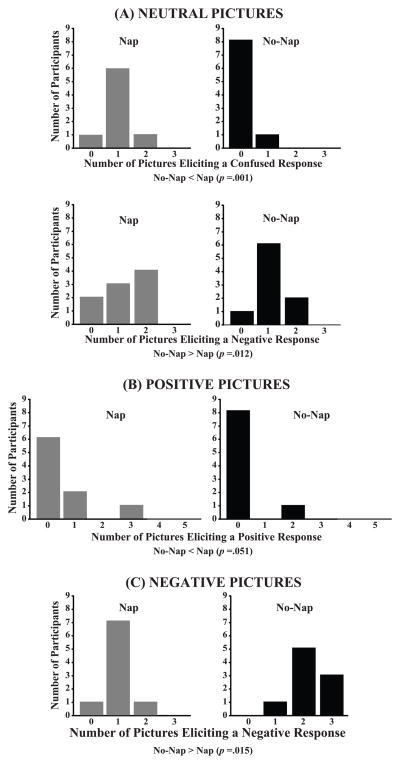
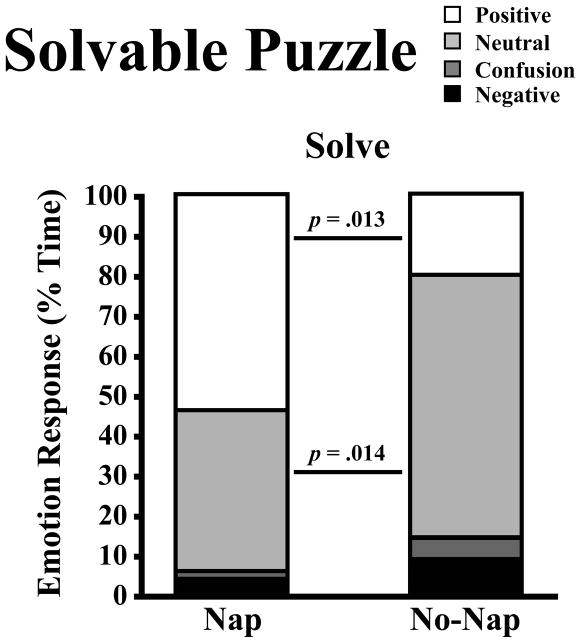
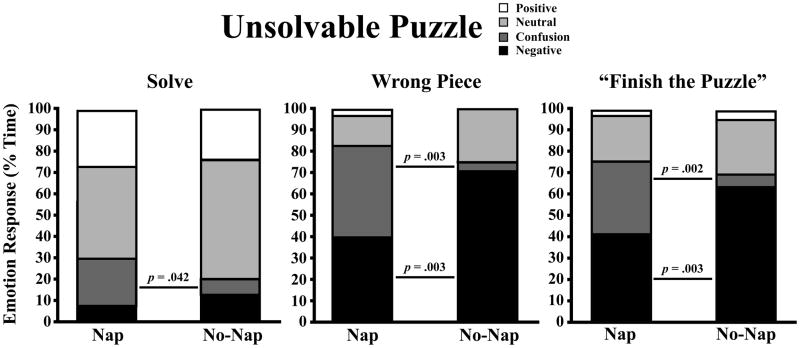
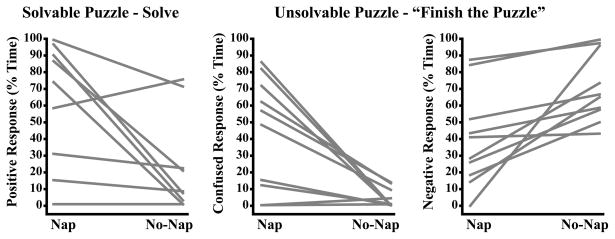
Early childhood is a period of dramatic change in sleep and emotion processing, as well as a time when disturbance in both domains are first detected. Although sleep is recognized as central in emotion processing and psychopathology, the great majority of experimental data have been collected in adults. We examined the effects of acute sleep restriction (nap deprivation) on toddlers' emotion expression. Ten healthy children (seven females; 30-36 months old) followed a strict sleep schedule (≥12.5 h time in bed per 24-h) for 5 days, before each of two randomly assigned afternoon emotion assessments following Nap and No-Nap conditions (resulting in an 11-day protocol). Children viewed emotion-eliciting pictures (five positive, three neutral, three negative) and completed puzzles (one solvable, one unsolvable). Children's faces were video-recorded, and emotion displays were coded. When sleep restricted, children displayed less confusion in response to neutral pictures, more negativity to neutral and negative pictures, and less positivity to positive pictures. Sleep restriction also resulted in a 34% reduction in positive emotion responses (solvable puzzle), as well as a 31% increase in negative emotion responses and a 39% decrease in confused responses (unsolvable puzzle). These findings suggest sleep is a key factor in how young children respond to their world. When sleep restricted, toddlers are neither able to take full advantage of positive experiences nor are they as adaptive in challenging contexts. If insufficient sleep consistently 'taxes' young children's emotion responses, they may not manage emotion regulation challenges effectively, potentially placing them at risk for future emotional/behavioral problems.
© 2011 European Sleep Research Society.
Figures

References
-
- Acebo C, Lebourgeois MK. Actigraphy. Respir Care Clin N Am. 2006;12:23–30. - PubMed
-
- Achenbach TM, Rescorla LA. Manual for ASEBA Preschool Forms & Profiles. University of Vermont, Research Center for Children, Youth, & Families; Burlington, VT: 2000.
-
- Brownell CA, Kopp CB. Socioemotional Development in the Toddler Years: Transitions and Transformations. Guilford Press; New York: 2007.
-
- Cole PM, Michel MK, Teti LO. The development of emotion regulation and dysregulation: A clinical perspective. In: Fox NA, editor. The Development of Emotion Regulation: Biological and Behavioral Considerations, Monographs of the Society for Research in Child Development. 2–3. Vol. 59. University of Chicago Press; Chicago: 1994. pp. 73–100. Series 240. - PubMed
-
- Coulombe JA, Reid GJ, Boyle MH, Racine Y. Concurrent associations among sleep problems, indicators of inadequate sleep, psychopathology, and shared risk factors in a population-based sample of healthy Ontario children. J Pediatr Psychol. 2010;35:790–9. - PubMed
Publication types
MeSH terms
Grants and funding
LinkOut - more resources
Full Text Sources
Medical
Research Materials
