


Analysis of conserved microRNAs in floral tissues of sexual and apomictic Boechera species
- PMID: 21988906
- PMCID: PMC3208272
- DOI: 10.1186/1471-2164-12-500
Analysis of conserved microRNAs in floral tissues of sexual and apomictic Boechera species
Abstract
Background: Apomixis or asexual seed formation represents a potentially important agronomic trait whose introduction into crop plants could be an effective way to fix and perpetuate a desirable genotype through successive seed generations. However, the gene regulatory pathways underlying apomixis remain unknown. In particular, the potential function of microRNAs, which are known to play crucial roles in many aspects of plant growth and development, remains to be determined with regards to the switch from sexual to apomictic reproduction.
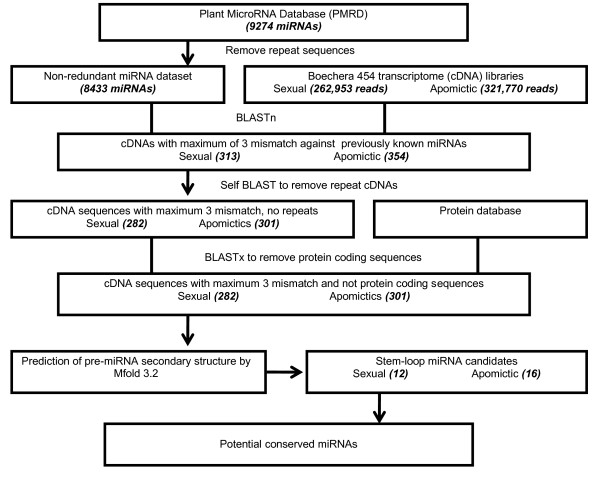
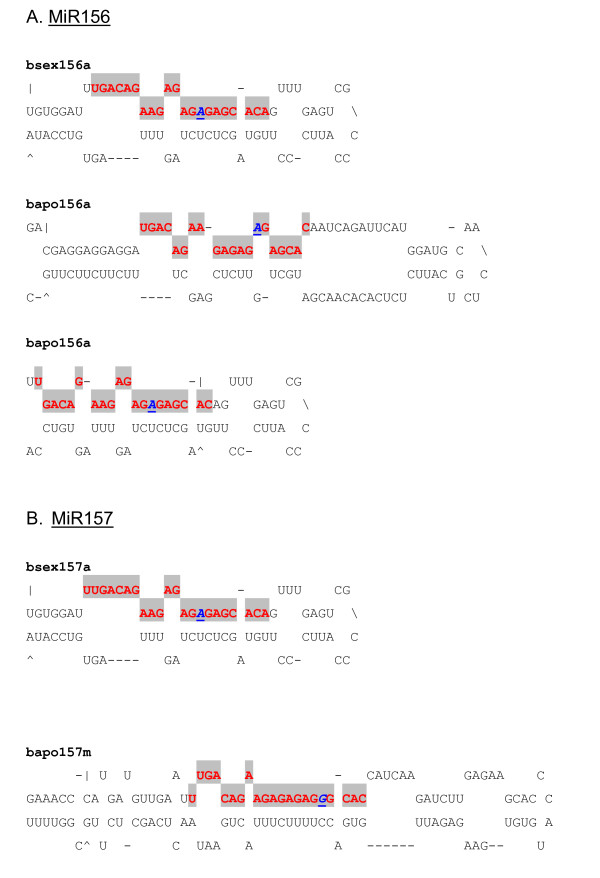
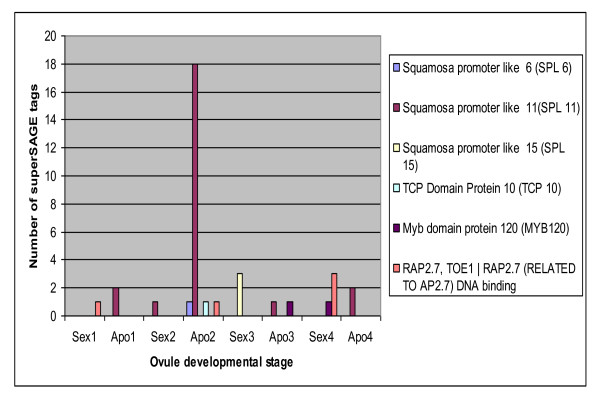
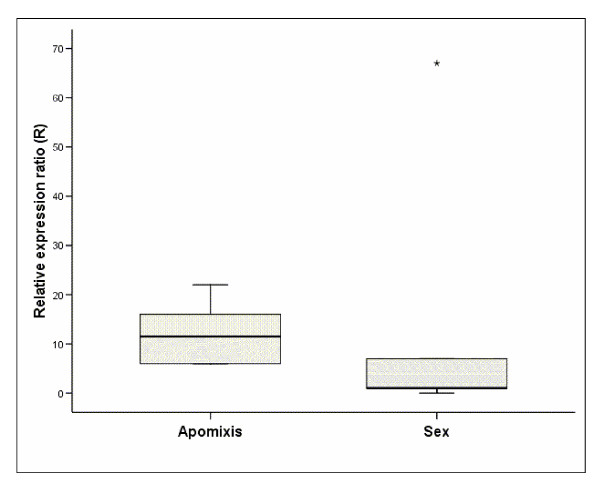
Results: Using bioinformatics and microarray validation procedures, 51 miRNA families conserved among angiosperms were identified in Boechera. Microarray assay confirmed 15 of the miRNA families that were identified by bioinformatics techniques. 30 cDNA sequences representing 26 miRNAs could fold back into stable pre-miRNAs. 19 of these pre-miRNAs had miRNAs with Boechera-specific nucleotide substitutions (NSs). Analysis of the Gibbs free energy (ΔG) of these pre-miRNA stem-loops with NSs showed that the Boechera-specific miRNA NSs significantly (p ≤ 0.05) enhance the stability of stem-loops. Furthermore, six transcription factors, the Squamosa promoter binding protein like SPL6, SPL11 and SPL15, Myb domain protein 120 (MYB120), RELATED TO AP2.7 DNA binding (RAP2.7, TOE1 RAP2.7) and TCP family transcription factor 10 (TCP10) were found to be expressed in sexual or apomictic ovules. However, only SPL11 showed differential expression with significant (p ≤ 0.05) up-regulation at the megaspore mother cell (MMC) stage of ovule development in apomictic genotypes.
Conclusions: This study constitutes the first extensive insight into the conservation and expression of microRNAs in Boechera sexual and apomictic species. The miR156/157 target squamosa promoter binding protein-like 11 (SPL11) was found differentially expressed with significant (p ≤ 0.05) up-regulation at the MMC stage of ovule development in apomictic genotypes. The results also demonstrate that nucleotide changes in mature miRNAs significantly (p ≤ 0.05) enhance the thermodynamic stability of pre-miRNA stem-loops.
Figures
References
-
- Simon JC, Delmotte F, Rispe C, Crease T. Phylogenetic relationships between parthenogens and their sexual relatives: the possible routes to parthenogenesis in animals. Biol J Linn Soc Lond. 2003;79:151–163. doi: 10.1046/j.1095-8312.2003.00175.x. - DOI
-
- Koch M, Bishop J, Mitchell-Olds T. Molecular systematics and evolution of Arabidopsis and Arabis. Plant Biology. 1999;1:529–537. doi: 10.1111/j.1438-8677.1999.tb00779.x. - DOI
-
- Böcher TW. Cytological and embryological studies in the amphi-apomictic Arabis holboellii complex. Det Kongelige Danske Videnskabernes Selskab. 1951;6:1–59.
Publication types
MeSH terms
Substances
LinkOut - more resources
Full Text Sources
Research Materials
