


Review
doi: 10.1055/s-0031-1287870.
Epub 2011 Oct 11.
Acute lung failure
Affiliations
- PMID: 21989697
- PMCID: PMC3601050
- DOI: 10.1055/s-0031-1287870
Item in Clipboard
Review
Acute lung failure
Semin Respir Crit Care Med.
2011 Oct.
Abstract
Lung failure is the most common organ failure seen in the intensive care unit. The pathogenesis of acute respiratory failure (ARF) can be classified as (1) neuromuscular in origin, (2) secondary to acute and chronic obstructive airway diseases, (3) alveolar processes such as cardiogenic and noncardiogenic pulmonary edema and pneumonia, and (4) vascular diseases such as acute or chronic pulmonary embolism. This article reviews the more common causes of ARF from each group, including the pathological mechanisms and the principles of critical care management, focusing on the supportive, specific, and adjunctive therapies for each condition.
© Thieme Medical Publishers.
Figures
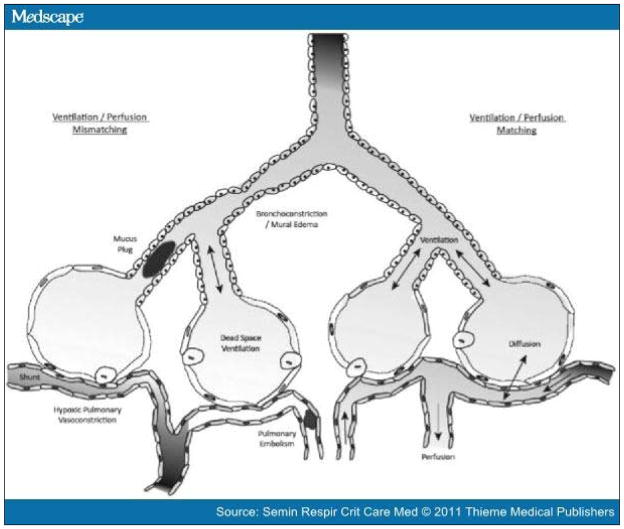
The four primary alveolar processes: ventilation, diffusion, perfusion, and their regulatory mechanism hypoxic pulmonary vasoconstriction. All forms of lung failure result from a defect in one or more of these processes which culminates in V/Q mismatch, or its extreme variants shunt and dead space ventilation.
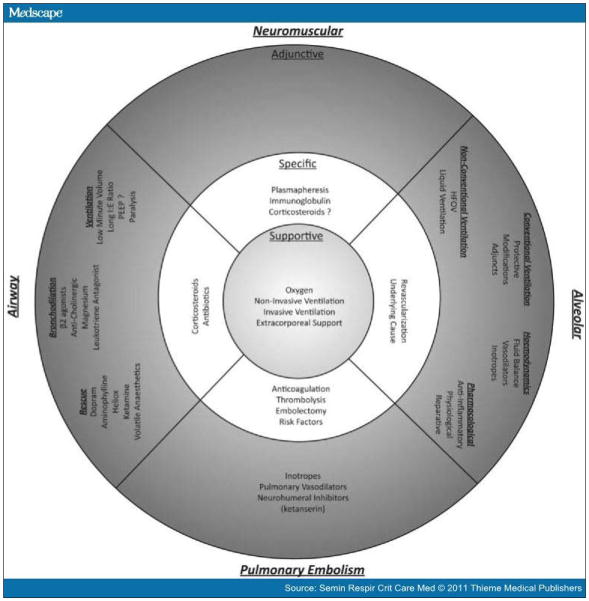
Comparison of therapies for different modes of lung failure. See text for details.
References
-
- Vincent J-L, de Mendonça A, Cantraine F, et al. Use of the SOFA score to assess the incidence of organ dysfunction/failure in intensive care units: results of a multicenter, prospective study. Working group on ‘sepsis-related problems’ of the European Society of Intensive Care Medicine. Crit Care Med. 1998;26(11):1793–1800. - PubMed
-
- Vincent J-L, Akça S, De Mendonça A, et al. SOFA Working Group. Sequntial organ failure assessment. The epidemiology of acute respiratory failure in critically ill patients(*) Chest. 2002;121(5):1602–1609. - PubMed
-
- Hadden RDM, Cornblath DR, Hughes RAC, et al. Plasma Exchange/Sandoglobulin Guillain-Barré Syndrome Trial Group. Electrophysiological classification of Guillain-Barré syndrome: clinical associations and outcome. Ann Neurol. 1998;44(5):780–788. - PubMed
-
- Hughes RA, Cornblath DR. Guillain-Barré syndrome. Lancet. 2005;366(9497):1653–1666. - PubMed
-
- Winer JB. Guillain-Barré syndrome. BMJ. 2008;337:a671. doi: 10:1136/bmj.a671. Review. No abstract available 227–231. - PubMed
Publication types
MeSH terms
Grants and funding
LinkOut - more resources
Full Text Sources
Other Literature Sources
Medical
