


Clinical significance of NTRK family gene expression in neuroblastomas
- PMID: 21990266
- PMCID: PMC3258457
- DOI: 10.1002/pbc.23343
Clinical significance of NTRK family gene expression in neuroblastomas
Abstract
Background: Neuroblastomas (NBs) are characterized by clinical heterogeneity, from spontaneous regression to relentless progression. The pattern of NTRK family gene expression contributes to these disparate behaviors. TrkA/NTRK1 is expressed in favorable NBs that regress or differentiate, whereas TrkB/NTRK2 and its ligand brain-derived neurotrophic factor (BDNF) are co-expressed in unfavorable NBs, representing an autocrine survival pathway. We determined the significance of NTRK family gene expression in a large, representative set of primary NBs.
Patients and methods: We analyzed the expression of the following genes in 814 NBs using quantitative real-time reverse transcriptase polymerase chain reaction (RT-PCR): NTRK1, NTRK2, NTRK3, P75/NGFR, nerve growth factor (NGF), BDNF, IGFR1, and EGFR. Expression (high vs. low) was dichotomized by median expression value and compared to clinical and biological variables as well as outcome.
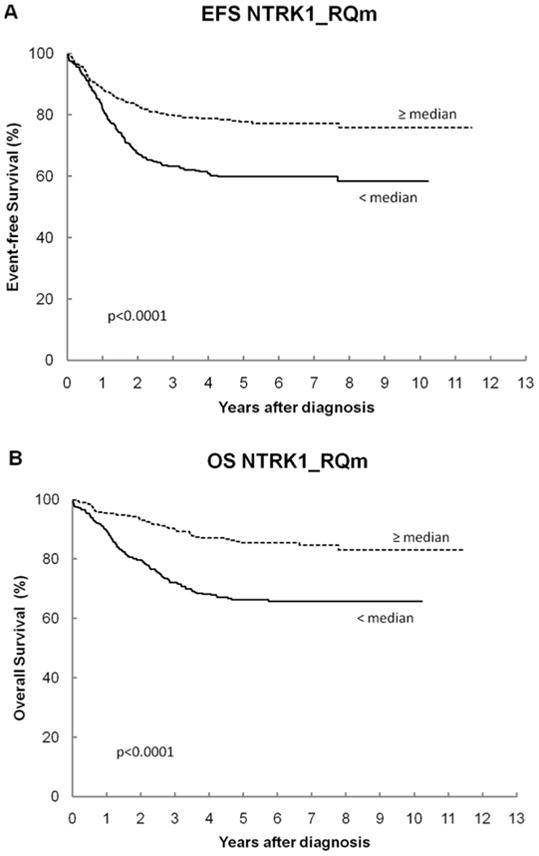
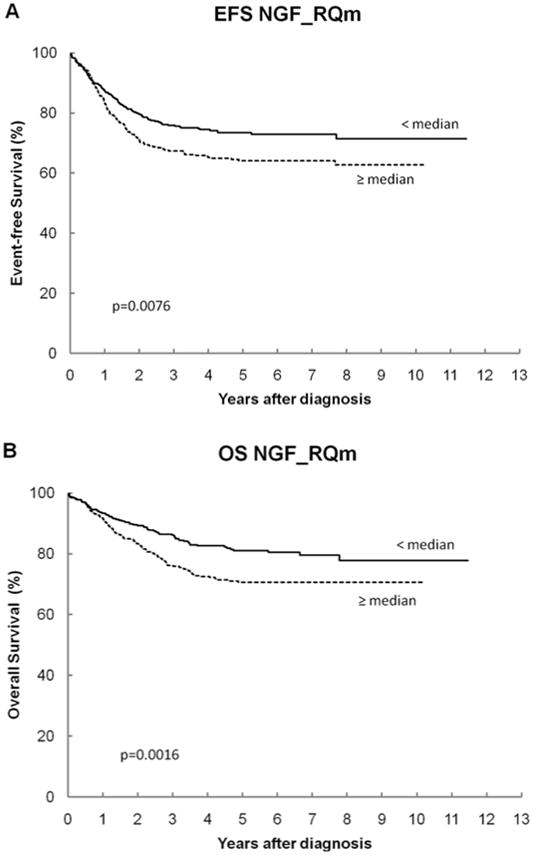
Results: High NTRK1 expression was strongly correlated with favorable age, stage, MYCN status, histology, ploidy, risk group, and outcome (P < 0.0001 for all). However, it did not add significantly to the panel of prognostic variables currently used for cooperative group trials. NTRK2 expression was associated with risk factors but not with outcome. High NGF expression was also associated with most risk factors and weakly with unfavorable outcome.
Conclusions: High expression of NTRK1 is strongly associated with favorable risk factors and outcome in a large, representative population of NB patients. It did not add significantly to the current risk prediction algorithm, but it may contribute to future expression classifiers. Indeed, prospective assessment of NTRK1 and NTRK2 expression will identify tumors that would be candidates for NTRK-targeted therapy, either alone or in combination with conventional agents.
Copyright © 2011 Wiley Periodicals, Inc.
Conflict of interest statement
None of the authors have any conflicting financial interests with any of the material, data, results or conclusions in this manuscript.
References
-
- Brodeur GM, Hogarty MD, Mosse YP, et al. Neuroblastoma. In: Pizzo PA, Poplack DG, editors. Principles and Practice of Pediatric Oncology. 6. Philadelphia: Lippincott, Williams and Wilkins; 2011. pp. 886–922.
-
- Brodeur GM. Neuroblastoma: biological insights into a clinical enigma. Nat Rev Cancer. 2003;3(3):203–216. - PubMed
-
- Nakagawara A, Arima M, Azar CG, et al. Inverse relationship between trk expression and N-myc amplification in human neuroblastomas. Cancer Res. 1992;52(5):1364–1368. - PubMed
Publication types
MeSH terms
Substances
Grants and funding
LinkOut - more resources
Full Text Sources
Other Literature Sources
Medical
Research Materials
Miscellaneous
