. 2011 Dec 23;286(51):43933-43943.
doi: 10.1074/jbc.M111.241232. Epub 2011 Oct 11.

α-Synuclein stimulates a dopamine transporter-dependent chloride current and modulates the activity of the transporter

Affiliations

α-Synuclein stimulates a dopamine transporter-dependent chloride current and modulates the activity of the transporter

Jarod Swant et al. J Biol Chem. .

Abstract

Dysregulation of dopamine (DA) homeostasis is implicated in neurodegenerative diseases, drug addiction, and neuropsychiatric disorders. The neuronal plasma membrane dopamine transporter (DAT) is essential for the maintenance of DA homeostasis in the brain. α-Synuclein is a 140-amino acid protein that forms a stable complex with DAT and is linked to the pathogenesis of neurodegenerative disease. To elucidate the potential functional consequences of DAT/α-synuclein interaction, we explored α-synuclein modulation of DAT activity in midbrain dopaminergic neurons obtained from TH::RFP mice, immortalized DA neurons, and a heterologous system expressing DAT. We used dual pipette whole cell patch clamp recording to measure the DAT-mediated current before and after dialysis of recombinant α-synuclein into immortalized DA neurons. Our data suggest that intracellular α-synuclein induces a Na+ independent but Cl--sensitive inward current in DAT-expressing cells. This current is blocked by DAT blocker GBR12935 and is absent when heat-inactivated α-synuclein is dialyzed into these cells. The functional consequence of this interaction on DAT activity was further examined with real-time monitoring of transport function using a fluorescent substrate of DAT, 4-(4-(dimethylamino)styryl)-N-methylpyridinium (ASP+). Overexpression of α-synuclein in DAT-positive immortalized DA neurons and CHO cells expressing DAT decreased the magnitude and rate of DAT-mediated substrate uptake without a decrease in the initial binding of the substrate at the plasma membrane. Taken together our findings are consistent with the interpretation that DAT/α-synuclein interaction at the cell surface results in a DAT-dependent, Na+-insensitive, Cl-sensitive inward current with a decrease in substrate uptake, suggesting that DAT/α-synuclein interaction can modulate dopamine transmission and thus neuronal function.


Figures
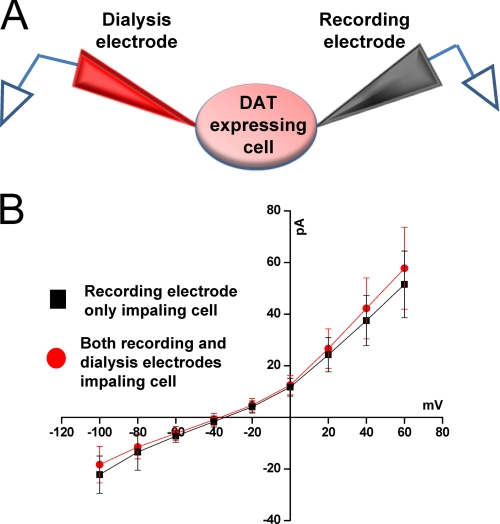
FIGURE 1.
FIGURE 1.
Dual patch clamp technique is an advantageous approach to measure changes in DAT-mediated whole cell currents. A, shown is a schematic presentation of an experimental configuration. Immortalized DA neurons (1RB3AN27 cells) stably overexpressing DAT were voltage-clamped with two patch electrodes (one in voltage clamp mode, the other in current clamp mode). B, representative DAT-mediated whole cell currents after single and dual patch clamp show that dual patch clamp does not affect DAT-mediated currents. After obtaining two tight seals, the recording electrode was switched into whole cell voltage clamp configuration, whereas the dialysis electrode was kept in current-clamp mode. After a 10-min equilibration period, whole cell currents were recorded by stepping the membrane potential in 20-mV steps (+60 to −100 mV), from a holding potential of −20 mV. The dialysis electrode was then gently transitioned into the whole cell configuration and quickly switched back to current clamp mode. This electrode remained in current clamp mode throughout the rest of the experiment. Ten minutes after the dialysis electrode assumed whole cell configuration, a second I(V) was generated. Both electrodes contained physiological-like internal solution (see above) (n = 7).
FIGURE 2.
FIGURE 2.
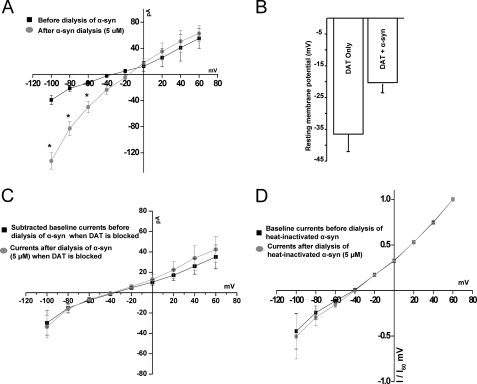
A and B, α-synuclein increases DAT-mediated inward currents and induces a rightward shift in the current-voltage I(V) relationship. A, the experiments were performed as in Fig. 1 except the dialysis electrode contained 5 μm α-synuclein. Briefly, after two tight seals were obtained, the recording electrode was transitioned into whole cell configuration. The whole cell currents were recorded as described in Fig. 1. The dialysis electrode containing 5 μm α-synuclein was then switched to whole cell configuration, dialyzing the recombinant α-synuclein into the cell for 10 min. Whole cell currents were recorded at this time (n = 4–5). B, shown are resting membrane potentials of cells expressing DAT only or DAT with and without α-synuclein (n = 6). C, active dopamine transporter is required for α-synuclein-stimulated increase in inward currents. A 5-min pre-application of a DAT blocker, GBR 12935 (5 μm), eliminates the effect of α-synuclein on inward currents and the rightward shift in the current voltage relationship. The black squares represent GBR12935 subtracted base-line currents. The circles represent the currents after the dialysis of α-synuclein into the cell when the transporter is blocked (n = 4) D, heat-inactivated α-synuclein does not increase the inward currents or affect the reversal potential. Averaged normalized whole cell currents before and after dialysis of heat-inactivated α-synuclein into the cell are shown; experiments were performed as in Figs. 2 and 3. Whole cell currents were recorded before and 10 min after dialysis of heat-inactivated α-synuclein into the cell. There is no effect on the reversal potential of the I(V) curve with intracellular heat-inactivated α-synuclein (n = 4).
FIGURE 3.
FIGURE 3.
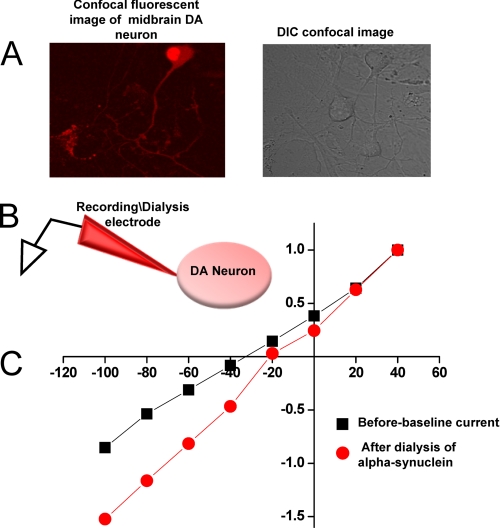
A–C, dialysis of α-synuclein into DA neuron increases DAT-mediated inward currents and induces a rightward shift in the current-voltage I(V) relationship. A, the left panel depicts a confocal fluorescent image of midbrain DA, and the right panel is the differential interference contrast (DIC) confocal image of the same field showing that in the acutely dissociated midbrain primary culture a DA neuron can be selected for recording. Panel B depicts the experimental configuration of α-synuclein dialysis into the neuron via the recording electrode. C, the voltage-current relationship at time 0 (black squares) and 10 min after dialysis of α-synuclein (red circles) into the neuron is shown.
FIGURE 4.
FIGURE 4.
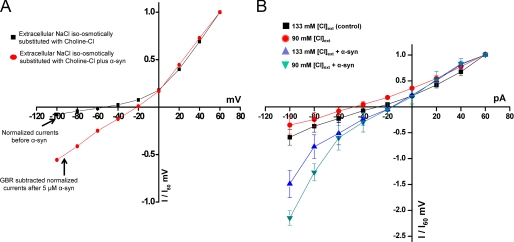
A, α-synuclein-mediated inward currents are not dependent on extracellular Na+. The experiments were performed as in Figs. 1 and 2. Representative I(V) for the iso-osmotic substitution of choline chloride for NaCl in the external solution in the absence (black squares) or presence (red circles) of 5 μm α-synuclein. Note the decrease in DAT-mediated inward current (black squares) in the absence of extracellular Na+ as reported by Sonders et al. (63). Intracellular α-synuclein sustains an increase in the GBR12935 sensitive inward currents (red circles) in the absence of extracellular Na+. The intracellular α-synuclein induces a rightward shift in the reversal potential of I(V). The ionic compositions of the solutions in the recording and dialysis electrodes are as described in Fig. 1 and kept constant. The dialysis electrode contained 5 μm recombinant α-synuclein. Circles depict GBR12935 sensitive currents (n = 4). B, the magnitude of α-synuclein-mediated inward current is affected by extracellular Cl levels. In the presence of intracellular α-synuclein the GBR 12935-sensitive inward current increases when external Cl is reduced (Cl gradient is increased). The experiments were performed as described in Figs. 1 and 2 except that the external solution contained either 130 or 90 mm Cl (reduced) by iso-osmotic substitution of NaCl with sodium acetate. In all experiments the pH for the intracellular and extracellular solutions was adjusted to 7.35. The osmolarity for internal and external solutions kept constant 270 and 290 mosm, respectively. The dialysis pipette contained α-synuclein or heat-inactivated α-synuclein (n = 5).
FIGURE 5.
FIGURE 5.
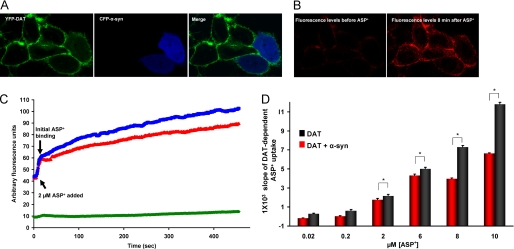
A and B, overexpression of α-synuclein decreases substrate uptake via DAT. A, representative images show live cell images of CHO cells stably expressing YFP-DAT, transiently expressing CFP-α-synuclein, and merge. B, before and after ASP+ binding and transport via cell surface DAT is shown. ASP+ uptake is decreased in α-synuclein expressing cells as measured by a decrease in intracellular ASP+ fluorescence. C and D, the rate of DAT-mediated substrate uptake decreases when α-synuclein is overexpressed. C, the average uptake rate of 2 μm ASP+ is decreased when α-synuclein is overexpressed in DAT cells. The blue line depicts DAT-expressing cells, the red line depicts DAT and α-synuclein-expressing cells, and the green line shows cells expressing no dopamine transporter. D, shown is a bar graph summary of the rate of ASP+ uptake over multiple concentrations of ASP+ in DAT cells overexpressing α-synuclein. The error bars in B depict mean ± S.D., and the values are listed in supplemental Table 1.
FIGURE 6.
FIGURE 6.
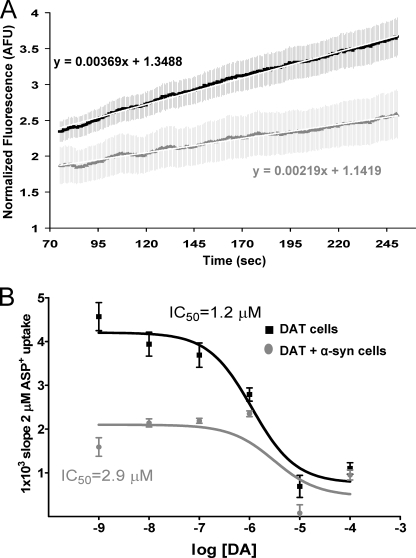
α-Synuclein overexpression increases the IC50 for DA. A, in the presence of dopamine (0.01 μm), the rate of ASP+ uptake is decreased by α-synuclein. B, competitive binding curve demonstrates that dopamine competes for ASP+ uptake. Note the lower ASP+ uptake in cells expressing both DAT and α-synuclein. The error bars in B depict the mean ± S.D., and the values are listed in supplemental Table 2.

References

    1. Abramov E., Dolev I., Fogel H., Ciccotosto G. D., Ruff E., Slutsky I. (2009) Nat. Neurosci. 12, 1567–1576 - PubMed
    1. Gray B. C., Siskova Z., Perry V. H., O'Connor V. (2009) Neurobiol. Dis. 35, 63–74 - PubMed
    1. Zhang C., Wu B., Beglopoulos V., Wines-Samuelson M., Zhang D., Dragatsis I., Südhof T. C., Shen J. (2009) Nature 460, 632–636 - PMC - PubMed
    1. Nemani V. M., Lu W., Berge V., Nakamura K., Onoa B., Lee M. K., Chaudhry F. A., Nicoll R. A., Edwards R. H. (2010) Neuron 65, 66–79 - PMC - PubMed
    1. Chandra S., Fornai F., Kwon H. B., Yazdani U., Atasoy D., Liu X., Hammer R. E., Battaglia G., German D. C., Castillo P. E., Südhof T. C. (2004) Proc. Natl. Acad. Sci. U.S.A. 101, 14966–14971 - PMC - PubMed

Publication types

LinkOut - more resources