


Preexisting Japanese encephalitis virus neutralizing antibodies and increased symptomatic dengue illness in a school-based cohort in Thailand
- PMID: 21991398
- PMCID: PMC3186763
- DOI: 10.1371/journal.pntd.0001311
Preexisting Japanese encephalitis virus neutralizing antibodies and increased symptomatic dengue illness in a school-based cohort in Thailand
Abstract
Background: Dengue viruses (DENVs) and Japanese encephalitis virus (JEV) have significant cross-reactivity in serological assays; the clinical implications of this remain undefined. An improved understanding of whether and how JEV immunity modulates the clinical outcome of DENV infection is important as large-scale DENV vaccine trials will commence in areas where JEV is co-endemic and/or JEV immunization is routine.
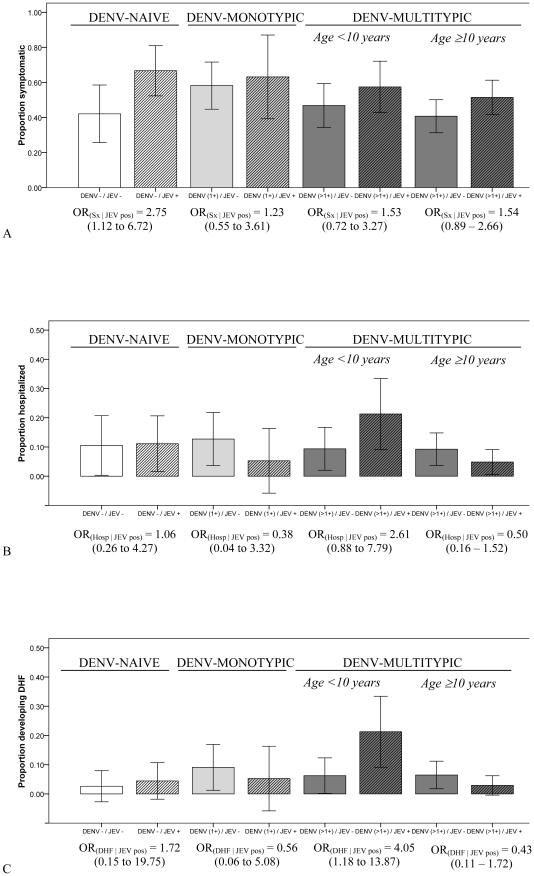
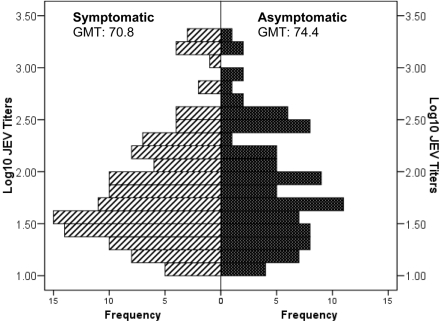
Methods and findings: The association between preexisting JEV neutralizing antibodies (NAbs) and the clinical severity of DENV infection was evaluated in a prospective school-based cohort in Thailand that captured asymptomatic, non-hospitalized, and hospitalized DENV infections. Covariates considered included age, baseline DENV antibody status, school of attendance, epidemic year, and infecting DENV serotype. 942 children experienced at least one DENV infection between 1998 and 2002, out of 3,687 children who were enrolled for at least one full year. In crude analysis, the presence of JEV NAbs was associated with an increased occurrence of symptomatic versus asymptomatic infection (odds ratio [OR]= 1.55, 95% CI: 1.08-2.23) but not hospitalized illness or dengue hemorrhagic fever (DHF). The association was strongest in children with negative DENV serology (DENV-naive) (OR=2.75, 95% CI: 1.12-6.72), for whom the presence of JEV NAbs was also associated with a symptomatic illness of longer duration (5.4 days for JEV NAb+ versus 2.6 days for JEV NAb-, p=0.048). JEV NAbs were associated with increased DHF in younger children with multitypic DENV NAb profiles (OR=4.05, 95% CI: 1.18 to 13.87). Among those with JEV NAbs, the association with symptomatic illness did not vary by antibody titer.
Interpretation: The prior existence of JEV NAbs was associated with an increased probability of symptomatic as compared to asymptomatic DENV illness. These findings are in contrast to previous studies suggesting an attenuating effect of heterologous flavivirus immunity on DENV disease severity.
Conflict of interest statement
The authors have declared that no competing interests exist.
Figures
References
-
- Grossman RA, Gould D, Smith TJ, Johnsen DO, Pantuwatana S. Study of Japanese encephalitis virus in Chiangmai valley, Thailand. I. Introduction and study design. Am J Epidemiol. 1973;98:111–120. - PubMed
-
- Endy TP, Nisalak A. Japanese encephalitis virus: ecology and epidemiology. Curr Top Microbiol Immunol. 2002;267:11–48. - PubMed
-
- Chunsuttiwat S. Department of Communicable Disease Control, Ministry of Public Health, Thailand; 1998. Issues related to integration of JE vaccine into national EPI: experience from Thailand.
-
- Makino Y, Tadano M, Saito M, Maneekarn N, Sittisombut N, et al. Studies on serological cross-reaction in sequential flavivirus infections. Microbiol Immunol. 1994;38:951–955. - PubMed
Publication types
MeSH terms
Substances
Grants and funding
LinkOut - more resources
Full Text Sources
Medical
