Oral acyclovir suppression and neurodevelopment after neonatal herpes
- PMID: 21991950
- PMCID: PMC3250992
- DOI: 10.1056/NEJMoa1003509
Oral acyclovir suppression and neurodevelopment after neonatal herpes
Abstract
Background: Poor neurodevelopmental outcomes and recurrences of cutaneous lesions remain unacceptably frequent among survivors of neonatal herpes simplex virus (HSV) disease.
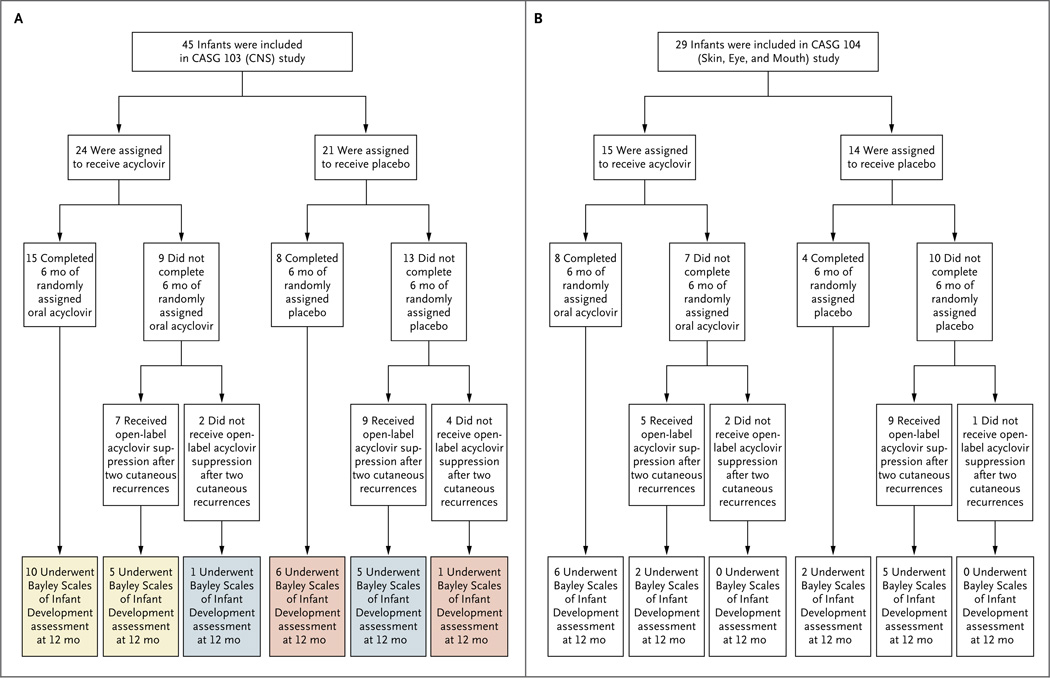
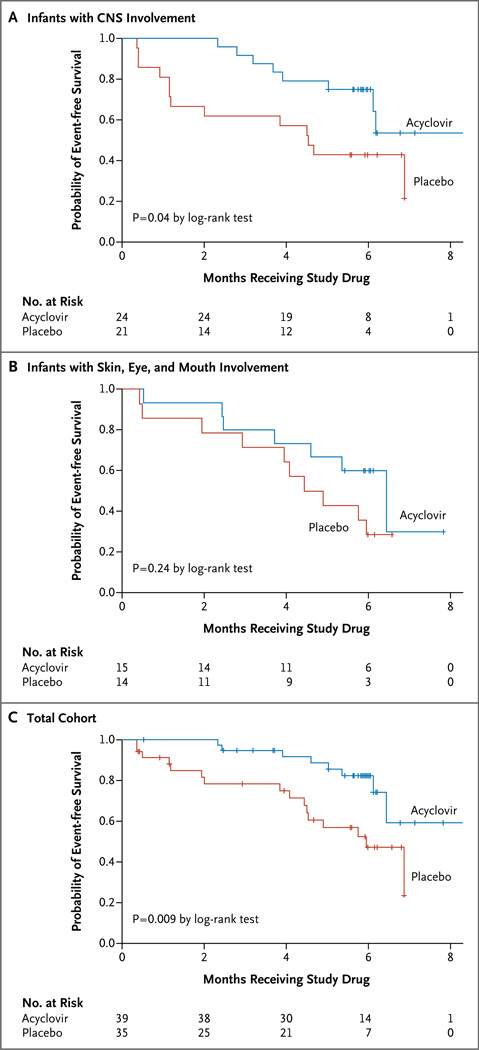
Methods: We enrolled neonates with HSV disease in two parallel, identical, double-blind, placebo-controlled studies. Neonates with central nervous system (CNS) involvement were enrolled in one study, and neonates with skin, eye, and mouth involvement only were enrolled in the other. After completing a regimen of 14 to 21 days of parenteral acyclovir, the infants were randomly assigned to immediate acyclovir suppression (300 mg per square meter of body-surface area per dose orally, three times daily for 6 months) or placebo. Cutaneous recurrences were treated with open-label episodic therapy.
Results: A total of 74 neonates were enrolled--45 with CNS involvement and 29 with skin, eye, and mouth disease. The Mental Development Index of the Bayley Scales of Infant Development (in which scores range from 50 to 150, with a mean of 100 and with higher scores indicating better neurodevelopmental outcomes) was assessed in 28 of the 45 infants with CNS involvement (62%) at 12 months of age. After adjustment for covariates, infants with CNS involvement who had been randomly assigned to acyclovir suppression had significantly higher mean Bayley mental-development scores at 12 months than did infants randomly assigned to placebo (88.24 vs. 68.12, P=0.046). Overall, there was a trend toward more neutropenia in the acyclovir group than in the placebo group (P=0.09).
Conclusions: Infants surviving neonatal HSV disease with CNS involvement had improved neurodevelopmental outcomes when they received suppressive therapy with oral acyclovir for 6 months. (Funded by the National Institute of Allergy and Infectious Diseases; CASG 103 and CASG 104 ClinicalTrials.gov numbers, NCT00031460 and NCT00031447, respectively.).
Figures
Comment in
-
Neonatal herpes simplex infection and the Three Musketeers.N Engl J Med. 2011 Oct 6;365(14):1338-9. doi: 10.1056/NEJMe1107953. N Engl J Med. 2011. PMID: 21991957 Free PMC article. No abstract available.
-
Oral acyclovir suppression after neonatal herpes.N Engl J Med. 2012 Jan 5;366(1):90; author reply 90-1. doi: 10.1056/NEJMc1112822. N Engl J Med. 2012. PMID: 22216852 No abstract available.
References
-
- Kimberlin DW, Lin CY, Jacobs RF, et al. Natural history of neonatal herpes simplex virus infections in the acyclovir era. Pediatrics. 2001;108:223–229. - PubMed
-
- Kimberlin DW, Lin CY, Jacobs RF, et al. Safety and efficacy of high-dose intravenous acyclovir in the management of neonatal herpes simplex virus infections. Pediatrics. 2001;108:230–238. - PubMed
-
- Whitley R, Arvin A, Prober C, et al. A controlled trial comparing vidarabine with acyclovir in neonatal herpes simplex virus infection. N Engl J Med. 1991;324:444–449. - PubMed
-
- Whitley RJ, Kimberlin DW, Roizman B. Herpes simplex viruses. Clin Infect Dis. 1998;26:541–553. - PubMed
-
- Kimberlin DW, Rouse DJ. Genital herpes. N Engl J Med. 2004;350:1970–1977. - PubMed
Publication types
MeSH terms
Substances
Supplementary concepts
Associated data
Grants and funding
LinkOut - more resources
Full Text Sources
Other Literature Sources
Medical