. 2012 Jan 20;7(1):155-9.
doi: 10.1021/cb200230x. Epub 2011 Oct 21.

Plasmodium falciparum Sir2A preferentially hydrolyzes medium and long chain fatty acyl lysine

Plasmodium falciparum Sir2A preferentially hydrolyzes medium and long chain fatty acyl lysine

Anita Y Zhu et al. ACS Chem Biol. .

Abstract

Plasmodium falciparum Sir2A (PfSir2A), a member of the sirtuin family of nicotinamide adenine dinucleotide-dependent deacetylases, has been shown to regulate the expression of surface antigens to evade the detection by host immune surveillance. It is thought that PfSir2A achieves this by deacetylating histones. However, the deacetylase activity of PfSir2A is weak. Here we present enzymology and structural evidence supporting that PfSir2A catalyzes the hydrolysis of medium and long chain fatty acyl groups from lysine residues more efficiently. Furthermore, P. falciparum proteins are found to contain such fatty acyl lysine modifications that can be removed by purified PfSir2A in vitro. Together, the data suggest that the physiological function of PfSir2A in antigen variation may be achieved by removing medium and long chain fatty acyl groups from protein lysine residues. The robust activity of PfSir2A would also facilitate the development of PfSir2A inhibitors, which may have therapeutic value in malaria treatment.


Figures
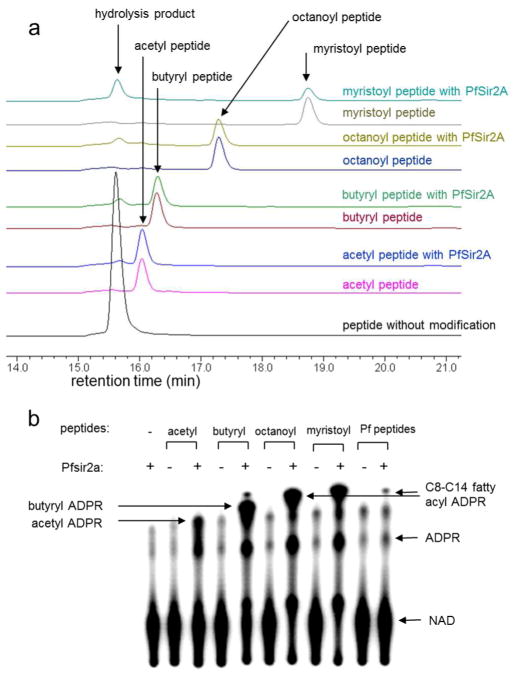
Figure 1
Figure 1
PfSir2A could hydrolyze medium and long chain fatty acyl lysine more efficiently than acetyl lysine. a) Overlaid HPLC traces showing PfSir2A-catalyzed hydrolysis of different fatty acyl lysine peptides. Acyl peptides were used at 20 μM, PfSir2A at 1 μM, and NAD at 500 μM. The corresponding synthetic peptide without any acyl lysine modification (H3K9WW unmodified) was used as the control to indicate the position of the hydrolysis product formed. b) 32P-NAD assay could detect the presence of medium or long chain fatty acyl lysine modifications on P. falciparum proteins. PfSir2A were incubated with 32P-NAD and synthetic peptides bearing different acyl modifications. Negative controls were reactions without PfSir2A or peptides. The reactions were resolved by TLC and detected by autoradiography. With P. falciparum peptides (last two lanes), the acyl ADPR spot formed was similar to the C8–C14 acyl ADPR, suggesting that such fatty acyl groups were present and could be removed by PfSir2A.
Figure 2
Figure 2
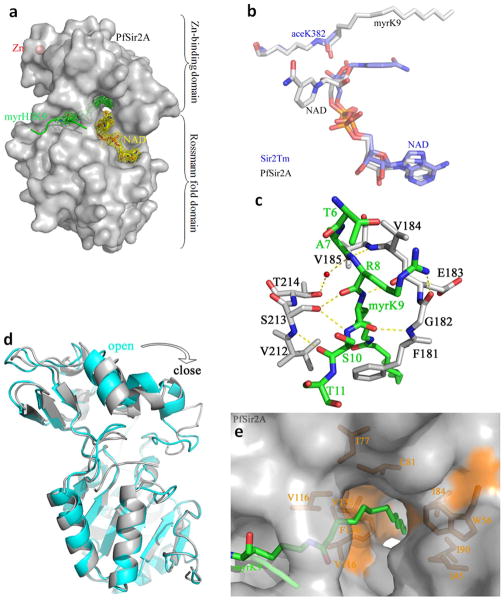
Structural basis for the recognition of myristoyl lysine by PfSir2A. a) Overall structure of PfSir2A. The Fo-Fc map at 1.6σ shows the H3K9 myristoyl peptide (green) and NAD (yellow) at the active site. b) The structural alignment between Sir2Tm (blue) and PfSir2A (grey). The positions of H3K9 myristoyl peptide and NAD in PfSir2A were similar to the positions of acetyl peptide and NAD in Sir2Tm. c) Hydrogen bonding interactions between the H3K9 myristoyl peptide (green) and PfSir2A (grey). d) Structural alignment between PfSir2A-AMP (cyan, PDB code: 3JWP) and PfSir2A-myrH3K9 showed that the binding of the substrate peptide myrH3K9 drove PfSir2A from an inactive open state to an active close state. e) PfSir2A had a long open hydrophobic tunnel which accommodated fatty acyl groups. PfSir2A surface representation: grey; myristoyl lysine: green; hydrophobic residues: orange.

References

    1. Imai S-i, Armstrong CM, Kaeberlein M, Guarente L. Transcriptional silencing and longevity protein Sir2 is an NAD-dependent histone deacetylase. Nature. 2000;403:795–800. - PubMed
    1. Sauve AA, Wolberger C, Schramm VL, Boeke JD. The biochemistry of sirtuins. Annu Rev Biochem. 2006;75:435–465. - PubMed
    1. Imai S-i, Guarente L. Ten years of NAD-dependent SIR2 family deacetylases: implications for metabolic diseases. Trends in Pharmacological Sciences. 2010;31:212–220. - PMC - PubMed
    1. Haigis MC, Sinclair DA. Mammalian Sirtuins: Biological Insights and Disease Relevance. Annu Rev Pathol. 2010;5:253–295. - PMC - PubMed
    1. Frye RA. Phylogenetic classification of prokaryotic and eukaryotic Sir2-like proteins. Biochem Biophys Res Commun. 2000;273:793–798. - PubMed

Publication types

MeSH terms