


Premature menopause or early menopause and risk of ischemic stroke
- PMID: 21993082
- PMCID: PMC3258468
- DOI: 10.1097/gme.0b013e31822a9937
Premature menopause or early menopause and risk of ischemic stroke
Abstract
Objective: The general consensus has been that estrogen is invariably a risk factor for ischemic stroke (IS). We reviewed new observational studies that challenge this simple conclusion.
Methods: This was a review of observational studies of the association of premature or early menopause with stroke or IS published in English from 2006 through 2010.
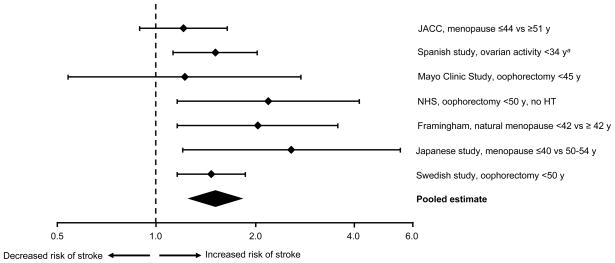
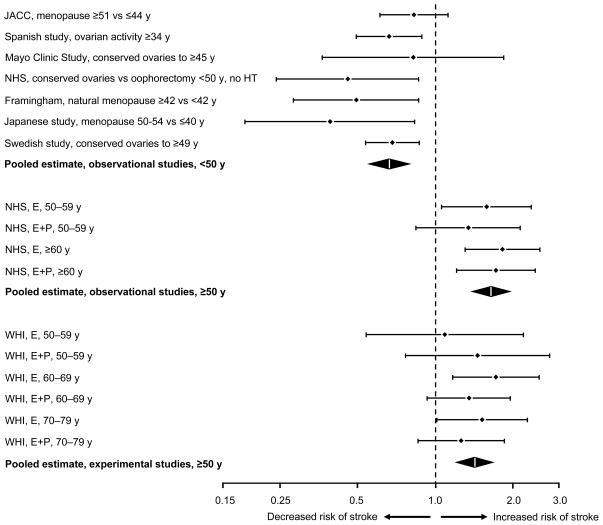
Results: Three cohort studies showed an increased risk of all types of stroke in women who underwent bilateral oophorectomy compared with women who conserved their ovaries before age 50 years. The increased risk of stroke was reduced by hormone therapy in one of the studies, suggesting that estrogen deprivation is involved in the association. Four additional observational studies showed an association of all types of stroke or IS with the early onset of menopause or with a shorter life span of ovarian activity. In three of the seven studies, the association was restricted to IS. Age at menopause was more important than type of menopause (natural vs induced).
Conclusions: The findings from seven recent observational studies challenge the consensus that estrogen is invariably a risk factor for IS and can be reconciled by a unifying timing hypothesis. We hypothesize that estrogen is protective for IS before age 50 years and may become a risk factor for IS after age 50 years or, possibly, after age 60 years. These findings are relevant to women who experienced premature or early menopause or to women considering prophylactic bilateral oophorectomy before the onset of natural menopause.
Figures
Comment in
-
Estrogens and stroke: disentangling a complex relationship.Menopause. 2012 Mar;19(3):247-9. doi: 10.1097/gme.0b013e3182468b84. Menopause. 2012. PMID: 22367729 No abstract available.
References
-
- Wassertheil-Smoller S, Hendrix SL, Limacher M, et al. Effect of estrogen plus progestin on stroke in postmenopausal women: the Women’s Health Initiative: a randomized trial. JAMA. 2003;289:2673–2684. - PubMed
-
- Bushnell CD. Oestrogen and stroke in women: assessment of risk. Lancet Neurol. 2005;4:743–751. - PubMed
-
- Hendrix SL, Wassertheil-Smoller S, Johnson KC, et al. Effects of conjugated equine estrogen on stroke in the Women’s Health Initiative. Circulation. 2006;113:2425–2434. - PubMed
-
- Magliano DJ, Rogers SL, Abramson MJ, Tonkin AM. Hormone therapy and cardiovascular disease: a systematic review and meta-analysis. BJOG. 2006;113:5–14. - PubMed
Publication types
MeSH terms
Grants and funding
LinkOut - more resources
Full Text Sources
Other Literature Sources
Medical
