. 2012 Mar;6(3):564-76.
doi: 10.1038/ismej.2011.116. Epub 2011 Oct 13.

Assessing the complex sponge microbiota: core, variable and species-specific bacterial communities in marine sponges

Affiliations

Assessing the complex sponge microbiota: core, variable and species-specific bacterial communities in marine sponges

Susanne Schmitt et al. ISME J. 2012 Mar.

Abstract

Marine sponges are well known for their associations with highly diverse, yet very specific and often highly similar microbiota. The aim of this study was to identify potential bacterial sub-populations in relation to sponge phylogeny and sampling sites and to define the core bacterial community. 16S ribosomal RNA gene amplicon pyrosequencing was applied to 32 sponge species from eight locations around the world's oceans, thereby generating 2567 operational taxonomic units (OTUs at the 97% sequence similarity level) in total and up to 364 different OTUs per sponge species. The taxonomic richness detected in this study comprised 25 bacterial phyla with Proteobacteria, Chloroflexi and Poribacteria being most diverse in sponges. Among these phyla were nine candidate phyla, six of them found for the first time in sponges. Similarity comparison of bacterial communities revealed no correlation with host phylogeny but a tropical sub-population in that tropical sponges have more similar bacterial communities to each other than to subtropical sponges. A minimal core bacterial community consisting of very few OTUs (97%, 95% and 90%) was found. These microbes have a global distribution and are probably acquired via environmental transmission. In contrast, a large species-specific bacterial community was detected, which is represented by OTUs present in only a single sponge species. The species-specific bacterial community is probably mainly vertically transmitted. It is proposed that different sponges contain different bacterial species, however, these bacteria are still closely related to each other explaining the observed similarity of bacterial communities in sponges in this and previous studies. This global analysis represents the most comprehensive study of bacterial symbionts in sponges to date and provides novel insights into the complex structure of these unique associations.


Figures
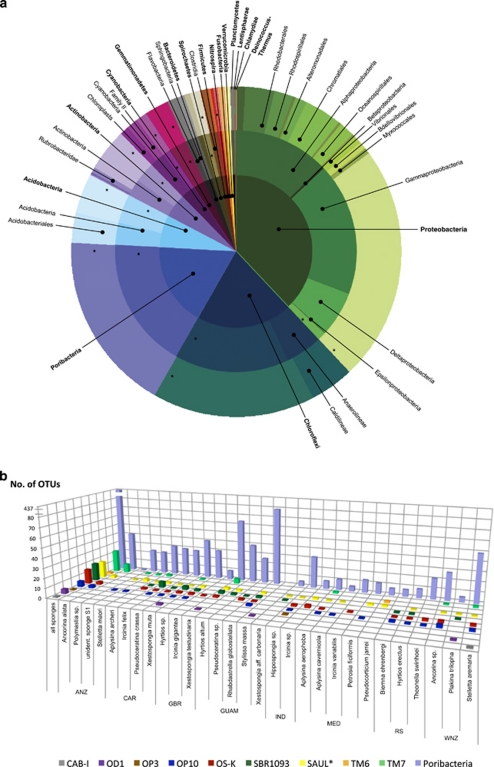
Figure 1
Figure 1
Bacterial richness in sponges. (a) Phylogenetic distribution of 97% OTUs on phylum (inner circle), class (middle circle) and order level (outer circle). Only taxonomically described phyla and the candidate phylum Poribacteria are shown. Phylum names are given in bold. Selected class and order groups are labeled. *represents unclassified groups. (b) Taxonomic richness of 97% OTUs that were assigned to candidate phyla, for all sponges and for each sponge species. *indicates a sponge-associated unclassified lineage (SAUL). ANZ, Auckland, New Zealand; CAR, Caribbean Sea; GBR, Great Barrier Reef; GUAM, Guam, Pacific Ocean; IND, Indian Ocean; MED, Mediterranean Sea; RS, Red Sea; WNZ, Wellington, New Zealand.
Figure 2
Figure 2
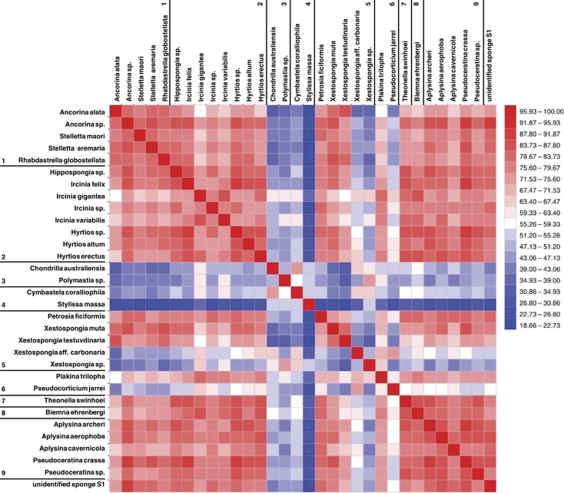
Microbial community similarity among 32 sponge species. Heat map displaying Bray–Curtis similarities based on abundances of assigned 97% OTUs at phylum level (75% sequence similarity) is shown. Sponges are listed according to their taxonomy and orders are labeled as follows: 1, Astrophorida; 2, Dictyoceratida; 3, Hadromerida; 4, Halichondrida; 5, Haplosclerida; 6, Homosclerophorida; 7, Lithistida; 8, Poecilosclerida; 9, Verongida.
Figure 3
Figure 3
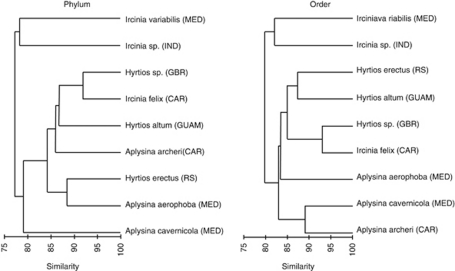
Microbial community similarity among Aplysina, Hyrtios and Ircinia sponges. Cluster analysis based on Bray–Curtis similarities of assigned 97% OTUs on phylum (75% sequence similarity) and order (80% sequence similarity) level is shown. CAR, Caribbean Sea; GBR, Great Barrier Reef; GUAM, Guam, Pacific Ocean; IND, Indian Ocean; MED, Mediterranean Sea; RS, Red Sea.
Figure 4
Figure 4
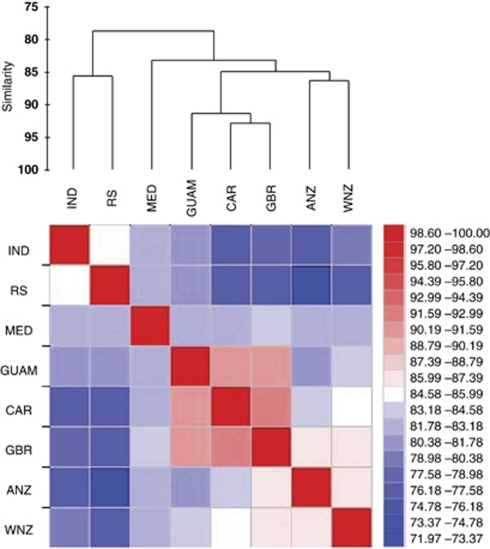
Microbial community similarity among eight sampling locations. Cluster analysis and heat map displaying Bray–Curtis similarities based on abundances of assigned 97% OTUs at phylum level (75% sequence similarity) is shown. Ninety-seven percent OTUs were defined after combining tag sequences from each location. ANZ, Auckland, New Zealand; CAR, Caribbean Sea; GBR, Great Barrier Reef; GUAM, Guam, Pacific Ocean; IND, Indian Ocean; MED, Mediterranean Sea; RS, Red Sea; WNZ, Wellington, New Zealand.
Figure 5
Figure 5
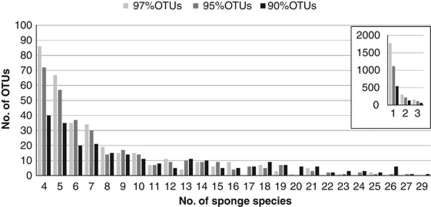
Distribution of 97 (light grey bar), 95 (dark grey bar) and 90% (black bar) OTUs within 32 sponge species. Note that the inset (presence in 1, 2 or 3 sponge species) has a different bar.
Figure 6
Figure 6
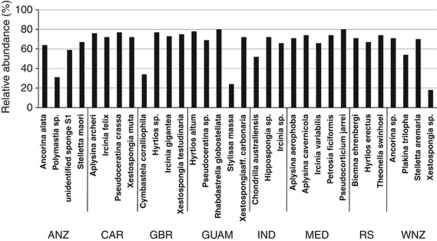
Relative abundance of Plus-OTUs within each sponge species. Distribution of 97% OTUs that were assigned to a previously published sponge-derived 16S rRNA gene sequence (Plus-OTU). ANZ, Auckland, New Zealand; CAR, Caribbean Sea; GBR, Great Barrier Reef; GUAM, Guam, Pacific Ocean; IND, Indian Ocean; MED, Mediterranean Sea; RS, Red Sea; WNZ, Wellington, New Zealand.
Figure 7
Figure 7
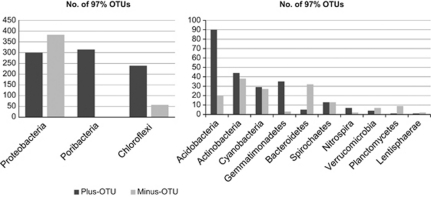
The species-specific bacterial community in sponges. Distribution of 97% Plus- and Minus-OTUs among different bacterial phyla. Note that the species-specific community contains members of all phyla and candidate phyla detected in this study, with the exception of Deinococcus-Thermus, but only those phyla that contain Plus-OTUs are shown.
Figure 8
Figure 8
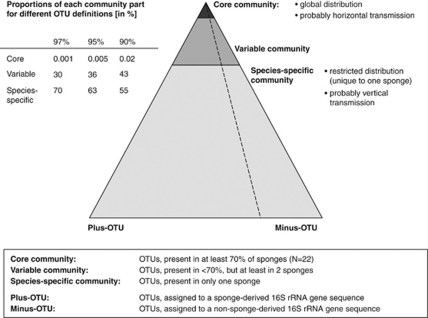
Schematic representation of the sponge microbiota that was divided into core, variable and species-specific bacterial communities.

References

    1. Ahlgren NA, Rocap G. Culture isolation and culture-independent clone libraries reveal new marine Synechococcus ecotypes with distinctive light and N physiologies. Appl Environ Microbiol. 2006;72:7193–7204. - PMC - PubMed
    1. Altschul SF, Gish W, Miller W, Myers EW, Lipman DJ. Basic local alignment search Tool. J Mol Biol. 1990;215:403–410. - PubMed
    1. Andersson AF, Riemann L, Bertilsson S. Pyrosequencing reveals contrasting seasonal dynamics of taxa within Baltic Sea bacterioplankton communities. ISME J. 2010;4:171–181. - PubMed
    1. Bayer K, Schmitt S, Hentschel U. Physiology, phylogeny and in situ evidence for bacterial and archaeal nitrifiers in the marine sponge Aplysina aerophoba. Environ Microbiol. 2008;10:2942–2955. - PubMed
    1. Bouman HA, Ulloa O, Scanlan DJ, Zwirglmaier K, Li WKW, Platt T, et al. Oceanographic basis of the global surface distribution of Prochlorococcus ecotypes. Science. 2006;312:918–921. - PubMed

Publication types