Evidence for a role of anti-ADAMTS13 autoantibodies despite normal ADAMTS13 activity in recurrent thrombotic thrombocytopenic purpura
- PMID: 21993669
- PMCID: PMC3269492
- DOI: 10.3324/haematol.2011.051433
Evidence for a role of anti-ADAMTS13 autoantibodies despite normal ADAMTS13 activity in recurrent thrombotic thrombocytopenic purpura
Abstract
Background: Severe ADAMTS13 deficiency is a critical component of the pathogenesis of idiopathic thrombotic thrombocytopenic purpura but is found only in about 60% of patients clinically diagnosed with this disease.
Design and methods: Over a period of 8 years and six episodes of thrombotic thrombocytopenic purpura we studied the evolution of the anti-ADAMTS13 antibody response in a patient using different ADAMTS13 assays and epitope mapping.
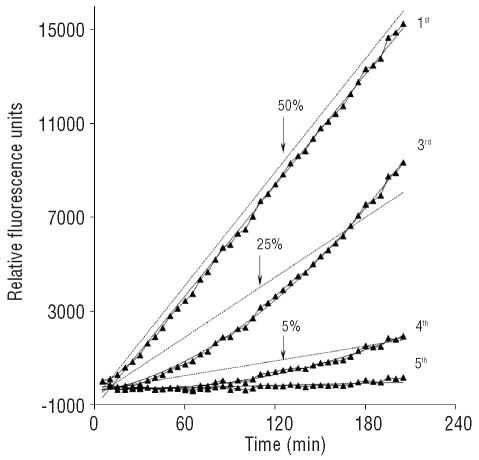
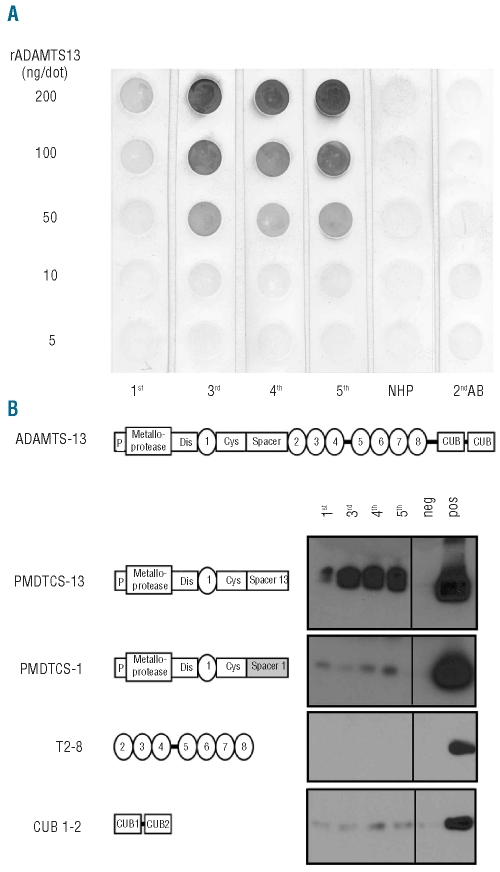
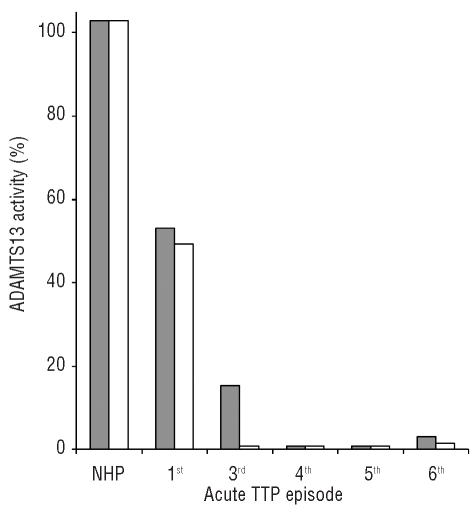
Results: Anti-ADAMTS13 autoantibodies were found in all episodes but were inhibitory only in the last two episodes. In a flow-based assay, normal ADAMTS13 activity was found only during the first disease episode, while ADAMTS13 activity was normal using a static assay in episodes 1 and 3, and severely deficient in the last two episodes. Fluorescence evolution in a modified fluorescence resonance energy transfer assay using a von Willebrand factor A2 domain peptide substrate was linear in episodes 1, 5 and 6, but increased exponentially in episodes 3 and 4. Despite the variable functional characteristics of the anti-ADAMTS13 autoantibodies, their principal epitope was the ADAMTS13 spacer domain in all episodes.
Conclusions: The patient is unique as he displayed features of maturation or shaping of the anti-ADAMTS13 autoantibody response during the course of multiple episodes of thrombotic thrombocytopenic purpura. Anti-ADAMTS13 autoantibodies may be important in vivo despite normal ADAMTS13 activity in routine assays. Consequently, treatment decisions should not be based solely on activity assay results.
Figures
References
-
- Moake JL. Thrombotic microangiopathies. N Engl J Med. 2002;347(8):589–600. - PubMed
-
- Kremer Hovinga JA, Vesely SK, Terrell DR, Lämmle B, George JN. Survival and relapse in patients with thrombotic thrombocytopenic purpura. Blood. 2010;115(8):1500–11. - PubMed
-
- Lämmle B, Kremer Hovinga JA, George JN. Acquired thrombotic thrombocytopenic purpura: ADAMTS13 activity, anti-ADAMTS13 autoantibodies and risk of recurrent disease. Haematologica. 2008;93(2):172–7. - PubMed
-
- Benjamin M, Terrell DR, Vesely SK, Voskuhl GW, Dezube BJ, Kremer Hovinga JA, et al. Frequency and significance of HIV infection among patients diagnosed with thrombotic thrombocytopenic purpura. Clin Infect Dis. 2009;48(8):1129–37. - PubMed
Publication types
MeSH terms
Substances
Grants and funding
LinkOut - more resources
Full Text Sources
Other Literature Sources