Treatment with lenalidomide does not appear to increase the risk of progression in lower risk myelodysplastic syndromes with 5q deletion. A comparative analysis by the Groupe Francophone des Myelodysplasies
- PMID: 21993675
- PMCID: PMC3269480
- DOI: 10.3324/haematol.2011.045914
Treatment with lenalidomide does not appear to increase the risk of progression in lower risk myelodysplastic syndromes with 5q deletion. A comparative analysis by the Groupe Francophone des Myelodysplasies
Abstract
Background: Although lenalidomide is very effective in the treatment of anemia of lower risk myelodysplastic syndromes with 5q deletion (del 5q), concerns have been raised over the fact that this drug could trigger progression to acute myeloid leukemia in some patients.
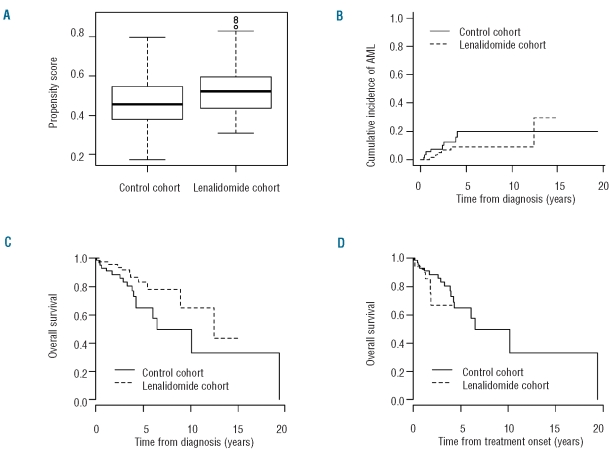
Design and methods: Ninety-five transfusion-dependent patients with lower risk myelodysplastic syndromes with del 5q were treated with lenalidomide (10 mg/day, for 3 weeks every 4 weeks); six (6.3%) of the patients progressed to acute myeloid leukemia. This cohort of 95 lenalidomide-treated patients was compared to a historical control cohort of 99 patients with lower risk myelodysplastic syndromes with del 5q who never received lenalidomide, using a propensity score approach that can control for potential confounders in non-randomized comparisons.
Results: The 4-year estimated cumulative incidence of leukemia was 9% in patients treated with lenalidomide and 15.8% in controls who did not receive lenalidomide (P=0.16).
Conclusions: Using a propensity score approach, we found no significant difference in acute myeloid leukemia progression and survival from diagnosis between the cohort treated with lenalidomide and the control cohort.
Figures
References
-
- Greenberg P, Cox C, LeBeau MM, Fenaux P, Morel P, Sanz G, et al. International scoring system for evaluating prognosis in myelodysplastic syndromes. Blood. 1997;89(6):2079–88. - PubMed
-
- Haase D, Germing U, Schanz J, Pfeilstocker M, Nosslinger T, Hildebrandt B, et al. New insights into the prognostic impact of the karyotype in MDS and correlation with sub-types: evidence from a core dataset of 2124 patients. Blood. 2007;110(13):4385–95. - PubMed
-
- Giagounidis AA, Germing U, Haase S, Hildebrandt B, Schlegelberger B, Schoch C, et al. Clinical, morphological, cytogenetic, and prognostic features of patients with myelodysplastic syndromes and del(5q) including band q31. Leukemia. 2004;18(1):113–9. - PubMed
-
- Giagounidis AA, Germing U, Wainscoat JS, Boultwood J, Aul C. The 5q- syndrome. Hematology. 2004;9(4):271–7. - PubMed
-
- Van den Berghe H, Michaux L. 5q-, twenty-five years later: a synopsis. Cancer Genet Cytogenet. 1997;94(1):1–7. - PubMed
Publication types
MeSH terms
Substances
LinkOut - more resources
Full Text Sources
Medical