. 2009 Sep;1(2):185-209.
doi: 10.3390/v1020185. Epub 2009 Sep 1.

HBV life cycle: entry and morphogenesis

Affiliations

HBV life cycle: entry and morphogenesis

Stephanie Schädler et al. Viruses. 2009 Sep.

Abstract

Hepatitis B virus (HBV) is a major cause of liver disease. HBV primarily infects hepatocytes by a still poorly understood mechanism. After an endocytotic process, the nucleocapsids are released into the cytoplasm and the relaxed circular rcDNA genome is transported towards the nucleus where it is converted into covalently closed circular cccDNA. Replication of the viral genome occurs via an RNA pregenome (pgRNA) that binds to HBV polymerase (P). P initiates pgRNA encapsidation and reverse transcription inside the capsid. Matured, rcDNA containing nucleocapsids can re-deliver the RC-DNA to the nucleus, or be secreted via interaction with the envelope proteins as progeny virions.

Keywords: entry; hepatitis B virus; liver disease; morphogenesis.


Figures
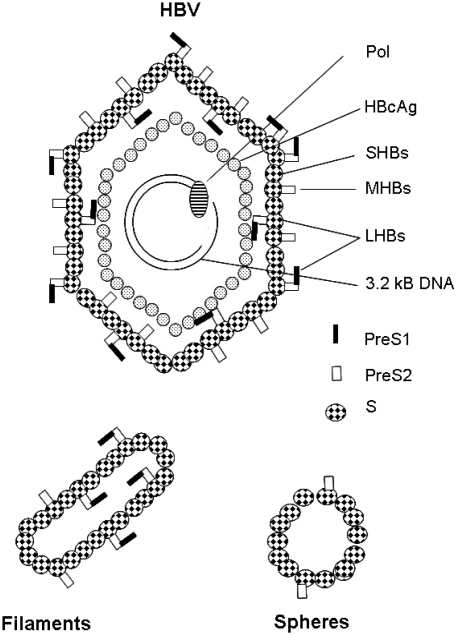
Figure 1.
Figure 1.
Schematic structure of the HBV particle and subviral particles. HBV is an enveloped virus with a diameter of about 42 nm (42 nm particle). The envelope is formed by the three viral surface proteins LHBs, MHBs and SHBs that surround the viral nucleocapsid. The core protein (HBcAg) forms the nucleocapsid that harbors the partially double-stranded circular DNA genome that is covalently linked to the viral polymerase. In the serum of HBV-positive patients, large amounts of non-infectious subviral particles in the form of filaments or spheres (20nm particles) are found; these are composed of the viral surface proteins, but lack the viral nucleic acid.
Figure 2.
Figure 2.
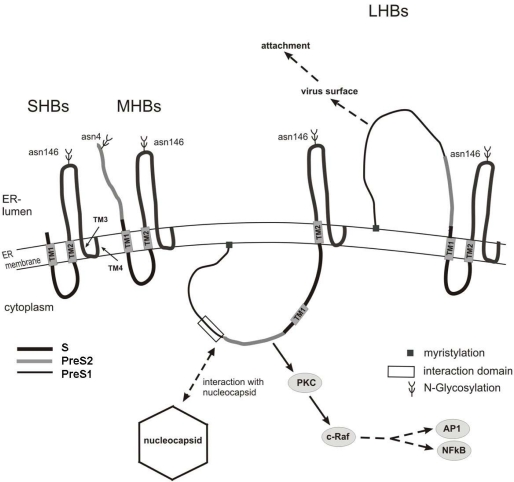
Schematic structure of the HBV surface proteins. The S-domain is common to all three HBV surface proteins. In the case of the large surface protein (LHBs), TM1 is not used as a start transfer signal, resulting in a cytoplasmic orientation of the PreS1PreS2 region. In a fraction of LHBs the PreSPreS2 domain is posttranslationally translocated across the ER membrane. In this case, the PreS1PreS2 domain faces the lumen of the ER. The two forms of LHBs fulfill different functions. This fraction that faces the ER lumen is exposed to the viral surface in the mature viral particle and is involved in the attachment process. The cytoplasmic form mediates the contact to the nucleocapsid and triggers intracellular signal transduction cascades by the interaction of the PreS2 domain with protein kinase C (PKC).
Figure 3.
Figure 3.
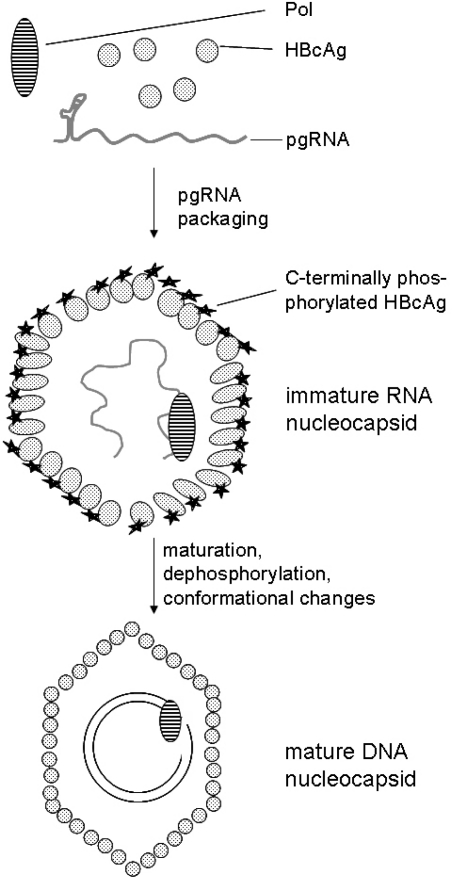
Genome packaging and nucleocapsid maturation. HBV nucleocapsid formation starts when the complex of the RNA pregenome, HBV polymerase and HBcAg dimers has formed. Efficient packaging of the RNA pregenome requires phosphorylation in the C-terminal part of the core protein. Conversion of the immature RNA-containing nucleocapsid to the mature DNA-containing nucleocapsid is associated with dephosphorylation and conformational changes. These significant differences in the structure between the RNA-containing immature nucleocapsid and the mature nucleocapsid trigger the envelopment of the mature nucleocapsid.

References

    1. Locarnini S. Molecular virology of hepatitis B virus. Semin Liver Dis. 2004;24:3–10. - PubMed
    1. Lupberger J, Hildt E. Hepatitis B virus-induced oncogenesis. World J Gastroenterol. 2007;13:74–81. - PMC - PubMed
    1. Cougot D, Neuveut C, Buendia MA. HBV induced carcinogenesis. J Clin Virol. 2005;34:S75–78. - PubMed
    1. Ganem D, Schneider RJ. Hepadnaviridae: the viruses and their replication. In: Knipe DM, Howley PM, editors. Fields Virology. 4th ed. Vol. 2. Lippincott Williams; Wilkins, Philadelphia, USA: 2001. pp. 2923–2969.
    1. Gerlich WH, Heermann KH, Lu X. Functions of hepatitis B surface proteins. Arch Virol Suppl. 1992;4:129–132. - PubMed

LinkOut - more resources