


doi: 10.3390/v1031003.
Epub 2009 Nov 23.
Bunyaviruses and the type I interferon system
Affiliations
- PMID: 21994579
- PMCID: PMC3185543
- DOI: 10.3390/v1031003
Item in Clipboard
Bunyaviruses and the type I interferon system
Viruses.
2009 Dec.
Abstract
The family Bunyaviridae contains more than 350 viruses that are distributed throughout the world. Most members of the family are transmitted by arthopods, and several cause disease in man, domesticated animals and crop plants. Despite being recognized as an emerging threat, details of the virulence mechanisms employed by bunyaviruses are scant. In this article we summarise the information currently available on how these viruses are able to establish infection when confronted with a powerful antiviral interferon system.
Keywords: NSs proteins; bunyaviruses; interferon system.
Figures
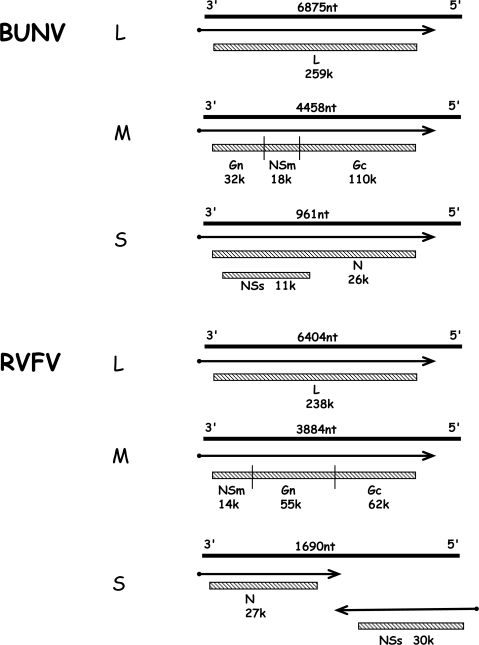
BUNV orthobunyavirus and RVFV phlebovirus coding strategies (not to scale). The three genomic RNA segments L, M and S are shown as solid lines with their lengths (nt) shown above. mRNAs are indicated by arrows, with solid dot depicting nontemplated primer at 5′end. Gene products are shown as hatched boxes, and protein designations and sizes (kDa) are indicated. The ambisense S segment of RVFV encodes proteins in both negative- and positive-sense orientations, separated by an intergenic region that can form a hairpin structure.
References
-
- Elliott RM. The Bunyaviridae. Plenum Press; New York, NY, USA: 1996.
-
- Pinheiro FP, Travassos da Rosa AP, Travassos da Rosa JF, Ishak R, Freitas RB, Gomes ML, LeDuc JW, Oliva OF. Oropouche virus. I. A review of clinical, epidemiological, and ecological findings. Am J Trop Med Hyg. 1981;30:149–160. - PubMed
-
- Dionisio D, Esperti F, Vivarelli A, Valassina M. Epidemiological, clinical and laboratory aspects of sandfly fever. Curr Opin Infect Dis. 2003;16:383–388. - PubMed
Grants and funding
LinkOut - more resources
Full Text Sources
Other Literature Sources
