Review
. 2011 Apr;3(4):398-422.
doi: 10.3390/v3040398. Epub 2011 Apr 15.

Insertional oncogenesis by non-acute retroviruses: implications for gene therapy

Affiliations
Review

Insertional oncogenesis by non-acute retroviruses: implications for gene therapy

Hung Fan et al. Viruses. 2011 Apr.

Abstract

Retroviruses cause cancers in a variety of animals and humans. Research on retroviruses has provided important insights into mechanisms of oncogenesis in humans, including the discovery of viral oncogenes and cellular proto-oncogenes. The subject of this review is the mechanisms by which retroviruses that do not carry oncogenes (non-acute retroviruses) cause cancers. The common theme is that these tumors result from insertional activation of cellular proto-oncogenes by integration of viral DNA. Early research on insertional activation of proto-oncogenes in virus-induced tumors is reviewed. Research on non-acute retroviruses has led to the discovery of new proto-oncogenes through searches for common insertion sites (CISs) in virus-induced tumors. Cooperation between different proto-oncogenes in development of tumors has been elucidated through the study of retrovirus-induced tumors, and retroviral infection of genetically susceptible mice (retroviral tagging) has been used to identify cellular proto-oncogenes active in specific oncogenic pathways. The pace of proto-oncogene discovery has been accelerated by technical advances including PCR cloning of viral integration sites, the availability of the mouse genome sequence, and high throughput DNA sequencing. Insertional activation has proven to be a significant risk in gene therapy trials to correct genetic defects with retroviral vectors. Studies on non-acute retroviral oncogenesis provide insight into the potential risks, and the mechanisms of oncogenesis.

Keywords: gene therapy; non-acute retrovirus; oncogene; oncogenesis; proto-oncogene; retroviral vector; retrovirus.


Figures
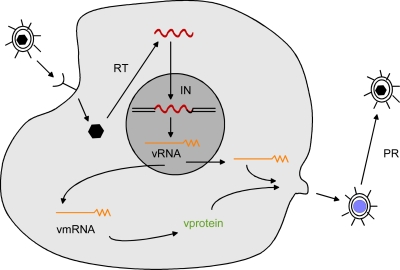
Figure 1.
Figure 1.
The retrovirus life cycle. See text for details.
Figure 2.
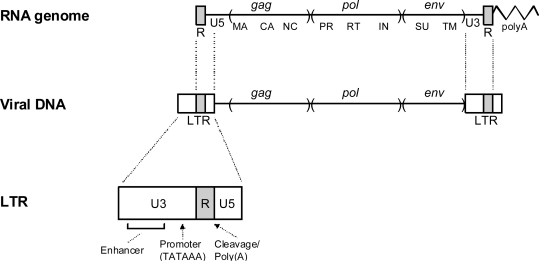
Figure 2.
Retroviral LTRs. The relationship of retroviral RNA to the reverse transcribed DNA is shown. The viral RNA contains short direct repeats at either end (R), and the viral DNA contains long terminal repeats. Subdivision of the LTR into U3, R and U5 regions is shown at the bottom.
Figure 3.
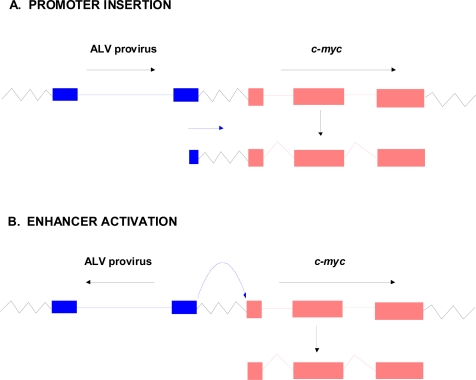
Figure 3.
Insertion activation of c-myc in avian leukosis virus (ALV)-induced B-lymphomas. (A) Promoter insertion activation of c-myc as reported by Hayward et al. [42]. (B) Enhancer activation of c-myc (one of the configurations) reported by Payne et al. [43].
Figure 4.
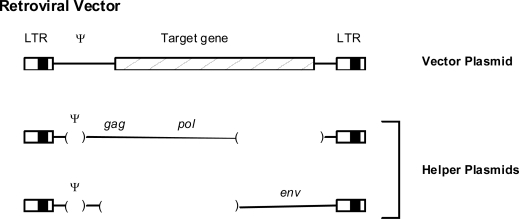
Figure 4.
Retroviral vectors. Organization of a retroviral vector as well as two helper plasmids to produce the viral proteins are shown. Ψ, the packaging sequences on viral RNA. In some cases the helper plasmids are stably expressed in a packaging cell, or in other cases they are co-transfected with the vector plasmid.

References

    1. Urisman A, Molinaro RJ, Fischer N, Plummer SJ, Casey G, Klein EA, Malathi K, Magi-Galluzzi C, Tubbs RR, Ganem D, Silverman RH, Derisi JL. Identification of a Novel Gammaretrovirus in Prostate Tumors of Patients Homozygous for R462Q RNASEL Variant. PLoS Pathog. 2006;2:e25. - PMC - PubMed
    1. Dong B, Kim S, Hong S, Das Gupta J, Malathi K, Klein EA, Ganem D, Derisi JL, Chow SA, Silverman RH. An infectious retrovirus susceptible to an IFN antiviral pathway from human prostate tumors. Proc. Natl. Acad. Sci. U. S. A. 2007;104:1655–1660. - PMC - PubMed
    1. Hue S, Gray ER, Gall A, Katzourakis A, Tan CP, Houldcroft CJ, McLaren S, Pillay D, Futreal A, Garson JA, Pybus OG, Kellam P, Towers GJ. Disease-associated XMRV sequences are consistent with laboratory contamination. Retrovirology. 2010;7:111. - PMC - PubMed
    1. Schlaberg R, Choe DJ, Brown KR, Thaker HM, Singh IR. XMRV is present in malignant prostatic epithelium and is associated with prostate cancer, especially high-grade tumors. Proc. Natl. Acad. Sci. U. S. A. 2009;106:16351–16356. - PMC - PubMed
    1. Fischer N, Hellwinkel O, Schulz C, Chun FK, Huland H, Aepfelbacher M, Schlomm T. Prevalence of human gammaretrovirus XMRV in sporadic prostate cancer. J. Clin. Virol. 2008;43:277–283. - PubMed

Publication types