Review
. 2011 May;3(5):456-68.
doi: 10.3390/v3050456. Epub 2011 May 5.

Making sense out of antisense transcription in human T-cell lymphotropic viruses (HTLVs)

Affiliations
Review

Making sense out of antisense transcription in human T-cell lymphotropic viruses (HTLVs)

Benoit Barbeau et al. Viruses. 2011 May.

Abstract

Retroviral gene expression generally depends on a full-length transcript that initiates in the 5' long terminal repeat (LTR), which is either unspliced or alternatively spliced. We and others have demonstrated the existence of an antisense transcript initiating in the 3' LTR of the Human T-cell Leukemia Virus type 1 (HTLV-1) that is involved in the production of HBZ (HTLV-1 basic leucine zipper (bZIP) factor). HBZ is a Fos-like factor capable of inhibiting Tax-mediated activation of the HTLV-1 LTR by interacting with the cellular transcription factor cAMP-response element-binding protein (CREB) and the pleiotropic cellular coactivators p300/CBP. HBZ can also activate cellular transcription through its interaction with p300/CBP. Interestingly, HBZ has also been found to promote T-lymphocyte proliferation. By down-regulating viral expression and by stimulating T-cell proliferation, HBZ could be essential in the establishment of a chronic infection. Antisense transcription also occurs in the closely related HTLV-2 retrovirus as well as in the recently discovered HTLV-3 and HTLV-4. These antisense transcripts are also involved in the production of retroviral proteins that we have termed Antisense Protein of HTLVs (APH). Like HBZ, the APH proteins are localized in the nucleus of transfected cells and repress Tax-mediated viral transcription.

Keywords: HBZ; HTLV; LTR; antisense transcription; chronic infection.


Figures
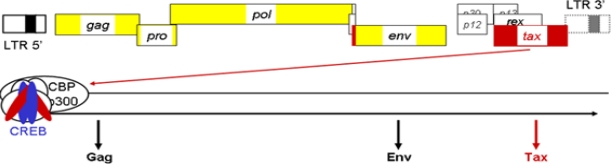
Figure 1
Figure 1
Schematic representation of the Human T-cell Leukemia Virus type 1 (HTLV-1) proviral genome. In addition to the common retroviral genes (in yellow), the provirus contains genes encoding different regulatory proteins. Among them, the Tax protein (in red) interacts with CREB (in blue) to bind to the Tax-responsive elements (TxREs). Tax then stabilizes the TxRE-bound complex and recruits p300/CBP to stimulate the viral transcription and the production of the different viral proteins such as Gag, Env, and Tax.
Figure 2
Figure 2
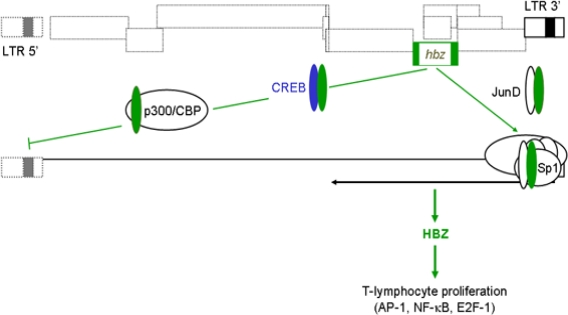
Regulation of sense and antisense transcription by HTLV-1 basic leucine zipper (bZIP) factor (HBZ). Antisense transcripts initiated from the 3′ LTR are responsible for encoding the HBZ protein. HBZ then downmodulates Tax-dependent viral gene expression by interacting with CREB and p300/CBP. HBZ could also activate its own expression by forming HBZ/JunD heterodimers able to interact with the Sp1 transcription factor bound to the Sp1-binding sites involved in the stimulation of antisense transcription. HBZ would thus render the infected cells less likely to be targeted by the immune response through lower expression of viral proteins but should also promote T-lymphocyte proliferation by controlling cellular transcription through AP-1, NF-κB and E2F-1 pathways.
Figure 3
Figure 3
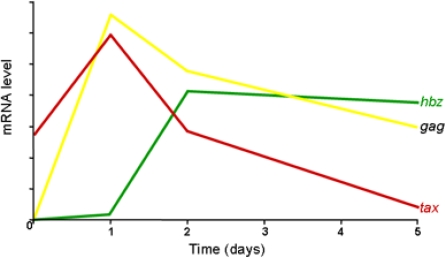
Kinetic analysis of HTLV-1 transcription. Quantification of tax (red), gag (yellow) and hbz (green) mRNAs in lymphocytes from HTLV-1 associated myelopathy/tropical spastic paraparesis (HAM/TSP) patients following ex vivo culture.
Figure 4
Figure 4
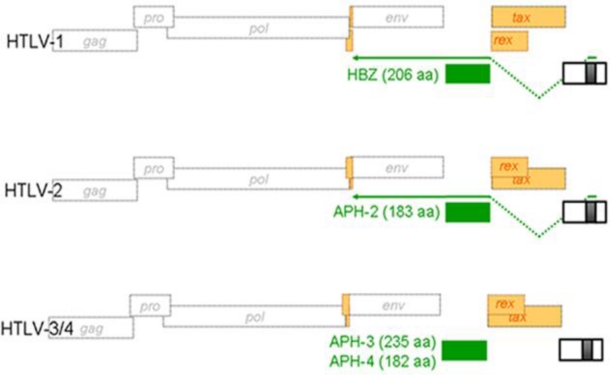
Schematic representation of antisense open reading frame (ORF) in other HTLV proviral genomes. Positioning of antisense transcript-encoded proteins termed APH in HTLV-2, HTLV-3 and HTLV-4 is similar to HBZ in HTLV-1. These proteins do share certain additional similarities with HBZ although their cellular localization and amino acid sequence do indicate functional differences. Recent results from our team have confirmed that both synthesis of APH-3 and APH-4 are dependent on a spliced transcript.

References

    1. Takatsuki K. Discovery of adult T-cell leukemia. Retrovirology. 2005;2:16. - PMC - PubMed
    1. Cooper SA, van der Loeff MS, Taylor GP. The neurology of HTLV-1 infection. Pract Neurol. 2009;9:16–26. - PubMed
    1. Lemasson I, Polakowski NJ, Laybourn PJ, Nyborg JK. Transcription factor binding and histone modifications on the integrated proviral promoter in HTLV-I-infected T cells. J Biol Chem. 2002;277:49459–49465. - PubMed
    1. Gachon F, Thebault S, Peleraux A, Devaux C, Mesnard JM. Molecular interactions involved in the transactivation of the human T-cell leukemia virus type 1 promoter mediated by Tax and CREB-2 (ATF-4) Mol Cell Biol. 2000;20:3470–3481. - PMC - PubMed
    1. Sharma N, Nyborg JK. The coactivators CBP/p300 and the histone chaperone NAP1 promote transcription-independent nucleosome eviction at the HTLV-1 promoter. Proc Natl Acad Sci U S A. 2008;105:7959–7963. - PMC - PubMed

Publication types

LinkOut - more resources