Review
. 2011 Jun;3(6):861-85.
doi: 10.3390/v3060861. Epub 2011 Jun 17.

Orf-I and orf-II-encoded proteins in HTLV-1 infection and persistence

Affiliations
Review

Orf-I and orf-II-encoded proteins in HTLV-1 infection and persistence

Dustin Edwards et al. Viruses. 2011 Jun.

Abstract

The 3' end of the human T-cell leukemia/lymphoma virus type-1 (HTLV-1) genome contains four overlapping open reading frames (ORF) that encode regulatory proteins. Here, we review current knowledge of HTLV-1 orf-I and orf-II protein products. Singly spliced mRNA from orf-I encodes p12, which can be proteolytically cleaved to generate p8, while differential splicing of mRNA from orf-II results in production of p13 and p30. These proteins have been demonstrated to modulate transcription, apoptosis, host cell activation and proliferation, virus infectivity and transmission, and host immune responses. Though these proteins are not essential for virus replication in vitro, p8, p12, p13, and p30 have an important role in the establishment and maintenance of HTLV-1 infection in vivo.

Keywords: HTLV-1; ORF-I; ORF-II; human T-cell leukemia/lymphoma virus type-1; p12; p13; p30; p8.


Figures
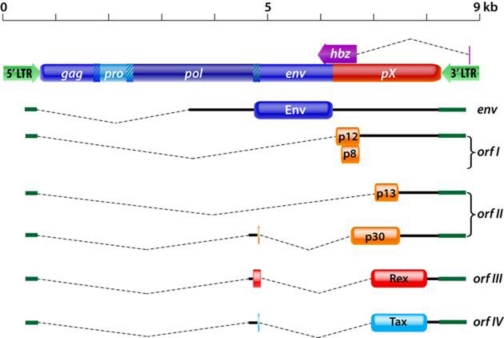
Figure 1.
Figure 1.
A scheme of the human T-cell leukemia/lymphoma virus type-1 (HTLV-1) genome. Spliced mRNAs and encoded proteins for orf-I and orf-II are shown. Orf-I encodes for the p12 protein which can be proteolytically cleaved at the amino terminus to generate the p8 protein. The p30 protein is translated from doubly spliced mRNA transcribed from orf-II and the 5′ end of env. The p13 protein is translated from singly spliced mRNA transcribed from orf-II and corresponds to the carboxyl terminus of p30.
Figure 2.
Figure 2.
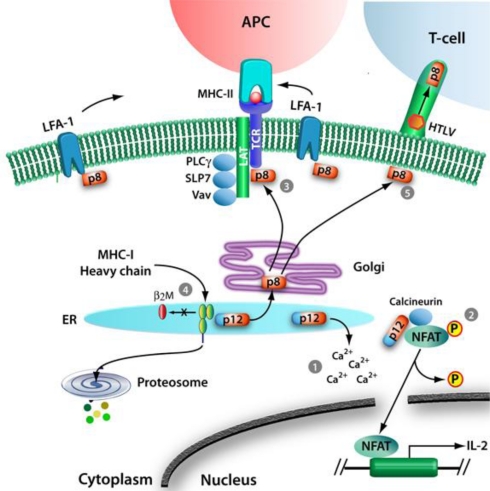
Functions of p12 and p8. In the ER, p12 is proteolytically cleaved at the amino terminus to generate p8, which traffics to the cell surface through the secretory pathway. (1) In the ER, p12 mediates Ca2+ release, which enables (2) either calcineurin binding of NFAT and subsequent dephosphorylation, nuclear translocation, and upregulation of the IL-2 gene, or p12 binding to calcineurin and inhibition of NFAT activation. (3) Upon trafficking through the secretory pathway, p8 localizes at the immunological synapse where it interacts with LAT and inhibits proximal TCR signaling. (4) In the ER, p12 binds the immature heavy chains of the MHC-I and prevents their interactions with the β2-microglobulin, leading MHC-I degradation by the proteosome. (5) At the cell surface, p8 increases the clustering of LFA-1 and the formation of intracellular conduits and facilitates viral transmission to target cells.
Figure 3.
Figure 3.
Functions of p30. (1) Alternatively double spliced mRNA is translated to form the Tax and Rex regulatory proteins. (2) Tax protein localizes to the nucleus to exert its function on the LTR as a positive regulator of viral transcription. (3) Within the nucleus, Rex recognizes the Rex-responsive elements (RexRE) of viral mRNA and shuttles these transcripts to the cytoplasm while inhibiting splicing processes. However, some of the viral RNA is processed in the spliced env mRNA, the double spliced p30, (4) and the alternatively spliced tax/rex mRNA. p30 mRNA is subject to negative regulation by hbz mRNA. Once p30 protein is produced, it translocates to the nucleus and (5) interacts with p30-responsive elements (p30RE) created by the double splicing and therefore is present on tax/rex mRNA only. Moreover, p30 interacts with Rex to inhibit Rex-mediated nuclear export of double spliced viral mRNA, including tax transcripts. By preventing Tax production, p30 decreases viral transcription.
Figure 4.
Figure 4.
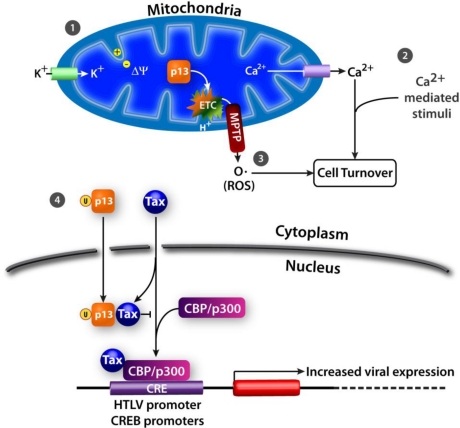
Functions of p13. In mitochondria, p13 mediates (1) K+ influx, inner mitochondrial membrane potential, and electron transport chain activity to affect (2) Ca2+ signaling and (3) ROS production. (4) In the presence of Tax, p13 is ubiquitinated and translocates to the nucleus. In the nucleus, p13 inhibits Tax-CBP/p300 complex formation to decrease transcription of cellular and viral genes.

References

    1. Poiesz BJ, Ruscetti FW, Gazdar AF, Bunn PA, Minna JD, Gallo RC. Detection and isolation of type C retrovirus particles from fresh and cultured lymphocytes of a patient with cutaneous T-cell lymphoma. Proc. Natl. Acad. Sci. U. S. A. 1980;77:7415–7419. - PMC - PubMed
    1. Poiesz BJ, Ruscetti FW, Mier JW, Woods AM, Gallo RC. T-cell lines established from human T-lymphocytic neoplasias by direct response to T-cell growth factor. Proc. Natl. Acad. Sci. U. S. A. 1980;77:6815–6819. - PMC - PubMed
    1. Gallo RC. The first human retrovirus. Sci. Am. 1986;255:88–98. - PubMed
    1. Gessain A, Barin F, Vernant JC, Gout O, Maurs L, Calender A, de The G. Antibodies to human T-lymphotropic virus type-I in patients with tropical spastic paraparesis. Lancet. 1985;2:407–410. - PubMed
    1. Watanabe T. HTLV-1-associated diseases. Int. J. Hematol. 1997;66:257–278. - PubMed

Publication types

LinkOut - more resources