. 2011 Dec 2;286(48):41246-41252.
doi: 10.1074/jbc.C111.310847. Epub 2011 Oct 12.

Extremely conserved ATP- or ADP-dependent enzymatic system for nicotinamide nucleotide repair

Affiliations

Extremely conserved ATP- or ADP-dependent enzymatic system for nicotinamide nucleotide repair

Alexandre Y Marbaix et al. J Biol Chem. .

Abstract

The reduced forms of NAD and NADP, two major nucleotides playing a central role in metabolism, are continuously damaged by enzymatic or heat-dependent hydration. We report the molecular identification of the eukaryotic dehydratase that repairs these nucleotides and show that this enzyme (Carkd in mammals, YKL151C in yeast) catalyzes the dehydration of the S form of NADHX and NADPHX, at the expense of ATP, which is converted to ADP. Surprisingly, the Escherichia coli homolog, YjeF, a bidomain protein, catalyzes a similar reaction, but using ADP instead of ATP. The latter reaction is ascribable to the C-terminal domain of YjeF. This represents an unprecedented example of orthologous enzymes using either ADP or ATP as phosphoryl donor. We also show that eukaryotic proteins homologous to the N-terminal domain of YjeF (apolipoprotein A-1-binding protein (AIBP) in mammals, YNL200C in yeast) catalyze the epimerization of the S and R forms of NAD(P)HX, thereby allowing, in conjunction with the energy-dependent dehydratase, the repair of both epimers of NAD(P)HX. Both enzymes are very widespread in eukaryotes, prokaryotes, and archaea, which together with the ADP dependence of the dehydratase in some species indicates the ancient origin of this repair system.


Figures
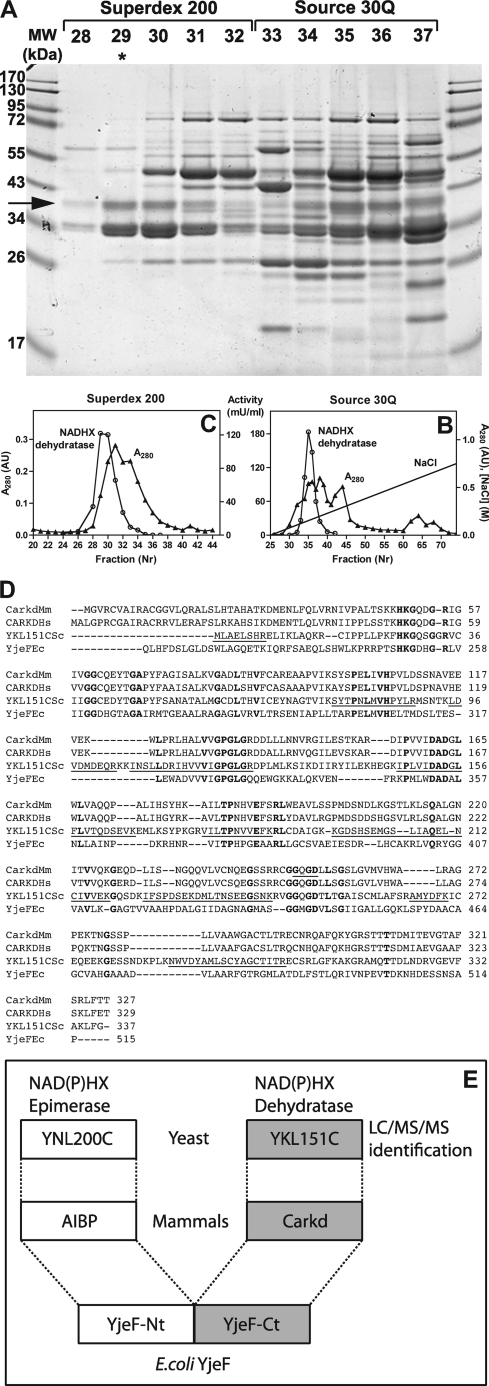
FIGURE 1.
FIGURE 1.
Molecular identification of yeast NADHX dehydratase as YKL151C, an extremely conserved protein among living species. A–C, NADHX dehydratase was purified from dry bakers' yeast (A), and the peak activity fractions of the Source 30Q (B) and the Superdex 200 (C) columns were analyzed by SDS-PAGE. A protein band co-eluting with enzyme activity (arrow) was excised from the gel (Superdex 200 fraction 29 indicated by an asterisk) and analyzed by LC/MS/MS. MW, molecular weight; AU, absorbance units. D, alignment of S. cerevisiae YKL151C (YKL151CSc; NP_012771.1) with mouse (CarkdMm; NP_001177286.1) and human (CARKDHs; NP_001229811.1) Carkd and with the C-terminal part of E. coli YjeF (YjeFEc; NP_418588.1; residues 211–515). Strictly conserved residues are in bold. The peptides identified in YKL151C are underlined. The GXGD motif, common to proteins of the ribokinase superfamily, with the catalytic aspartate is underlined in mouse Carkd. The human and mouse sequences starting at Met1 are predicted to be mitochondrial, and those starting at the second methionine are predicted to be cytosolic. For human CARKD, the long sequence is the most frequent one among expressed sequence tags. E, in E. coli, the Carkd domain represents the C-terminal part of the bifunctional YjeF protein. The N-terminal domain of YjeF is also very conserved, and the homologs in yeast and mammals are designated YNL200C and AIBP, respectively. Except in bacteria, AIBP and Carkd homologs are, however, encoded by separate genes.
FIGURE 2.
FIGURE 2.
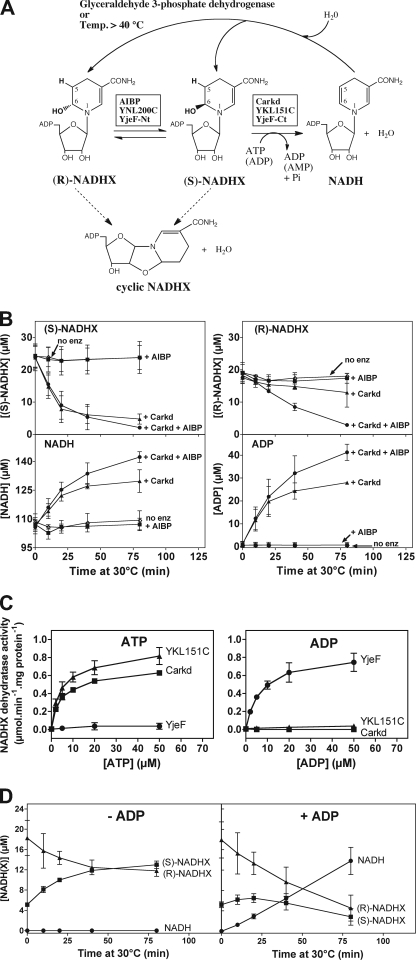
Characterization of the enzymatic reactions catalyzed by mammalian Carkd and AIBP and E. coli YjeF to repair hydrated NAD(P)H. A, scheme illustrating the reactions leading to NADHX formation and those leading to NADHX repair by the enzymes identified in this study. Although only NADHX repair is represented, the same reactions are catalyzed by the same enzymes on NADPHX. YjeF-Ct, C-terminal domain of YjeF. B, time course showing the stereospecific (S)-NADHX conversion to NADH by Carkd accompanied by the formation of stoichiometric amounts of ADP from ATP. Significant (R)-NADHX consumption is observed only when both Carkd and the AIBP epimerase are present. Carkd and/or AIBP were added at final concentrations of 2 and 8 μg/ml, respectively, to a reaction mixture at pH 8 containing (S)- and (R)-NADHX and 0.1 mm ATP-Mg. Reactions were stopped at the indicated times by protein denaturation through the addition of an equal volume of 8 m urea. Control reactions without added enzyme (no enz) were also performed. The concentrations of the indicated compounds were determined by HPLC analysis. The values shown are means ± S.D. (n = 3). C, dependence of the (S)-NADHX dehydratase activity of Carkd and YKL151C on ATP and of YjeF on ADP. Enzyme activities were determined spectrophotometrically in a reaction mixture at pH 7.1 containing ∼20 μm (S)-NADHX. D, time course demonstrating the NADHX epimerase activity and the ADP-dependent NADHX dehydratase activity of the bifunctional YjeF enzyme. YjeF, at a final concentration of 2.1 μg/ml, was incubated at pH 8 in the presence of an NADHX solution enriched in (R)-NADHX, 5 mm KCl, and with or without 0.1 mm ADP-Mg for the times indicated. Reactions were stopped by the addition of an equal volume of a mixture containing 8 m urea and 10 mm EDTA. The concentrations of the indicated compounds were determined by reverse-phase HPLC. Control reactions without added enzyme were also performed in the presence of ADP-Mg; little change in concentration for the various compounds analyzed was observed under these conditions. The values shown represent means ± S.D. (n = 3).

References

    1. Van Schaftingen E., Rzem R., Veiga-da-Cunha M. (2009) J. Inherit. Metab. Dis. 32, 135–142 - PubMed
    1. Adler L. N., Gomez T. A., Clarke S. G., Linster C. L. (2011) J. Biol. Chem. 286, 21511–21523 - PMC - PubMed
    1. Rafter G. W., Chaykin S., Krebs E. G. (1954) J. Biol. Chem. 208, 799–811 - PubMed
    1. Chaykin S., Meinhart J., Krebs E. G. (1956) J. Biol. Chem. 220, 811–820 - PubMed
    1. Oppenheimer N. J., Kaplan N. O. (1974) Biochemistry 13, 4685–4694 - PubMed

Publication types

MeSH terms